Best bonus-buy slots in the UK: the licensed sites, the maths, and what the feature costs a player
 Available in GB
Data current as of 23 September 2026 and verified against the Gambling Commission’s public register of gambling businesses.

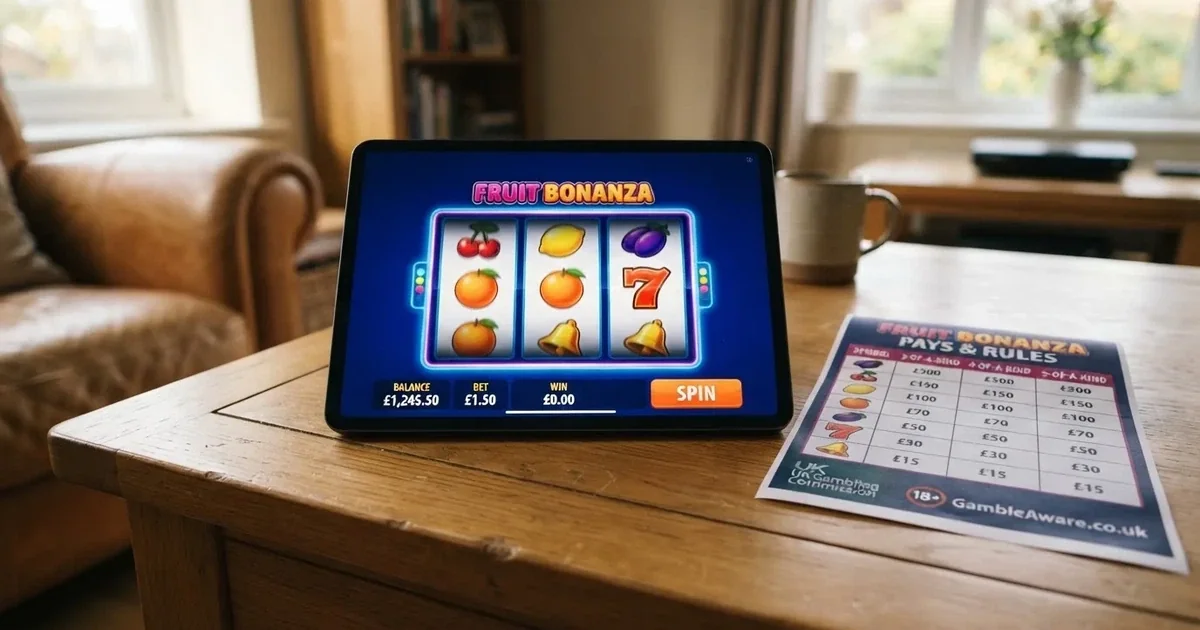
A bonus-buy slot sells the bonus round for a price printed on the button, then runs that round once and pays whatever it pays. At a licensed UK casino the button is just another stake: it sits inside the same £5 ceiling that governs every spin, eats into the same deposit-ledger, and runs on a return-to-player figure the operator has to monitor and disclose. The hard question is not whether to press it but whether the maths, the limits and the licence behind the button are the ones a player is prepared to trust with their money.
Table of Contents
- Where the feature stands legally: the Gambling Commission and the GB-only frame
- Responsible gaming: the rules that govern the press of the button
- What a bonus-buy slot actually is: a paid-for entry into the game’s own bonus round
- The £5 / £2 ceiling and the 10x wagering cap, applied to a real purchase
- The licensed UK operator set, side by side
- How a player reads the table
- What the framework says about playing bonus-buy slots in the UK
- A short reading on what the page is for
- Frequently asked questions
Where the feature stands legally: the Gambling Commission and the GB-only frame
The frame around every online slot in Great Britain is the Gambling Act 2005, enforced by the Gambling Commission. Since the Gambling (Licensing and Advertising) Act 2014 any operator taking customers in Great Britain needs a Commission licence, wherever the operator itself is based. A Curaçao, Maltese or Gibraltar licence is not a substitute. Online casino is licensable, and the public register of gambling businesses is the whole test of whether a brand actually holds one.

As of 18 September 2026, the public register listed 139 businesses holding an active remote casino operating licence. The register’s domain list held 1065 active and 361 white-label domain entries on the same date — a white-label site trades under another company’s licence, so what a player sees as one brand can be backed by the licence account of a completely different operator. A remote casino licence number on the register has the form account-R-number-suffix, the leading six digits repeat the licence holder’s account number and the R marks a remote (online) licence. That string is the single piece of evidence that says a brand is licensed at all.
Offering a slot with a bonus-buy feature to a UK player without holding that licence is an offence under section 33 of the Gambling Act 2005. The Commission disrupts illegal sites through cease-and-desist notices, search-engine delisting, and referrals to payment and hosting providers, but it has no power to block at the ISP level. No penalty is aimed at the player; what a player loses on an unlicensed site is the protection those licences bring — no GAMSTOP, no Commission complaints route, no approved ADR.
Responsible gaming: the rules that govern the press of the button
A bonus-buy purchase is a stake, not a free pass. Every player-protection rule that governs an ordinary spin governs a bonus-buy purchase too.

Age, identity and the £5 ceiling
The minimum age is 18, and a licensed site has to verify name, address and date of birth before the first deposit or any play. Anonymous play is not possible at a licensed site, and any brand marketing itself as one is by definition outside the GB frame.
Online slots carry a maximum stake per game cycle — £5 for players aged 25 and over from 9 April 2025, and £2 for 18-24 year olds from 21 May 2025. The £2 limit exists because the UK government has stated that 18 to 24 year olds have the highest average problem gambling score of any age group, with lower disposable income and ongoing neurological development cited alongside. A bonus-buy button that asks a player for, say, 80x the base stake is therefore a button that has to fit inside those ceilings, or it is illegal to press at all. For an 18-24 year old on a 20p base stake that ceiling is two and a half base-stake-equivalents per spin; the bonus-buy price on most of the high-volatility slots the feature is built for is well above that. The result, in plain language: a lot of bonus-buy titles are not actually buyable by younger players at a licensed site. They see the button; the site won’t let them press it.
Auto-play, spin speed and the things the rules have already removed
Auto-play is banned on every UK slot, and a slot spin may not be faster than 2.5 seconds. Losses disguised as wins — slot animations that celebrate a return smaller than the stake — are banned. Reverse withdrawals were banned from 31 October 2021; once a player has asked for a payout, the funds are gone from the gambling balance. None of these rules targets the bonus-buy button directly. They target the experience around it, and they shape what the feature can be at a UK-licensed site: a manual, deliberate purchase, not a turbocharged loop.
Financial vulnerability checks and the limit prompt
Operators must prompt a player to set a financial limit before the first deposit, from 31 October 2025. There is no state-set deposit or loss ceiling. Financial vulnerability checks run at £150 net deposits in a rolling 30 days, using public data only, from 28 February 2025; the wider financial risk assessments have been announced but are not yet in force. The bonus-buy purchase shows up on the deposit ledger and on the vulnerability ledger the same way every other stake does.
GAMSTOP and the claim that does not survive the register
GAMSTOP is the national online self-exclusion scheme and a mandatory condition of every online licence since 31 March 2020, with periods of six months, one year or five years and no early cancellation. A site that markets itself as “not on GAMSTOP” is marketing itself as outside the GB licence frame, which is the same thing as marketing itself as one of the sites the Commission’s disruption programme targets. The bonus-buy feature is not a separate track from that frame. A player self-excluded through GAMSTOP cannot reach the button at any licensed site; a site where the button is reachable regardless is not licensed.
Payments, credit cards and the wagering cap
Credit cards have been banned for gambling since 14 April 2020, including credit cards routed through e-wallets. From 19 December 2025 wagering requirements are capped at 10x and mixed-product bonuses — a free bet on sport that hands out casino spins, for instance — are banned. The 10x cap matters here because bonus-buy slots are the slots most often paired with the kind of sticky welcome package where the wagering multiplies fast; the cap is the line at which the mathematics of pressing the button starts to be a question of how many hours of play it costs, not just how many pounds.
What a bonus-buy slot actually is: a paid-for entry into the game’s own bonus round
From Fey’s Liberty Bell to a button that sells the bonus
Charles Fey of San Francisco built the first automatic slot machine, the three-reel Liberty Bell, with reels bearing horseshoes, diamonds, spades, hearts and a bell symbol. It paid ten nickels — 50 cents — for three aligned bell symbols. Before Fey’s device, Sittman and Pitt of Brooklyn built a poker-based machine in 1893 with five drums holding 50 card faces, though it made no automatic payouts. Herbert Mills produced the first copy of the Liberty Bell slot machine in 1907. Norwegian mathematician Inge Telnaes patented technology in 1984 for using a random number generator to select slot reel-stop positions, letting manufacturers weight symbol probabilities independently of physical reel frequency. That decoupling is the technical foundation of every modern video slot, and the technical foundation of the bonus-buy button: the random outcomes of the bonus round are pre-determined by the RNG, so the round can be sold in isolation rather than earned spin by spin.
Volatility, RTP and what changes when the bonus is bought
Slot machine volatility describes the risk profile of a game: a low-volatility slot pays smaller wins more regularly, while a high-volatility slot pays fewer but bigger wins. Slot machines are typically programmed to a theoretical return-to-player percentage set by the operator, and jurisdictions set differing minimums, such as Nevada’s 75% and New Jersey’s 83%. The UK does not set a numerical minimum RTP in the same way, but the Commission requires operators to have processes in place to measure the ongoing performance of games such as online slots, comparing actual return-to-player against the advertised figure and raising alerts when performance falls outside the acceptable range. The Commission also requires operators to submit a key event when a game shows a confirmed return-to-player performance error, and reviews RTP monitoring processes as part of annual games testing audits.
What that means at the press of the button: the theoretical RTP of the bonus round is built into the game’s design. Buying the bonus round does not change the RTP — it concentrates the variance. A spin cycle that normally has, say, a 0.5% chance of triggering the bonus becomes a 100% chance, paid up front. The advertised RTP of the slot as a whole still holds across the bonus-buy purchase; what changes is the player’s path to it. The two figures the player actually needs to know are the bonus-buy price — which is the stake for one spin cycle under the Commission’s stake-cap rules — and the advertised RTP, which is the long-run average across enough spins to wash the variance out.
Crash games and why they are a separate shelf
A crash game such as Spribe’s Aviator works on a different shape from a slot: a multiplier curve rises from 1.00x until the round randomly crashes, and a player must cash out before the crash to win their stake multiplied by the current value. Spribe’s Aviator was released in 2019, has reported more than 42 million active users and processes around 350,000 bets per minute across more than 5,000 operators worldwide. The crash game is not a bonus-buy slot — there is no bonus round to buy, only a multiplier to ride — but the genre often shows up in the same lobby and under the same “feature buy” marketing that promises the player control over their variance. It is a different mathematics and a different decision, and a comparison that lumps them together is not a comparison that helps the reader.
The £5 / £2 ceiling and the 10x wagering cap, applied to a real purchase
How the wagering band is shaped
The arithmetic the page keeps is simple and bounded by the rules. A bonus-buy purchase at a licensed site is one spin cycle for stake-cap purposes: the £5 ceiling for players aged 25 and over, £2 for 18-24. Wagering requirements on any bonus attached to the purchase have been capped at 10x since 19 December 2025, with mixed-product bonuses banned on the same date.
The shape of the cost is a band, not a point. Two extremes, both real at a licensed UK casino:
- Lower end of the band. A £10 bonus with 10x wagering means £100 of qualifying turnover. A bonus-buy purchase on a low-volatility title at, say, 20x the base stake of 20p is £4 — itself below the £5 ceiling — and would clear the wagering in roughly 25 such purchases at the same stake, by which point the bonus’s house edge has done most of the work the wagering requirement was meant to surface.
- Upper end of the band. A £100 bonus with 10x wagering means £1,000 of qualifying turnover. The same bonus-buy at a high-volatility title priced at, say, 100x base stake at £1 base is £100 per purchase — at the £5 ceiling the wagering requirement is unmeetable in one bonus-buy spin and has to be cleared through ordinary spins between purchases, with the time cost that adds.
The band matters because the two extremes tell the reader two different stories. At the lower end the bonus-buy purchase is the headline act; at the upper end it is a small fraction of a much larger clearing job that has to be done mostly by ordinary spins. A reader who only sees the headline price is missing the rest of the bill.
What the £2 ceiling does to the feature
For an 18-24 year old, the £2 ceiling cuts a typical bonus-buy purchase down to a tiny fraction of its real price. A high-volatility title that prices the bonus round at 100x base stake on a £1 base is, for that player, a button that is disabled until the base stake falls low enough that the multiplied price sits under £2. The feature is still on the slot, but it is on a slot that the player cannot afford to play in the way the feature is built for. The licensed site’s enforcement of the ceiling is the only reason the feature stops being a single button press.
Time, in hours, as the cost the marketing does not print
A 10x wagering requirement on a £50 bonus equates to £500 of qualifying turnover. At a 20p stake, this requires 2,500 spins (at 2.5 seconds per spin, totaling ~1.7 hours of play). At a 50p stake, it requires 1,000 spins, totaling ~42 minutes of play. The Commission’s rules define a bonus-buy purchase as one spin cycle; consequently, clearing the wagering requirement relies largely on regular spins, extending the time required to meet the cap.
The licensed UK operator set, side by side
The ten brands below are taken from the Gambling Commission’s public register as of 18 September 2026. Every one holds an active remote casino operating licence and lists the named domain against it. The table does not rank them, and it does not describe their bonus-buy line-up — research did not name a bonus-buy catalogue per brand and there is nothing honest to put in that column. Where a slot’s RTP or volatility is stated elsewhere on the page, it stays scoped to the title research gave it for, never copied across.
The comparison, in one table
| Brand | Licence holder and GB remote casino licence | Domain status on the register | Bonus-buy subject support |
|---|---|---|---|
| Paddy Power | PPB Games Limited, 039411-R-319335-010 | Active | — |
| kwiff | Eaton Gate Gaming Limited, 044448-R-323408-017 | Active | — |
| Betway | Betway Limited, 039372-R-319367-029 | Active | — |
| bet365 | Hillside (UK Gaming) ENC, 055149-R-331499-004 | Active | — |
| Unibet | Platinum Gaming Limited, 045322-R-324275-019 | Active | — |
| 888casino | 888 UK Limited, 039028-R-319297-014 | Active | — |
| Virgin Games | Gamesys Operations Limited, 038905-R-319430-022 | White-label | — |
| Midnite | Dribble Media Limited, 042647-R-321653-022 | Active | — |
| Betfred | Petfre (Gibraltar) Limited, 039544-R-319290-010 | Active | — |
| BetVictor | BV Gaming Limited, 039576-R-319370-028 | Active | — |
The column the table leaves empty — bonus-buy subject support — is the column the reader most wants filled, and it is empty for a reason. The research register carried no per-brand bonus-buy catalogue, only the licence and the domain. A column with one guessed value down most of its rows would have looked complete and read as invention. The honest shape is the one above: every brand is licensed, the licence number is on the page, and what each brand actually offers in this corner of the lobby is a question research did not answer and so a question the table does not pretend to answer either.
The line a player should read from the table is what it does carry. A licence number whose first six digits are the operator’s account and whose middle letter is R is the smallest piece of evidence that the brand is licensed at all. A white-label entry — Virgin Games here — is a domain that trades under another company’s licence; the protection the licence offers is the protection of the account holder behind it, not of the brand on the tin. The active-versus-white-label split is the only piece of due diligence the table does.
Paddy Power
Paddy Power’s Paddy Power is listed on the Gambling Commission register as an active domain of account 39411, with the active remote casino operating licence 039411-R-319335-010 held by PPB Games Limited. The licence holder is established; the domain is its own, not a white-label. The brand sits inside a multi-brand UK group, so the catalogue and the promotions it runs are part of a wider commercial machine, but the licence is real and on the register. For a player who wants a long-established name on a GB-licensed site, this is one of the safer picks by the test the register applies. The page does not promise a particular bonus-buy line-up; what it does is anchor the brand to the licence it actually holds.
kwiff
kwiff’s Kwiff.com appears on the Gambling Commission register under account 44448, with the active remote casino operating licence 044448-R-323408-017 held by Eaton Gate Gaming Limited. The account number suggests a more recent licence, a detail that reflects the register’s own data rather than the operator’s standing. For a player who knows the brand by reputation, the register provides the necessary confirmation. The catalogue is not described here because the register did not carry a bonus-buy list.
Betway
Betway’s Betway.com sits on the register as an active domain of account 39372, covered by the active remote casino operating licence 039372-R-319367-029 held by Betway Limited. As an international name with a dedicated GB site, the licence is held by the operator itself. The Gambling Commission lists the operator as valid, though it offers no insight into whether the slot lobby prioritises the bonus-buy feature.
bet365
bet365’s Bet365.com appears on the register under account 55149, with the active remote casino operating licence 055149-R-331499-004 held by Hillside (UK Gaming) ENC. This ENC also runs the brand globally, confirming the site is licensed under its own legal entity. The operator’s specific bonus-buy catalogue remains a separate commercial detail not documented in the register data.
Unibet
Unibet’s unibet.co.uk is present on the register under account 45322, with the active remote casino operating licence 045322-R-324275-019 held by Platinum Gaming Limited. The .co.uk domain is licensed separately for the GB market. For a player comparing licensed GB brands, the register provides this verification. The lobby’s feature selection is not detailed here as it is not part of the registered data.
888casino
888casino’s 888casino is an active domain of account 39028, with the active remote casino operating licence 039028-R-319297-014 held by 888 UK Limited. This account number aligns with the brand’s established UK history. The register validates the licence, clarifying that the brand is a heritage operator with a valid GB presence. The site’s lobby contents are separate from this registration data.
Virgin Games
Virgin Games’ Virgin Games is listed on the register as a white-label domain of account 38905, with the active remote casino operating licence 038905-R-319430-022 held by Gamesys Operations Limited. The white-label status is the part of the entry a player should read carefully: the domain trades under another company’s licence. The protection the licence brings is the protection of Gamesys Operations Limited, not of the Virgin brand on the front of the site. For a player who values the brand name, the value of that name at this site is the value of the licence behind it. The bonus-buy subject support is not described for the same reason as the rest of the table.
Midnite
Midnite’s Midnite.com is an active domain of account 42647, with the active remote casino operating licence 042647-R-321653-022 held by Dribble Media Limited. This licence reflects a newer market entry, allowing the operator to build its site around current rules like stake caps and wagering limits. Players seeking information on bonus-buy offerings should check the brand’s own lobby, as the register does not detail individual game features.
Betfred
Betfred’s Betfred.com appears on the register under account 39544, with the active remote casino operating licence 039544-R-319290-010 held by Petfre (Gibraltar) Limited. While the licence holder has Gibraltar roots, the licence itself is the GB version, which is the standard for operators serving this market. The register provides this verification. The operator’s bonus-buy list is not included here.
BetVictor
BetVictor’s Betvictor.com is an active domain of account 39576, with the active remote casino operating licence 039576-R-319370-028 held by BV Gaming Limited. This brand operates under a licence that covers both sportsbook and casino products. The register confirms the licence; the brand’s bonus-buy selection is not specified here.
How a player reads the table
The table is a register entry, not a ranking. It tells the reader two things and only two: that the brand holds a GB remote casino operating licence on 18 September 2026, and that the named domain is the brand’s own (active) or trades under another licence holder (white-label). Everything else — the size of the catalogue, the prominence of the bonus-buy button, the welcome offer, the wagering terms — would have to come from the brand’s own site, and the page does not put those figures onto the table because the register did not carry them.
For a player who wants to compare bonus-buy catalogues across the ten brands, the comparison has to be done on each brand’s own lobby, with the registered licence as the test that the comparison is even worth doing. For a player who wants to know whether a brand is licensed at all, the table is the answer.
What the framework says about playing bonus-buy slots in the UK
The licence test
A brand is licensed if its domain is on the Gambling Commission’s public register against a GB remote casino operating licence whose account number is the leading six digits of the licence number. A brand that does not pass that test is offering the feature to UK players without a licence, which is an offence under section 33 of the Gambling Act 2005. The Commission’s disruption programme aims at the operator, not the player; the player on such a site loses GAMSTOP-linked self-exclusion, the Commission’s complaints route, and approved ADR.
The limit test
For a player aged 25 and over, no bonus-buy purchase can exceed £5 per spin cycle. For 18-24, no bonus-buy purchase can exceed £2. Slots that price the bonus round above those ceilings are not buyable by the player in question at a licensed site; the button is disabled by the operator’s own stake-cap enforcement. The licensed site that disables the button is the one that is meeting its obligations; the site that lets the player press it regardless is the site that has not.
The wagering test
Any bonus attached to a bonus-buy purchase — or to the play between purchases — has carried a 10x wagering cap since 19 December 2025, with mixed-product bonuses banned on the same date. The cap is the line at which the marketing of a “huge bonus” stops being a multiple the player cannot meet. A bonus that offers £100 of bonus funds with 10x wagering means £1,000 of qualifying turnover at most; a bonus that offered the same £100 with 35x would be illegal at a licensed site.
The protection test
GAMSTOP self-exclusion is mandatory at every online licence. A player who has self-excluded cannot reach the button at any licensed site. The site’s identity check before the first deposit or any play is the check that closes that loop, and the reason the loop is closed is that the licence requires it.
The payment test
Credit cards are banned for gambling at any UK-facing site, including credit cards routed through e-wallets, since 14 April 2020. The bonus-buy purchase is paid for out of a deposit-ledger that cannot be funded from a credit card. The 10x wagering cap is enforced on the bonus, not on the deposit.
The cost test
The cost the marketing page does not print is the time cost of clearing a wagering requirement. A £50 bonus with 10x wagering at a base stake of 20p and a 2.5-second spin is around 1.7 hours of continuous play; the same bonus at a 50p base is around 42 minutes. The bonus-buy purchase itself clears the wagering requirement in one spin cycle only if the bonus-buy price is large enough to do so — at the £5 stake cap that requires a base stake of around 5p for a 100x-priced bonus, which is not a stake most of the feature’s high-volatility titles are built for. The clearing work is mostly done by ordinary spins, and the time those spins take is part of the cost.
A short reading on what the page is for
The page is for a player who has decided that bonus-buy slots are the corner of the lobby they want to play in and who needs to know that the corner is licensed, that the rules around it are the GB ones, and that the brands they compare are on the same register. It is not for a player who has not yet decided whether the feature is worth the volatility it concentrates; the maths and the limits above are written for the player who has. The brands are ten and the licences are real; the bonus-buy catalogue is a question the register does not answer and so a question the page does not answer either. What the page does is make the framework legible — the licence, the limits, the wagering cap, the protection — so that the reader’s choice inside that framework is an informed one.
Frequently asked questions
How much does buying the bonus round on a slot actually cost?
The bonus-buy price is a multiple of the base stake, usually between roughly 50x and 100x on a high-volatility title, set by the game’s developer. At a UK-licensed site the resulting price has to fit inside the £5 stake cap for players aged 25 and over or the £2 cap for 18-24 year olds, which means the button is often disabled for younger players on the feature’s headline titles.
Do bonus-buy slots count toward the same stake limits as ordinary spins?
Yes. A bonus-buy purchase is one spin cycle for the purposes of the Gambling Commission’s stake cap, the financial vulnerability check at £150 net deposits in 30 days, and the deposit-ledger prompt that operators must run before the first deposit. The button does not move the player outside the limit framework; it sits inside it.
Is the bonus-buy feature available on every slot at a UK casino?
No. Bonus-buy is a developer-built feature that has to be present on the title and licensed for UK release. Not every slot in a lobby carries it, and the titles that do often sit in a separate lobby tab. The licensed site cannot add the feature to a title that does not have it; only the developer can build it into the game.
Does the return-to-player rate change when the bonus is bought?
The advertised RTP of the slot as a whole holds across the bonus-buy purchase in theory; what changes is the player’s path to it. The bonus-buy concentrates the variance: a spin cycle that would have had a small chance of triggering the bonus becomes a 100% chance paid up front. The Commission’s RTP-monitoring rules apply to the game as a whole and the bonus-buy purchase is part of that monitored game.
Are bonus-buy slots covered by GAMSTOP self-exclusion in the same way as ordinary slots?
Yes. GAMSTOP is a mandatory condition of every online licence since 31 March 2020, and the self-exclusion applies across all real-money play on the licensed site, including bonus-buy purchases. A player who has self-excluded through GAMSTOP cannot reach the button at any licensed site, and the identity check before the first deposit or any play is the check that enforces it.
Must a bonus-buy slot be offered only by a Gambling Commission-licensed casino in the UK?
Yes, for players in Great Britain. Offering a slot with a bonus-buy feature to UK players without holding a Gambling Commission licence is an offence under section 33 of the Gambling Act 2005. The Commission’s public register is the test of whether a brand holds one, and any brand marketing itself as “not on GAMSTOP” is by definition outside that licence frame.
Prepared by the quickpayoutcasinouk editorial staff.