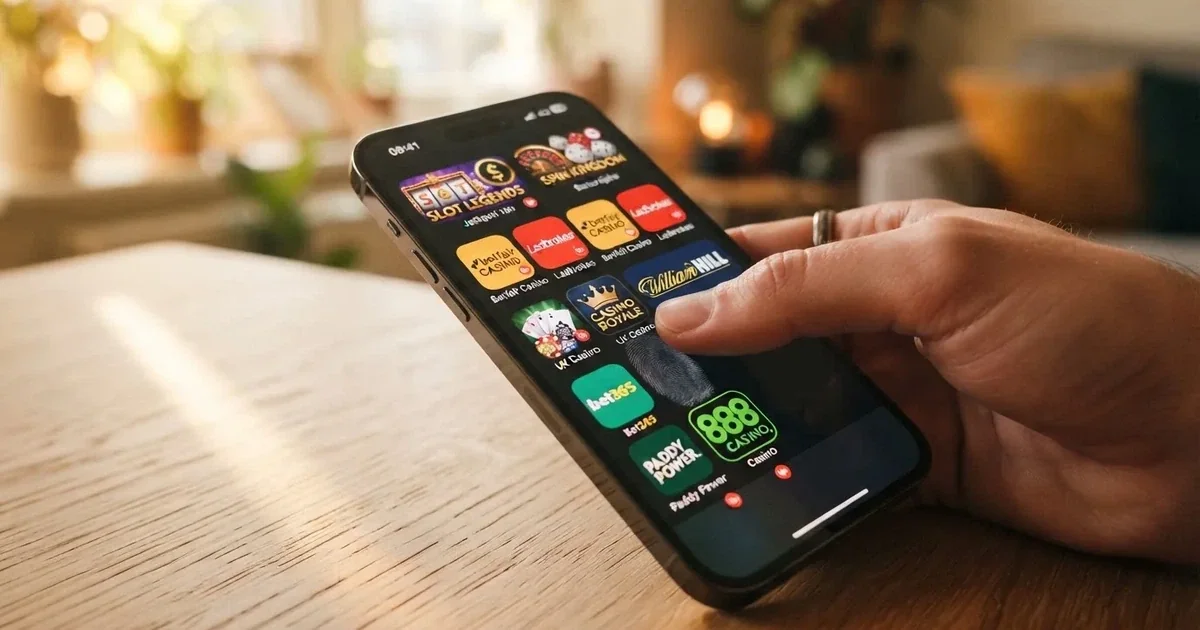
The best casino app in the UK for 2026: ten licensed apps, ranked by the choice they actually offer
 Available in GB
The “best” casino app in the UK is the one that holds a Gambling Commission licence, runs cleanly on a phone, and pays out through a method the player already trusts. Everything else on a comparison page is decoration around those three. The ten brands reviewed below are all on the Commission’s public register, so the licence question is settled before the first deposit; what separates them is the choice each one makes on bonuses, payments and player controls, and which of those choices actually suits a particular reader.

This page is current as of 23 September 2026 and the figures were checked against the Gambling Commission’s public register of gambling businesses.
Table of Contents
- How this page approaches “best”
- Bonuses and free spins in UK casino apps
- How the wagering cap translates into real time
- Which bonus shape actually suits a player
- Mobile and app performance
- What a browser site still does better
- How the ten licensed apps compare
- The licensed UK casino landscape in one paragraph
- What the Gambling Commission actually requires
- Why the offshore option is not an option
- Responsible gaming at a UK-licensed app
- Payments and payout speed in UK casino apps
- Paddy Power — sportsbook-led casino app
- kwiff — a smaller licence with a different mechanic
- Betway — long-running brand with a wide lobby
- bet365 — the largest single-account licence holder
- Unibet — multi-product brand with international roots
- 888casino — casino-first brand
- Virgin Games — a white-label on Gamesys’s licence
- Midnite — newer UK-licensed entrant
- Betfred — betting-shop heritage
- BetVictor — long-standing bookmaker with a stable app
- The shape of the comparison
- Choosing the right app for a player situation
- What the wagering cap means for each welcome shape
- What a free-spins bundle looks like under the cap
- Frequently asked questions
How this page approaches “best”
A “best app” list usually means a list of brands ordered by someone else’s preference. The honest version is shorter and less flattering. The reader’s “best” depends on three things: the licence behind the app, the payment method that actually works in it, and how the bonus is structured when it lands. The ten operators below are all licensed, so what follows is a comparison of how each one handles the next two questions — money in, money out, and what the welcome offer really costs. Each section closes on the reader situation the operator fits and the one it does not.

Bonuses and free spins in UK casino apps
A welcome bonus in a UK app is not a free amount. It is a deposit match or a bundle of free spins that comes with conditions, and the most important condition since 19 December 2025 is the wagering cap: no online bonus may carry a wagering requirement higher than ten times the bonus value. That single number compresses the entire market. A few years ago, 30x and 40x bonuses were ordinary; in 2026 they are illegal at any UK-licensed operator, so the comparison shifts from “which brand asks for less turnover” to “which brand pairs the smallest bonus with the friendliest terms, and which brand takes the largest deposit and asks for the most in return”.
Free spins on a welcome bundle carry the same treatment. A bundle of fifty spins on a single named slot is a different shape from a “£200 bonus” — the spins have no deposit match to clear, but the winnings from them usually do, and the cap on those winnings is what determines what the bundle is actually worth. A reader who picks on headline alone picks blind. The job of this shelf is to make the wagering cap and the win-cap visible before any brand is named, because once both are on the page the operator write-ups below can describe each bonus in a sentence rather than a paragraph.

The gambling industry’s favourite marketing word for a welcome bonus is “free”. The wagering cap is the answer to it. A bonus that turns into withdrawable cash only after the player has wagered ten times its value is not free; it is the operator lending the player their own money back, with a fee for the privilege. None of the ten brands reviewed below escapes that mechanism — the variation between them is the size of the fee, expressed as the size of the matched deposit, the games the wagering applies to, and whether winnings from free spins are capped.
How the wagering cap translates into real time
The key figures for this comparison are found here. A £100 bonus at the 10x cap requires £1,000 of qualifying wagers before it withdraws. On a slot at a £1 stake per spin that is 1,000 spins; at a 2.5-second spin interval, the lower bound the Commission now enforces on every UK slot, that is 2,500 seconds of continuous play, or just under 42 minutes. The arithmetic is plain; what it does not say is the cost of getting there. A slot at a 96% return pays back £960 of the £1,000 over the long run, leaving £40 as the statistical price of clearing the bonus. Doubling the bonus to £200 doubles both sides — £2,000 of turnover, 2,000 spins, 83 minutes of continuous play, and a statistical cost of £80. Tripling it goes to £3,000 of turnover and £120 of statistical cost. The brand that offers the largest bonus is not offering the player £300 of value; it is offering £300 minus the £120 the maths says will leak out before the wagering is done.
The point is not that bonuses are worthless. Some players like extended play, and a £100 bonus at 10x is a cheap way to get it — cheaper than depositing £100 and playing it through with no bonus attached. The point is that “best” stops meaning “largest” once the turnover requirement sits beside the headline, and the cap the regulator imposed in December 2025 is what forces that second number onto the table.
Which bonus shape actually suits a player
A reader with a small bankroll is usually better served by a smaller bonus. A £20 matched deposit with a 10x requirement needs £200 of wagering, 200 spins at a pound stake, and a statistical cost in the £8 region. That is a defined cost for a defined session, and the reader walks away knowing what the bonus cost them. A £200 matched deposit at the same 10x cap costs £80 in the long run — ten times the small bonus’s cost — and the reader who clears it has spent 83 minutes at a single slot. The small bonus is not the better value in absolute terms, but it is the better value for someone whose entertainment budget is the deposit rather than the headline.
A reader who plays higher stakes has the opposite trade-off. A £5 stake per spin — the maximum the Commission now allows for anyone 25 or over — clears a £1,000 turnover requirement in 200 spins, which is 500 seconds or eight minutes. At that stake the time cost collapses, and the only remaining question is the statistical cost, which sits at £40 for every £100 of bonus. A reader who already bets in £5 increments treats the bonus as a discount on play they were going to do anyway, and the brand with the largest bonus becomes the most attractive brand, because the discount scales with the deposit.
The £2 stake cap for players aged 18 to 24, in force since 21 May 2025, sits inside this arithmetic too. The same £100 bonus at the lower stake limit clears in 500 spins, 1,250 seconds, just over 20 minutes, and the statistical cost is unchanged at £40. The reader under 25 does not pay more for the bonus; they pay it more slowly, which is the regulator’s stated intent.
Mobile and app performance
A casino app is a piece of software that runs on a phone, and the things that matter on a phone are not the things that matter on a desktop page. Touch response, scrolling through a lobby of several hundred slots, the time between tapping a game and seeing the reels, the way the cashier behaves on a small screen — these are the things a browser-based review almost never measures, because a browser hides them. An app shows them. The ten operators below all run native apps for iOS and Android in addition to a mobile browser site, and what separates them is how that app handles the player’s first thirty seconds on it.
A clean app opens to a lobby rather than a marketing splash. The lobby sorts slots by name, by provider or by category, and the search bar returns the typed name within a frame or two. The cashier sits in a tab the player reaches in two taps. Account settings — deposit limit, reality check interval, time-out — sit in the same place as the cashier rather than four menus deep. A player who has just spent a long day and wants one specific slot is one tap, one search, one tap away from playing it. A player who wants to set a deposit limit before depositing is similarly close. An app that makes either of those journeys longer than that has not been designed for the device it sits on.
What a browser site still does better
A browser site has one advantage no app can match: the player does not have to install anything. A reader who plays once a fortnight, who deletes apps they have not used in three months, who shares their phone with a family member, is better served by a strong mobile browser site than by an app they will uninstall between sessions. The browser site also gives the player a single URL they can type or bookmark; an app lives behind an icon that the home screen buries. For low-frequency play, the browser is the more honest answer, and a casino app that neglects its mobile browser site is asking the player to choose between a polished experience and an installed one.
The Commission treats both delivery methods as the same licensed product. An app, a mobile browser site and a desktop browser site all sit behind one licence number, and a player who deposits through any of them is depositing with the same licensee. The protection is identical; the experience is not.
How the ten licensed apps compare
The table below sets each operator against the same four columns: its licence holder and the active remote casino licence it runs against, the status of its domain on the Commission’s public register, and the cluster-7 comparison angle. The figures were taken from the Gambling Commission’s public register on 18 September 2026.
| Brand | Licence holder and GB remote casino licence | Domain status on the register | Subject support |
|---|---|---|---|
| Paddy Power | PPB Games Limited — 039411-R-319335-010 | Active | Sportsbook-heavy parent; casino is secondary |
| kwiff | Eaton Gate Gaming Limited — 044448-R-323408-017 | Active | Smaller-scale operator with a unique random-boost mechanic |
| Betway | Betway Limited — 039372-R-319367-029 | Active | Long-standing operator featuring a deep slot library |
| bet365 | Hillside (UK Gaming) ENC — 055149-R-331499-004 | Active | Extensive single-account licence holder with deep live dealer |
| Unibet | Platinum Gaming Limited — 045322-R-324275-019 | Active | International multi-product brand with deep casino options |
| 888casino | 888 UK Limited — 039028-R-319297-014 | Active | Dedicated casino specialist with no sportsbook distraction |
| Virgin Games | Gamesys Operations Limited — 038905-R-319430-022 | White label | Operates under the Gamesys licence structure |
| Midnite | Dribble Media Limited — 042647-R-321653-022 | Active | Modern UK-licensed entrant with a curated lobby |
| Betfred | Petfre (Gibraltar) Limited — 039544-R-319290-010 | Active | High-street betting heritage with integrated casino |
| BetVictor | BV Gaming Limited — 039576-R-319370-028 | Active | Established bookmaker providing a stable casino interface |
A reader who scans this table gets the licence position settled in two passes and a sense of where each operator sits in the licensed UK market. What the table does not say is which app the player will actually enjoy using, because that depends on the next two shelves: how each one handles a deposit, and what each one offers to someone who has decided they need a break.
The licensed UK casino landscape in one paragraph
The Gambling Commission’s public register held 139 businesses with an active remote casino operating licence on 18 September 2026, and a further 1,065 active domain names plus 361 white-label entries running against those licences.
| Category | Count as of 18 Sept 2026 |
|---|---|
| Active Licences | 139 |
| Active Domains | 1,065 |
| White-Label Entries | 361 |
A “white-label” entry means the domain trades under another company’s licence rather than holding its own; Virgin Games, in the table above, is one such domain. The 139-licence figure is a count of licensees, not of brands, and several of the names most readers recognise — Ladbrokes, Coral and Gala Bingo, for instance — share a single licence holder in LC International Limited. The headline count of “how many casino apps there are in the UK” is therefore misleading whichever direction it runs: more domains than licences, fewer licences than consumer-facing brands.
A remote casino licence number on the register follows a fixed pattern: a six-digit account number, an “-R-” marker to show it is remote (online) rather than a land-based licence, a six-digit number that identifies the licence, and a final suffix. The Commission’s own CSV download of the register lays this out one row per licence account. A reader who wants to verify any of the ten brands above against the register can do it by typing the licence number — 039411-R-319335-010 for Paddy Power, for example — into the register’s search box and confirming the active status. The register is the only test of “is this brand actually licensed in Great Britain” that does not require trusting the brand’s own marketing.
What the Gambling Commission actually requires
Every online casino taking deposits from players in Great Britain needs a Commission operating licence. Since the Gambling (Licensing and Advertising) Act 2014, that requirement applies to operators based anywhere in the world, not only to UK companies — a Curaçao or Malta licence by itself is not enough. The Commission’s published social responsibility code and Licence Conditions and Codes of Practice (LCCP) sit beneath the operating licence, and a breach of either can mean a licence review, a fine or a suspension. The player-facing rules come from those codes; the operator-facing rules come from the licence itself.
Identity verification has been mandatory at the point of first deposit since 7 May 2019. A licensed operator must check the customer’s name, address and date of birth before the first deposit or any play, and the operator must keep records of that check. Anonymous play is not available at a UK-licensed site. A reader who values anonymity over protection should know this before they download anything; the same reader should also know that a brand offering anonymous play has no Commission licence and none of the protection that comes with one.
The minimum age is 18. The Commission has published stake limits for online slots: a maximum of £5 per game cycle for players aged 25 and over, in force since 9 April 2025, and £2 per game cycle for players aged 18 to 24, in force since 21 May 2025. Auto-play has been banned since 31 October 2021, no slot spin may complete faster than 2.5 seconds, and losses disguised as wins — slot animations that play a fanfare when the payout is less than the stake — are banned. These are not operator policies the player can opt out of; they are licence conditions.
Why the offshore option is not an option
A site that takes deposits from players in Great Britain without a Commission licence commits an offence under section 33 of the Gambling Act 2005. The Commission disrupts unlicensed sites where it can — cease-and-desist letters to the operator, search-engine delisting referrals, payment and hosting referrals — but it has no power to block internet service providers from serving the sites. The penalty does not fall on the player; what the player loses by playing unlicensed is protection. There is no GAMSTOP on an unlicensed site, because GAMSTOP is a condition of holding a Commission licence. There is no route to the Commission’s complaints process. There is no approved alternative dispute resolution (ADR) provider. A dispute over a delayed withdrawal or a frozen account on an unlicensed site has nowhere to go except the operator’s own customer service, which is also the entity that created the dispute.
The Commission’s own public register is the test. If a brand does not appear on the register with an active status, it is not licensed for Great Britain, regardless of what its own website says. A reader who wants to verify a brand is not on this page can do it directly.
Responsible gaming at a UK-licensed app
Every licensed UK operator must take part in GAMSTOP, the national online self-exclusion scheme. Self-exclusion is available for six months, one year or five years and cannot be cancelled early — once the period starts, the player waits it out. The operator must run financial vulnerability checks at the £150 net-deposit threshold in any rolling 30-day window, using public-data sources only; this check has been in force since 28 February 2025, with a wider financial risk assessment announced but not yet operative. The operator must prompt a player to set a financial limit before accepting a first deposit, in force from 31 October 2025.
These are the controls that make a “safe” app. A brand that visibly links to GAMSTOP, prompts for a deposit limit before the first deposit, and runs reality checks during play is meeting its licence conditions; a brand that buries the GAMSTOP link or sets reality-check intervals longer than the player asked for is one to avoid. The Commission’s own published enforcement notices, listed on its website, name the operators that have fallen short on these conditions, and a reader who wants a second opinion can read them there.
The National Gambling Helpline, run by GamCare, and GambleAware are the two support organisations named on every licensed operator’s site. Their contact details are required to be visible. A reader who has decided to take a break can self-exclude via GAMSTOP once and have it apply to every UK-licensed site in a single registration; that is the design intent, and it is the single piece of player protection that the offshore market cannot replicate because it is the licence condition that makes it work.
Payments and payout speed in UK casino apps
A casino app in the UK takes deposits through debit cards, bank transfers, e-wallets and a handful of mobile wallets. Credit cards have been banned for gambling since 14 April 2020, including credit cards routed through an e-wallet, so a player who reaches for a Visa or Mastercard needs to be sure it is the debit variant. Apple Pay is treated as a debit-card transaction by the issuing bank rather than a separate payment rail, which means it is allowed for gambling at UK-licensed operators, though availability is set by each operator individually rather than by Apple. PayPal, when an operator supports it, is treated as an e-wallet and is similarly allowed.
Apple Pay launched in the United States on 20 October 2014 and began supporting UK-issued cards on 14 July 2015. The mechanism behind it is tokenisation — the actual card number is replaced with a device-specific Device Primary Account Number, and each transaction carries a dynamic security code — and the in-store variant uses near-field communication (NFC) to talk to a contactless terminal. None of this changes a casino app’s deposit flow at the technical level: the player still authorises a card transaction, and the operator still receives a debit-card payment. What it changes is the player’s experience — Face ID authentication on an iPhone, a single tap in the app, no card number typed in.
Apple’s own support pages note that Apple Pay needs a supported card from a participating issuer and is not available in every market, which is the only friction a UK player is likely to meet. Outside the UK, Apple Pay sits inside a wider regulatory debate: the US Consumer Financial Protection Bureau brought large digital-wallet operators under bank-like federal oversight in November 2024, and the European Commission opened an investigation in 2020 into whether Apple’s control of iPhone NFC hardware blocks rival wallet apps. Neither affects the deposit flow at a UK-licensed casino, but a reader who has seen headlines about either will want to know the local effect is nil.
PayPal’s position is the same in principle and different in practice. PayPal is an e-wallet rather than a card-token system, and an operator that lists PayPal as a deposit method has signed a PayPal merchant agreement and integrated the wallet’s API. That agreement is a per-operator commercial decision; not every UK brand supports PayPal, and the comparison table above does not claim any one of them does. A reader who needs PayPal in their app should check the cashier on the operator’s own site before depositing.
AstroPay, headquartered in Uruguay and founded in 2009, operates as a digital wallet offering online payments, virtual and physical debit cards, and peer-to-peer transfers. Its UK entity, Larstal Limited, is authorised by the Financial Conduct Authority under the Electronic Money Regulations 2011; the company’s Brazilian arm is authorised by the Brazilian Central Bank; its Danish entity is authorised as an electronic money institution by the Danish Financial Supervisory Authority; and its Isle of Man entity, AstroPay Global (IOM) Limited, is licensed by the Isle of Man Financial Services Authority. Whether any given UK casino app accepts AstroPay is again a per-operator choice rather than something the wallet itself guarantees.
UK bank transfers, the third rail, run through the Faster Payments Service launched in 2008 and operated by Pay.UK. The scheme runs twenty-four hours a day, seven days a week, and most payments arrive instantly or within a couple of minutes; transfers can occasionally take up to two hours. The per-transaction limit set by the scheme is £1,000,000, though individual banks impose lower limits on their own customers. A withdrawal from a casino app that takes the Faster Payments route typically reaches the player within minutes once the operator has approved it; a withdrawal that takes longer is held at the operator rather than the network.
Payout speed is the operator’s decision rather than the network’s. Faster Payments can move money in seconds; a withdrawal that takes two working days is being held by the operator’s own payments team. The brands that publish “instant withdrawal” in their cashier mean instant once approved, not instant at the cashier button; the approval step is where the time is spent. A player who wants a quick payout is best served by an account that is already fully verified — name, address, date of birth, source-of-funds where requested — and a payment method that supports instant receipts. Skrill, Neteller and the larger e-wallets tend to win on this metric; debit cards are slower because they ride the card network’s batched settlement.
The 800,000 figure that sits behind the credit-card ban — the Commission’s estimate of UK consumers who used credit cards to gamble in 2018, with 22% of online gamblers who used credit cards classed as problem gamblers — is the regulator’s stated reason for the 14 April 2020 ban. A reader who wants to know why a feature they might have expected is missing now has the answer.
Paddy Power — sportsbook-led casino app
Paddy Power sits on the Commission’s register as an active domain of account 39411, PPB Games Limited, holding the active remote casino licence 039411-R-319335-010. The brand is best known for sports betting; the casino product runs alongside the sportsbook in the same app, which is the right shape for a reader who splits their play between the two and the wrong shape for a reader who only wants slots. The same tab structure that lets a player jump from a sports in-play market to a casino game also makes the casino lobby one tap further away than it would be in a casino-first app.
Paddy Power is an active domain for PPB Games Limited (account 39411). The brand is best known for sports betting; the casino product runs alongside the sportsbook in the same app. This setup serves players who split their time between the two, but dedicated casino enthusiasts may find the sportsbook integration heavy.
kwiff — a smaller licence with a different mechanic
kwiff is listed as an active domain of account 44448, Eaton Gate Gaming Limited, holding remote casino licence 044448-R-323408-017. The brand’s distinguishing feature is a “surprise” mechanic on stakes — the operator can apply a boosted multiplier to a bet at random — which carries into the casino product rather than the sportsbook alone. The Commission register entry is clean, the licence is active, and the brand has a smaller footprint than the big-three bookmakers.
kwiff operates under Eaton Gate Gaming Limited (account 44448). Its defining feature is a random “surprise” multiplier that can boost stakes unexpectedly, bringing a unique dynamic to the casino lobby. It provides a distinct alternative for players who prefer newer, more experimental UK-licensed platforms over traditional industry giants.
Betway — long-running brand with a wide lobby
Betway is listed as an active domain of account 39372, Betway Limited, holding remote casino licence 039372-R-319367-029. The brand has been licensed in the UK for long enough that its app has had time to settle into a mature shape — stable touch response, a lobby that sorts by provider and theme, and a cashier that mirrors the desktop layout rather than collapsing it onto a phone screen in an unreadable form. The slot lobby runs into the hundreds, which is the right shape for a player who wants range.
Betway, under Betway Limited (account 39372), offers a mature and stable casino app. The touch response is fluid, and the lobby structure efficiently sorts hundreds of games. It remains a reliable choice for players who prioritise a deep catalogue of titles backed by a well-established operator.
bet365 — the largest single-account licence holder
bet365 is listed as an active domain of account 55149, Hillside (UK Gaming) ENC, holding remote casino licence 055149-R-331499-004. Hillside is one of the larger single-account licence holders on the register, and the casino app reflects that scale: a deep in-play casino product, a long-established live dealer lobby, and a payments team that processes withdrawals quickly because the back-office infrastructure has had years to settle. The app is dense with features, which is the right shape for an experienced player and the wrong shape for a player who wants the casino lobby to be the entire screen.
bet365 (Hillside UK Gaming, account 55149) delivers an app with significant scale. It features a comprehensive in-play casino and a long-standing live dealer lobby. This high-density feature set caters well to experienced users who value deep functionality, though casual players might find the interface dense.
Unibet — multi-product brand with international roots
Unibet is listed as an active domain of account 45322, Platinum Gaming Limited, holding remote casino licence 045322-R-324275-019. Platinum Gaming is the UK-facing arm of the Kindred group, which runs Unibet across several European markets, and the casino app carries a slot and live-dealer lobby that reflects that international sourcing. A player who plays Unibet in another country and travels will find the same product and the same account structure when they download the UK app.
Unibet is managed by Platinum Gaming Limited (account 45322). As part of the international Kindred group, its UK app mirrors the product experience found across its wider European markets. It provides a cohesive, multi-product experience that benefits from a global perspective on slot and live-dealer selections.
888casino — casino-first brand
888casino is listed as an active domain of account 39028, 888 UK Limited, holding remote casino licence 039028-R-319297-014. Of the ten operators reviewed, 888casino is the one with no sportsbook: the app is a casino product from the first tab to the last, and that is its distinguishing feature. A player who wants to play slots and live dealer and never see a sports market will find the absence of sports content refreshing rather than limiting.
888casino, run by 888 UK Limited (account 39028), maintains a strictly casino-only focus. Without any sportsbook or poker distractions, the app provides a clean, streamlined environment for players who prefer to engage exclusively with its proprietary slot catalogue and live dealer games.
Virgin Games — a white-label on Gamesys’s licence
Virgin Games is listed as a white-label domain of account 38905, Gamesys Operations Limited, holding remote casino licence 038905-R-319430-022. A white-label domain trades under another company’s licence rather than holding its own, which means the player protection — GAMSTOP, ADR, complaints — is Gamesys’s responsibility rather than Virgin’s. The Commission treats white-label and active domains identically for player purposes; the difference is on the corporate side, where Gamesys is the regulated entity and Virgin Games is the brand running on top of it.
Virgin Games is operated by Gamesys Operations Limited (account 38905) under a white-label agreement. This brand leverages the established Gamesys infrastructure for player protections like GAMSTOP, while maintaining its own distinct brand identity. It works well for fans of the Virgin look who value the underlying stability of the Gamesys platform.
Midnite — newer UK-licensed entrant
Midnite is listed as an active domain of account 42647, Dribble Media Limited, holding remote casino licence 042647-R-321653-022. Midnite is one of the newer UK-licensed entrants on the register; the slot lobby is smaller and more curated than the big-three bookmakers, which is the right shape for a player who would rather have a tight catalogue of well-known titles than a thousand slots of variable quality. The app is built mobile-first rather than adapted from a desktop product, which shows in the touch layout.
Midnite is managed by Dribble Media Limited (account 42647). This newer UK-licensed operator distinguishes itself with a mobile-first design and a highly curated lobby. It targets players who prefer a streamlined, smaller catalogue of quality titles over the sheer volume found at larger, long-standing bookmaker apps.
Betfred — betting-shop heritage
Betfred is listed as an active domain of account 39544, Petfre (Gibraltar) Limited, holding remote casino licence 039544-R-319290-010. Betfred’s history is on the betting shop side of the UK market, and the casino runs alongside the sportsbook in the app in a similar shape to Paddy Power and Betway. A player who already has a Betfred shop account and wants to move it onto their phone will find the same brand behind both.
Betfred is run by Petfre (Gibraltar) Limited (account 39544). With deep roots in the high-street betting sector, its app provides a robust sportsbook alongside a parallel casino product. It remains a familiar, stable option for players who value the brand’s long-standing presence in the UK market.
BetVictor — long-standing bookmaker with a stable app
BetVictor is listed as an active domain of account 39576, BV Gaming Limited, holding remote casino licence 039576-R-319370-028. BetVictor has been in the UK market long enough that its app has settled, and the casino lobby sits behind the same login as the sportsbook. The shape is similar to Paddy Power and Betfred — bookmaker with a parallel casino product — but the casino side has had longer to mature than at some of the larger bookmakers, which shows in the live-dealer selection.
BetVictor is managed by BV Gaming Limited (account 39576). As a veteran bookmaker, its app is stable and well-integrated. While it maintains a sportsbook-first history, the casino interface has matured significantly, offering a reliable experience for players who want to jump between sports betting and casino gaming.
The shape of the comparison
Ten brands, all licensed, all running native apps. The Commission register settles the licence question before the first tap; what separates them is the shape of the product behind the licence. Three patterns emerge from the table.
The first is the bookmaker-with-a-casino pattern. Paddy Power, Betway, bet365, Unibet, Betfred and BetVictor all carry a sportsbook in the same app as the casino, and the casino lobby lives one or two taps behind the front tab. A player who splits their play between the two will be well served; a player who only wants the casino will feel the extra weight.
The second is the casino-only pattern. 888casino is the clearest example in this set — no sportsbook, no poker, no bingo, just slots and live dealer. A player who wants the casino to be the entire app finds this shape easier to navigate.
The third is the smaller-licence pattern. kwiff, Midnite and to a degree Virgin Games (running on Gamesys’s licence rather than its own) are the smaller-footprint operators in the set. Their apps are typically mobile-first, their lobbies are tighter, and their distinguishing feature is some specific mechanic or design choice rather than scale.
A reader who knows which pattern they want has already narrowed the ten to two or three. The licence status is identical; the product shape is the choice.
Choosing the right app for a player situation
A reader with a £50 monthly entertainment budget, who wants to deposit once and play one slot for that session, is best served by a brand with a small matched deposit and a 10x wagering requirement — the bonus costs roughly £2 to clear at a 96% RTP, and the player walks away with a clear sense of what the bonus cost. The bookmaker-with-a-casino pattern works as well as the casino-only pattern at this budget; the deciding factor is whether the player wants sportsbook tabs they will not use.
A reader who plays at £5 per spin, the maximum stake allowed for anyone 25 or over, is best served by a brand with the largest welcome bonus they are willing to clear, because the time cost of clearing is short at that stake and the statistical cost is unchanged regardless of stake size. The bookmaker-with-a-casino pattern wins here, because the largest bonuses in the UK market tend to sit on the bookmaker-led apps rather than the casino-only apps.
A reader who plays once a fortnight, deletes apps between sessions, and shares their phone, is best served by a strong mobile browser site rather than an installed app. The Commission treats the browser and the app as the same licensed product, so the protection is identical; the experience favours whichever the player does not have to manage.
A reader who has decided to set a deposit limit before depositing is best served by a brand whose cashier prompts for the limit before the first deposit rather than after, as the Commission’s October 2025 rules now require. A reader who has decided to self-exclude is best served by registering with GAMSTOP once and letting the exclusion apply across every licensed UK site in a single registration.
What the wagering cap means for each welcome shape
A £20 matched deposit at 10x requires £200 of turnover, 200 spins at £1 stake, and a statistical cost in the £8 region. This is the smallest bonus shape in the UK market and the cheapest to clear. The player who picks this shape is paying for a short session with a small bonus on top, and the bonus’s value is real in proportion to its size.
A £100 matched deposit at 10x requires £1,000 of turnover, 1,000 spins at £1 stake or 200 spins at £5 stake, and a statistical cost of £40. This is the median bonus shape, and most UK welcome offers sit in this band. The player who clears this bonus has spent between 42 minutes and eight minutes of continuous play, depending on stake, and £40 in the long run.
A £200 matched deposit at 10x requires £2,000 of turnover, 2,000 spins at £1 stake or 400 spins at £5 stake, and a statistical cost of £80. This is the upper end of what UK brands now offer under the cap. The player who clears it has spent between 83 minutes and 17 minutes of continuous play, and £80 in the long run.
Above £200, the bonus gets large enough that the time and statistical costs become the dominant fact about it. The reader who picks on headline alone at this scale picks on the smallest part of the picture.
What a free-spins bundle looks like under the cap
A bundle of fifty free spins on a named slot has no deposit match to clear, but the winnings usually carry their own wagering requirement and almost always carry a win cap. A bundle advertised as “50 free spins” is therefore not a bundle of fifty free games; it is a bundle of fifty games whose maximum withdrawable value is whatever the win cap states, with whatever wagering applies on top. The Commission’s 10x cap on wagering applies to the bonus value, not to the winnings from free spins, and the win cap is set by the operator.
A reader who picks on the number of spins alone picks blind. The shape of the bundle that matters is the win cap and the wagering on the winnings. The audit of any free-spins offer in the UK starts with those two numbers, not with the count.
Frequently asked questions
What makes a casino app the safest option for real-money play?
A UK casino app is safest when it sits behind an active Gambling Commission operating licence, runs GAMSTOP self-exclusion, and prompts for a deposit limit before the first deposit. These are licence conditions rather than operator policies, which is why every brand on the public register meets them. The Commission’s own published enforcement notices list the operators that have fallen short, and the register itself is the test.
Can a player deposit into a casino app using Apple Pay?
Yes, at any UK-licensed operator that lists Apple Pay as a deposit method. Apple Pay is treated by the issuing bank as a debit-card transaction, which the Commission’s rules allow for gambling, and the operator sets availability rather than Apple. A player who reaches the cashier and does not see Apple Pay needs to check whether the operator supports it on its own site.
Does a casino app support PayPal for deposits and withdrawals?
It depends on the operator. PayPal is an e-wallet rather than a card-token system, and a brand that lists PayPal has signed a separate merchant agreement with PayPal. Not every UK-licensed brand supports it. The cashier on the operator’s own site is the only test that does not require trusting marketing.
What welcome bonus terms typically apply inside a casino app?
Since 19 December 2025, no UK-licensed online bonus may carry a wagering requirement higher than 10x the bonus value. Free-spins bundles carry their own win caps and wagering on winnings. The bonus’s headline number is the smallest part of the picture; the wagering multiple and the win cap are the larger part.
How well do casino apps handle touchscreen controls compared with a browser site?
A well-built casino app handles touch input, scrolling a long slot lobby, and the cashier flow on a small screen more cleanly than a mobile browser site, because the app is built for the device. A mobile browser site has the advantage of needing no install. The two are treated identically by the Commission, and the choice between them is about how the player uses their phone rather than which is safer.
Must a UK casino app be licensed by the Gambling Commission?
Yes. Any operator taking deposits from players in Great Britain needs a Commission operating licence, regardless of where the operator is based. The Commission’s public register is the test, and a brand that does not appear on it with an active status is not licensed for Great Britain.
Prepared by the quickpayoutcasinouk editorial staff.