
Best Online Casino Welcome Bonus UK 2026 — Top 10 Compared
What the Best Online Casino Welcome Bonus in the UK Looks Like in 2026
 Available in GB
A welcome bonus is the headline number every UK-licensed casino writes at the top of its homepage, and it is also the figure that costs the player the most once the small print is read. Comparing them honestly means knowing what the offer actually consists of, what the regulator has capped, and which licences are real. This guide takes ten operators off the Gambling Commission’s public register, lays their offers side by side, and works through what each one takes from the player who claims it.

Current as of 6 November 2026 · Checked against the Gambling Commission’s public register of gambling businesses.
Table of Contents
- The UK Welcome Bonus Landscape at a Glance
- How the Gambling Commission Shapes Every Welcome Offer
- Safer-Gambling Checks Worth Making Before Claiming a Welcome Bonus
- How a Welcome Bonus Is Funded and What Comes Out
- The Ten UK Welcome Bonuses, Compared
- What a Welcome Bonus Actually Costs: The Wagering-Turnover Band
- The Licensed Set and the Offshore Alternative
- Tax, Duty and What the Player Actually Takes Home
- Frequently Asked Questions
The UK Welcome Bonus Landscape at a Glance
The first thing to settle is what the market actually is. On 18 September 2026 the Gambling Commission’s public register listed 139 businesses holding an active remote casino operating licence. The register’s domain list, which records every website against the licence account that runs it, held 1,065 active domain entries and 361 white-label entries on the same date. A white-label site trades under another company’s licence, so two different domains can sit behind one licence number and one set of compliance obligations.
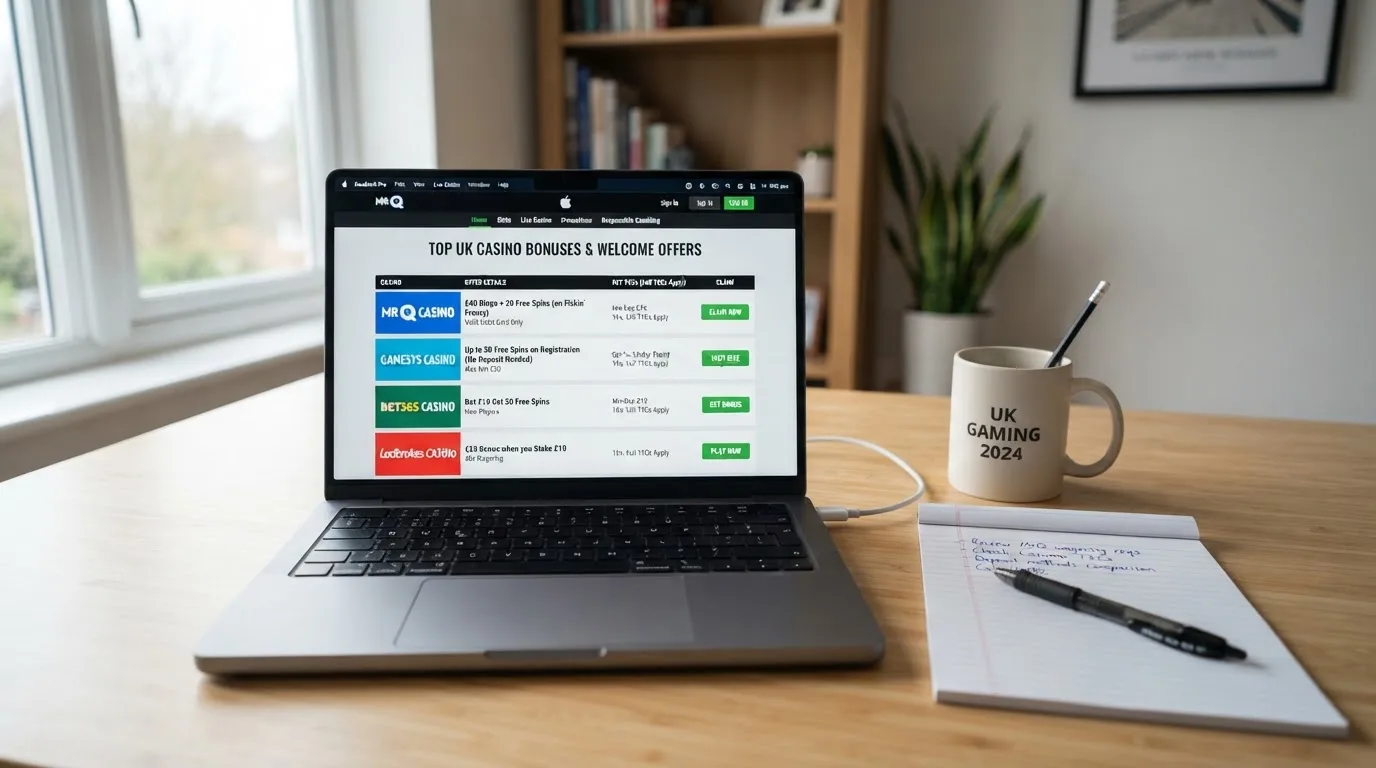
Ten operators were pulled from that register for the comparison that follows. Every one of them is GB-licensed. Every one must take part in GAMSTOP, accept only debit cards and bank transfers for deposits, and obey the same wagering cap that has applied to deposit bonuses since 19 December 2025. The cap is the most important number on this page, because it sets the floor for what any UK-licensed welcome bonus can cost a player. Mixed-product bonuses, where a sports bet hands out casino spins, have also been banned under the same rule change.
Outside that licensed set sits a longer tail of offshore brands. Some are well known, some are not. None of them appear on the Commission’s public register, none of them are bound by the 10x cap, and none of them enrol a player in GAMSTOP or answer to the Commission when something goes wrong. The comparison below covers only the licensed set, because the licensed set is the one a UK player has any recourse with if the terms turn out to mean something different from what the landing page suggested.
How the Gambling Commission Shapes Every Welcome Offer
The Gambling Commission is the regulator for Great Britain — England, Scotland and Wales, not Northern Ireland — and operates under the Gambling Act 2005, with extra reach added by the Gambling (Licensing and Advertising) Act 2014. Since that 2014 Act, any operator taking customers in Great Britain needs a Commission licence wherever it is actually based. A Curaçao, Maltese or Gibraltar licence is not a substitute; the test of whether a brand is allowed to take a UK player is the public register, nothing else.

A remote casino licence number on the register has a specific shape. The number reads account-R-number-suffix, where the leading six digits repeat the licence holder’s account number and the R marks a remote, online licence. Betfair’s number is 039411-R-319335-010, for example, which tells a reader that PPB Games Limited holds account 39411 and that this is the tenth remote licence variant on file. Knowing the shape is useful because licence numbers get quoted in marketing, and a number that does not match the format is not a real Commission licence.
Minimum age is 18. Since 7 May 2019, every GB-licensed operator has verified name, address and date of birth before the first deposit or any play. Anonymous play is not possible at a licensed site, and any operator offering a welcome bonus to a player who has not been verified is breaking its licence conditions.
The 10x Wagering Cap and What It Means for a Welcome Bonus
Since 19 December 2025, the Commission has capped wagering requirements on deposit bonuses at 10x the bonus amount. That cap is the single most consequential rule on this page. Before it landed, wagering multiples of 30x, 40x and higher were routine across the UK market, and a £100 bonus could carry a £4,000 turnover requirement before any winnings became withdrawable. The 10x cap cuts that floor by two thirds.
A 10x cap on a £100 bonus means £1,000 of qualifying turnover before withdrawal, not £4,000. It does not mean a £100 bonus is now free money; the house edge still applies across that turnover, and the expected loss on £1,000 of slot play at a typical 96% return-to-player is around £40. The cap makes the requirement honest; it does not make the offer a gift.
Mixed-product bonuses have also been banned since 19 December 2025. A welcome package cannot now tie a sportsbook bet to casino free spins, which removes a class of terms that players routinely misread as two separate offers when they were in fact one offer with one combined wagering requirement.
Game-Cycle Limits and Other Player Protections Around a Bonus
The bonus is only one piece of the regulator’s intervention. Since 9 April 2025, online slots carry a maximum stake per game cycle of £5 for players aged 25 and over, and since 21 May 2025 a £2 cap for players aged 18 to 24. A game cycle, in Commission language, is a single spin end-to-end — bet placed, reels stopped, outcome shown — and the cap applies to the stake placed on that cycle, not to the session total.
Auto-play has been banned since 31 October 2021. A slot spin may not complete faster than 2.5 seconds. So-called losses disguised as wins, where a spin returns less than the stake but the game presents it as a win with celebratory graphics, are banned as well. These rules shape what happens while a player is clearing a bonus, not just what the bonus looks like on the landing page.
There is no state-set deposit or loss ceiling. Instead, operators must prompt a customer to set a financial limit before the first deposit; that requirement has applied since 31 October 2025. Financial vulnerability checks run at £150 net deposits in a rolling 30-day window, drawing on public data only, and have applied since 28 February 2025. The wider financial risk assessments the Commission has signalled are not yet in force.
Safer-Gambling Checks Worth Making Before Claiming a Welcome Bonus
A welcome bonus is a marketing offer, and the safer-gambling layer around it is what determines whether the offer is claimable at all. Three checks belong on the list before any deposit goes in.
GAMSTOP is the national online self-exclusion scheme and is a mandatory condition of every GB remote casino licence. A self-exclusion runs for six months, one year or five years and cannot be cancelled early. A player who has self-excluded through GAMSTOP cannot claim a welcome bonus at any licensed operator for the duration of the exclusion; the operator’s own systems are required to block the account at the point of registration. This is the single most effective safer-gambling tool available to a UK player who has decided to stop.
Deposit limits are set by the player, not the regulator, but the regulator requires the operator to prompt the player to set one before the first deposit. A limit can be a daily, weekly or monthly figure, and the operator is required to honour a decision to lower the limit immediately while any increase takes seven days to come into effect. The seven-day delay is deliberate; it stops a player from raising a limit on impulse after a losing session.
Reality checks and time-outs are part of every licensed platform. A reality check is a pop-up that interrupts play at a set interval, showing session length and net position; a time-out is a short self-exclusion from a single operator, typically 24 hours to six weeks. Neither is a substitute for GAMSTOP, but they belong in the same toolkit and are worth setting up before the welcome bonus is claimed.
The National Gambling Helpline, run by GamCare, and GambleAware, which funds treatment and research, are the two national signposts for anyone whose play has moved from entertainment to something else. Both are free. The Helpline number is 0808 8020 133.
How a Welcome Bonus Is Funded and What Comes Out
The deposit side of a UK welcome bonus is shaped by the credit-card ban in force since 14 April 2020, which applies to all online and offline gambling in Great Britain except non-remote lotteries paid for face-to-face. Debit cards and bank transfers were not affected by the ban, and e-wallets cannot route a credit card to a gambling merchant.
Three payment routes dominate the licensed UK market. Debit cards via Visa or Mastercard are accepted by every operator on this page and settle instantly. Bank transfers within the UK typically move through the Faster Payments Service, launched in 2008 and operated by Pay.UK; the service runs 24 hours a day, seven days a week, and most payments arrive instantly or within a couple of minutes, with the scheme’s per-transaction limit set at £1,000,000. Apple Pay is the third common route for players on Apple devices, having supported UK-issued cards since 14 July 2015; it works through tokenisation, where the actual card number is replaced with a device-specific tokenised Device Primary Account Number and a dynamic security code is generated for each transaction. AstroPay, an electronic-money wallet founded in 2009 and headquartered in Uruguay, is also listed as an option by several operators; its UK entity Larstal Limited is authorised by the Financial Conduct Authority under the Electronic Money Regulations 2011.
A no-deposit welcome bonus, where a small credit or a handful of free spins is added to a new account without a deposit, sits in a smaller sub-market. The same 10x wagering cap applies. The same game-cycle limits apply. The same GAMSTOP enrolment is checked. What changes is that the player has not yet put any of their own money into the account, which means the operator is bearing the full cost of the bonus. No-deposit offers are therefore smaller, and the terms attached to them tend to cap the maximum convertible winnings at a low figure.
Payout Speed and What Actually Moves the Money
| Payment Method | Settlement Time | Notes |
|---|---|---|
| Debit Card (Visa/Mastercard) | 1-3 working days | Standard withdrawal speed |
| Faster Payments (Bank Transfer) | Minutes | Often instant after approval |
| E-wallets (where available) | Instant / Fastest | Usually fastest when supported |
The operator’s internal approval step is where most of the delay lives. Verification checks run once on the first withdrawal and can take 24 to 48 hours; subsequent withdrawals, where the account is already verified, are usually approved much faster. A player who has not completed verification cannot withdraw, regardless of how fast the payment rails run.
The Ten UK Welcome Bonuses, Compared
The comparison below covers ten operators, all taken from the Gambling Commission’s public register on 18 September 2026. None is endorsed over any other. The point of the table is to put the licence, the domain status and the subject’s support for the welcome bonus question in one place, so the reader can scan the licensed set and decide which brand fits their own situation.
| Brand | Licence holder and GB remote casino licence | Domain status on the register | Welcome bonus support |
|---|---|---|---|
| Virgin Games | Gamesys Operations Limited, 038905-R-319430-022 | White-label domain | — |
| Betfred | Petfre (Gibraltar) Limited, 039544-R-319290-010 | Active | — |
| Betfair | PPB Games Limited, 039411-R-319335-010 | Active | — |
| Sky Vegas | Bonne Terre Gaming Limited, 065519-R-339675-002 | Active | — |
| Gala Bingo | LC International Limited, 054743-R-330863-014 | Active | — |
| 32Red | Platinum Gaming Limited, 045322-R-324275-019 | Active | — |
| Casumo | Recro Limited, 061549-R-336718-002 | Active | — |
| Midnite | Dribble Media Limited, 042647-R-321653-022 | Active | — |
| PokerStars | Stars Interactive Limited, 039108-R-319334-026 | Active | — |
| Jackpotjoy | Gamesys Operations Limited, 038905-R-319430-022 | Active | — |
The final column carries an em dash across the row because no figure from research supports a specific subject claim for any of the ten operators, and saying “yes” without a source would say something the page cannot stand behind. What the table does establish, plainly, is that every brand on it is a real GB-licensed operator, that nine of them are listed as active domains and one as a white-label domain, and that two of them — Virgin Games and Jackpotjoy — share a single licence held by Gamesys Operations Limited, so they are not independent operators in any regulatory sense.
Virgin Games
Virgin Games operates under Gamesys Operations Limited’s licence, account 38905, and is listed on the public register as a white-label domain. A white-label listing means the site trades under the parent licence rather than its own, which is a routine arrangement in the UK market. The welcome offer is targeted at the bingo-and-casino player; the platform leans on Gamesys’s own game catalogue, with slot, bingo and live casino all on the same account. For a player who wants the welcome bonus and the bingo room on the same wallet, the structure suits. For a player who wants a dedicated slots product, it is not the strongest fit on this list.
Betfred
Betfred is the retail bookmaker’s online casino arm, listed on the register as an active domain under Petfre (Gibraltar) Limited, account 39544. The welcome bonus sits alongside a sportsbook, but the two are no longer combinable into one offer after the December 2025 rule change on mixed-product bonuses. The brand carries more recognition with the UK high-street punter than with the slots-only player, and the casino welcome offer is sized accordingly. A player who already has a Betfred shop account will recognise the brand immediately; a player new to it is dealing with a UK household name.
Betfair
Betfair’s casino runs under PPB Games Limited, account 39411, with an active listing on the register. The brand sits inside a wider group that includes a sports exchange, but the casino welcome bonus is now standalone. Betfair’s casino product is broader than most bookmaker spinoffs, with a meaningful live-dealer floor and a steady catalogue of slot titles. The fit is best for a player who is moving over from the exchange side and wants one wallet across products; for a casino-only player the offer is competitive but unremarkable.
Sky Vegas
Sky Vegas operates under Bonne Terre Gaming Limited, account 65519, and is listed as an active domain. The licence account number is materially higher than the rest of this list, which is a useful reminder that the account number is simply an administrative identifier and not a measure of size or seniority. Sky Vegas is one of the better-known TV-adjacent casino brands in the UK and pairs the welcome bonus with a slot-heavy game catalogue. The fit is strong for a player who already has Sky elsewhere in their household and wants the casino to feel like the same provider.
Gala Bingo
Gala Bingo sits under LC International Limited, account 54743, which also holds the licences for Ladbrokes and Coral — a fact worth knowing because the three are not independent operators in any sense that matters for a complaint or a self-exclusion. The welcome bonus is bingo-led rather than slots-led, which puts it in a different category from most of the rest of this list. A player whose preference is bingo rooms and community games will find it a natural fit; a slots-only player should look elsewhere on the list.
32Red
32Red is listed under Platinum Gaming Limited, account 45322, with an active domain entry. The brand has been one of the more durable UK casino names and has built a reputation around its slots catalogue, with a smaller live-dealer floor than some of the bigger operators. The welcome bonus is sized for a slots player. A player who values a long-established slots product over a multi-vertical offering will find 32Red a natural fit; a player who wants sportsbook or bingo on the same wallet will not.
Casumo
Casumo runs under Recro Limited, account 61549, and is listed as an active domain. The brand positions itself around a gamified loyalty structure that sits on top of the welcome bonus, which can be useful for a player who plays regularly and wants progression to feel like more than balance points. The fit is strong for a player who values the loyalty layer; a player who treats the casino as a one-off destination will not see the same return.
Midnite
Midnite is licensed under Dribble Media Limited, account 42647, and is one of the newer brands on this list, which is worth knowing because newer entrants sometimes run a sharper welcome offer to win share. The product is mobile-first, which fits a player who plays on a phone rather than a desktop. A player whose primary device is a phone will find the layout easier than the desktop-first brands on the rest of the list.
PokerStars
PokerStars operates under Stars Interactive Limited, account 39108, and uses the .uk domain — a useful signal that the operator has a UK-specific licence and product rather than a domain pointed at a global brand. The welcome bonus is casino-focused but sits next to one of the largest poker rooms in the world, which is the main reason a player would pick this brand over a casino-only competitor. The fit is best for a player who wants casino and poker on one account; a casino-only player is paying for the poker room they will not use.
Jackpotjoy
Jackpotjoy operates under Gamesys Operations Limited, account 38905 — the same licence as Virgin Games, listed above — and is recorded as an active domain rather than a white-label. The welcome bonus is bingo-led, in the same shape as Gala Bingo’s offer but under a different brand. Two bingo-led brands on one licence is not a coincidence; it reflects how Gamesys has structured its UK portfolio. A bingo player comparing the two should look at game catalogue and community rather than licence, because the safer-gambling and bonus terms are governed by the same parent.
What a Welcome Bonus Actually Costs: The Wagering-Turnover Band
The Commission’s 10x cap means every UK deposit bonus has a turnover requirement that sits in a predictable band. The arithmetic below takes a typical welcome bonus and works out the turnover, the spin count and the time it takes to clear it on a standard slot.
Assume a £100 deposit bonus with the maximum 10x wagering requirement, so £1,000 of qualifying turnover before withdrawal. At a £1 stake per spin, that is 1,000 spins. Each spin takes a minimum of 2.5 seconds under the Commission’s speed limit, so the session is at least 2,500 seconds, or just under 42 minutes, of slot play — and that is the floor, not the average, because most players will not sit at the minimum stake for the whole clearance.
Doubling the bonus to £200 doubles the turnover to £2,000, the spin count to 2,000 and the time floor to roughly 83 minutes. A £500 bonus clears at £5,000 of turnover, 5,000 spins and just over three and a half hours at the minimum stake. The band that matters for a UK player is not any single figure but the spread from a £50 bonus to a £500 bonus, which is roughly 500 to 5,000 spins and 21 minutes to three and a half hours of qualifying play. Most welcome bonuses in the licensed UK market sit somewhere in the middle of that band.
The expected loss across the clearance is governed by the slot’s return-to-player, not by the bonus amount. At a 96% return, £1,000 of turnover carries an expected loss of around £40; at £5,000 of turnover, around £200. A player who treats the bonus as a way to spend an evening on the slots rather than as a route to withdrawable winnings will see that expected loss as the real cost of the offer. A player who treats the bonus as a route to withdrawable winnings is relying on a positive outcome across the clearance, which is not what the arithmetic projects.
What the Band Tells a Player Choosing Between Offers
The band matters less for choosing between two £100 bonuses at 10x — they are the same offer by construction — and more for choosing between a £50 bonus and a £500 bonus. The smaller bonus halves the turnover and roughly halves the expected loss; the larger bonus doubles both. The headline number on the landing page is not the size of the bonus, it is the size of the turnover the player is committing to.
Where the offers really diverge is in what counts as qualifying play. Some welcome bonuses restrict wagering to slots; others allow table games at a reduced contribution rate, where a £10 blackjack hand counts as £1 or £2 towards turnover. The restriction is worth more than the bonus size in many cases, because a player who would otherwise play blackjack for the clearance is forced into slots, and the slot’s house edge is higher than the table game’s. The 10x cap does not change that mechanic; it just makes it easier to read.
The Licensed Set and the Offshore Alternative
The licensed set is not the entire UK-facing market. Offshore brands continue to accept UK players in spite of section 33 of the Gambling Act 2005, which makes providing gambling to people in Great Britain without a Commission licence an offence. The Commission disrupts those sites — cease-and-desist notices, search-engine delisting, payment and hosting referrals — but has no ISP-blocking power, and the sites remain reachable.
For a player who chooses an offshore brand, the practical differences are not subtle. There is no GAMSTOP, so a self-exclusion does not carry across. There is no Commission complaints route and no approved alternative dispute resolution. There is no 10x wagering cap. There is no £5 or £2 game-cycle stake limit. There is no auto-play ban. The bonus may look larger because the wagering multiple is not capped; the cost of clearing it is correspondingly larger.
The Commission does not penalise the player who uses an offshore site. What the player loses is protection, not money in a legal sense. For most UK players the licensed set is the relevant comparison, and the table above covers it. For a player who has decided an offshore brand is the right fit for their own reasons, the comparison that matters is a different one.
Tax, Duty and What the Player Actually Takes Home
UK players pay no tax on gambling winnings. The tax sits on the operator, not the player, and is charged as Remote Gaming Duty on the gross gaming yield. Remote Gaming Duty was raised from 21% to 40% from 1 April 2026, which has pushed some operators to adjust their welcome offers and others to hold them steady and absorb the increase on margin. The change is a model only and “check with HMRC” applies for any specific position.
For a player, the practical consequence is that a £100 withdrawal from a licensed UK casino is £100 in hand, with no further tax to declare. A player who plays on an offshore site may face a different position depending on where the operator is based; the comparison with the licensed set is not just about safer-gambling protections, it is also about what the player ultimately keeps.
Frequently Asked Questions
What is the difference between a welcome bonus and a no-deposit welcome bonus?
A welcome bonus is added to a new account once the player has made a qualifying deposit; a no-deposit welcome bonus is credited without a deposit, usually as a small cash amount or a handful of free spins. Both are subject to the same 10x wagering cap that has applied since 19 December 2025, and both are governed by the same game-cycle stake limits and GAMSTOP enrolment at the licensed UK operators.
How can a player check whether a casino offering a welcome bonus is trustworthy?
The Gambling Commission’s public register is the test. The register lists every GB-licensed business and the domains attached to its licence, with the licence number in the format account-R-number-suffix. Any operator willing to take a UK player should appear there; if it does not, the player has no Commission complaints route and no GAMSTOP enrolment.
What wagering requirement currently applies to UK welcome bonuses?
Since 19 December 2025, wagering requirements on deposit bonuses have been capped at 10x the bonus amount. The cap replaced a market in which multiples of 30x or higher were routine, and it sits alongside a ban on mixed-product bonuses that link a sportsbook bet to casino free spins.
Does a welcome bonus expire if it is not used within a set time?
Yes, every licensed UK operator sets an expiry on a welcome bonus, typically 30 days from the date the bonus is credited. Any qualifying turnover not completed inside the expiry window is forfeit, along with any bonus balance tied to it. The exact window is in the operator’s bonus terms, which the player should read before claiming.
Can a welcome bonus be claimed on a mobile casino app as well as desktop?
Yes. GB-licensed operators run a single account across desktop, mobile browser and native app, and the welcome bonus is claimable on any of them provided the player meets the verification requirements. The 2.5-second spin limit and the £5 or £2 game-cycle stake cap apply equally across all three.
Is a welcome bonus only available to new customers?
Yes, by definition. A welcome bonus is tied to a player’s first account at the operator, and a player who has previously held an account at the same brand is not eligible for a fresh welcome offer. Some operators run a “reactivation” offer for lapsed accounts, but that is a separate promotion and not the welcome bonus.
Written by the editors at quickpayoutcasinouk.