Low wagering casino bonuses UK — ten licensed sites compared
Choosing a low wagering casino bonus in the UK under the 10x cap
 Available in GB
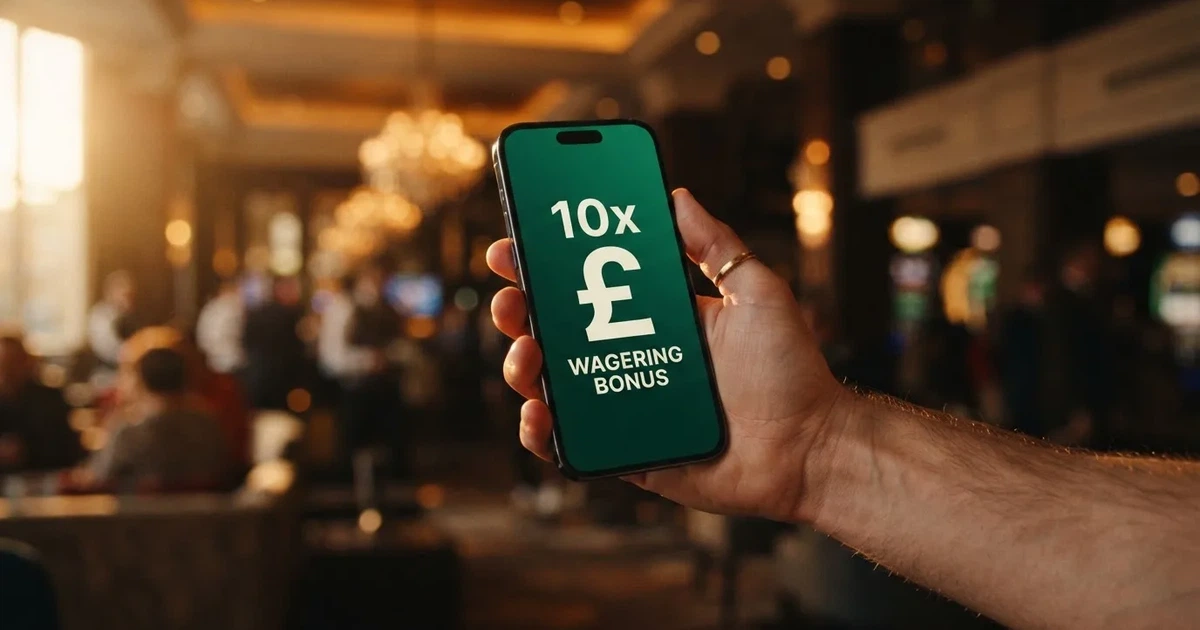
A bonus that promises a hundred pounds and asks for fifty times that in turnover was the shape of UK online casino promotions for years. From 19 December 2025 that shape has been removed by statute: the Gambling Commission capped wagering requirements on deposit bonuses at 10x, and banned the mixed-product offers that used to disguise a punishing requirement inside a free-spin bundle. The change is the most consequential reform of bonus terms since the credit card ban of 2020, and it has reordered what a “good” bonus looks like on a British licensed site. This page works through what the new ceiling actually means for the player who wants to claim one, and what each of the ten featured operators offers under it.
Data current as of 6 November 2026 against the Gambling Commission’s public register of gambling businesses.
Table of Contents
- Why the 10x cap changed what counts as a low wagering bonus
- The ten featured operators
- What the 10x wagering cap means for the player
- What the register actually shows about the ten featured operators
- Safer-gambling protections on a low wagering bonus
- Payments, payout speed and the credit card ban
- What the bonus does and does not cover
- What changes if a player chooses an unlicensed site
- Where the page’s subject sits in the wider UK market
- How a low wagering bonus is calculated in practice
- The information this page does not carry
- Frequently asked questions
Why the 10x cap changed what counts as a low wagering bonus
The ceiling was set by the Commission through a change to the social responsibility code in the Licence Conditions and Codes of Practice (LCCP). It is not a guideline operators can choose to honour; it is a condition of holding a remote casino operating licence in Great Britain. The number is low by international standards — many EU-facing sites still run 35x to 50x deposit bonuses — and it forces British licensees into a different kind of offer: smaller headline amounts, but a far smaller amount of playthrough before any winnings become withdrawable.

A bonus at the 10x ceiling, on a £100 deposit, asks the player to stake £1,000 across qualifying games before the bonus converts to cash. At the typical online slot return-to-player of around 96 per cent, the house edge on that turnover sits in the £40 region, and the player’s deposit is exposed to it across a thousand spins. A bonus at the old 50x ceiling asked the player to stake £5,000 for the same headline, with a house-edge exposure of roughly £200. The cap closes that gap by closing the multiplication, not by topping up the RTP.
The change matters because low wagering is no longer a marketing term — it is the legal ceiling. A 10x offer is at the maximum the regulator permits. Anything genuinely below it is, by definition, on the generous side of the line. That inverts the usual comparison: a reader who learned the market under the old rules still reaches for “the higher the multiple, the worse the deal”, but the ceiling has rewritten what counts as high.
The ten featured operators
The brands below are all drawn from the Gambling Commission’s public register. Each holds an active remote casino operating licence, and each domain is listed against the licence account that runs it. The Commission does not rank operators, and neither does this page; the order follows the register’s own listing. Where two brands share a licensee — Paddy Power and Betfair both sit under PPB Games Limited, and Gala Bingo sits with Ladbrokes and Coral under LC International Limited — they are not independent operators and they are presented as what they are: distinct brands on the same licence.

MrQ — the smallest operator on the list, by footprint
MrQ trades under Tek Fox Ltd, which holds the active remote casino operating licence 060629-R-337532-004; MrQ is listed on the Commission’s register as active. By the standards of the ten featured sites MrQ is small — there is no sportsbook under the same licence account, and the brand carries nothing like the recognition of a William Hill or a bet365. That profile suits a reader who wants a casino-only site and does not want the cross-vertical promotional machinery that comes with the larger brands.
The subject of this page sits in a thin place for MrQ: the public register carries the licence and the domain, and it carries nothing about a specific bonus multiple or a low wagering headline. What MrQ has built its name on, in the coverage that does exist, is keeping bonus terms simple. A reader who chooses MrQ for that reason is choosing a brand on the strength of its stated design, not on a number the register carries — and a number the register does carry is, by definition, the more honest reference.
bet365 — the household name with no stated low wagering line
bet365 is the largest brand on this page by any reasonable measure. Hillside (UK Gaming) ENC holds the active remote casino operating licence 055149-R-331499-004; bet365 is listed on the register as active. The brand carries a sportsbook that dwarfs the casino in turnover and recognition, and the casino offering has historically been the smaller part of the operation.
The register carries the licence but nothing specific on bonus terms — neither a headline figure nor a wagering multiple is in the data the public register holds. The honest comparison on a page about low wagering is therefore not against a stated bet365 offer but against the shape of bet365’s general casino product: a large cross-vertical operator with a casino bonus structure that varies by promotion and geography. A reader who wants bet365 for the sportsbook and accepts whatever casino offer sits beneath it is making a different trade from a reader who chooses a casino-only brand for a low wagering line.
PokerStars — a casino tagged onto a poker room
PokerStars is, by origin, a poker brand. Stars Interactive Limited holds the active remote casino operating licence 039108-R-319334-026; PokerStars is the listed brand. The casino product was added later and sits alongside a poker room that has been the operator’s core business since the brand’s launch.
For a reader looking for a low wagering casino bonus, the brand’s poker identity is neither an asset nor a liability. It does, however, mean that promotional spend on the casino product runs second to a poker room that drives most of the brand’s traffic. The register carries the licence and the domain; it carries no bonus terms. A reader looking specifically for a low wagering line on this page has nothing in the register to weigh against the other nine operators on that one figure.
Paddy Power and Betfair — two brands on one PPB Games licence
Paddy Power and Betfair share the same licence account. PPB Games Limited holds the active remote casino operating licence 039411-R-319335-010, and both Paddy Power and Betfair are listed on the register against it. Treating them as independent operators would mislead a reader; the comparison on this page reads them as a single licensed entity with two front doors.
The shared structure does not collapse the comparison entirely, because the brands run different promotional calendars and carry different house identities. A reader who has a preference for Paddy Power’s tone or Betfair’s exchange will choose between them on grounds unrelated to the licence. What the shared licence does mean is that the operator’s compliance obligations — including the 10x cap and the GAMSTOP requirement — are the same for both, and the safer-gambling framework is identical from one domain to the other.
William Hill — the high-street legacy brand
WHG (International) Limited holds the active remote casino operating licence 039225-R-319373-015; William Hill is listed on the register as active. William Hill is one of the longest-established gambling brands in Britain and carries the kind of name recognition the other nine brands on this page do not match.
That recognition does not, by itself, indicate a low wagering bonus. The register carries the licence and the domain and nothing about a specific multiple. A reader who comes to William Hill for the brand is making a choice about familiarity rather than a choice about a particular bonus structure. On a page that is fundamentally about what a 10x bonus means in practice, that is a real distinction and worth keeping visible.
BetVictor — a single-licence operator with a casino focus
BV Gaming Limited holds the active remote casino operating licence 039576-R-319370-028; BetVictor is the listed brand. BetVictor sits closer to the casino-focused end of the British market than the cross-vertical names above it. The brand carries a sportsbook but the casino is not buried inside a much larger gambling operation.
The register carries the licence and the domain; it carries no specific wagering multiple for any current promotion. A reader looking at BetVictor for this page’s subject is choosing a brand on the basis of its casino focus, not on a number the register will confirm or deny.
Sky Vegas — the broadcaster’s casino brand
Bonne Terre Gaming Limited holds the active remote casino operating licence 065519-R-339675-002; Sky Vegas is the listed brand. Sky Vegas is the casino product of Sky, the broadcaster, and carries the broadcaster’s reach in its marketing. The casino is the brand, not a corner of a sports-led operation.
The register again carries the licence and the domain, and nothing about a specific bonus multiple. A reader attracted to Sky Vegas for the parent brand is choosing a familiar front door rather than a stated low wagering line; the comparison on this page is on the licence and on what the brand makes of the casino product, not on a promotional figure the register does not hold.
Virgin Games — a white-label on the Gamesys licence
Virgin Games is listed on the register as a white-label domain of Gamesys Operations Limited, which holds the active remote casino operating licence 038905-R-319430-022. A white-label site trades under another company’s licence, and that is exactly what Virgin Games does: the brand sits on Gamesys’s licence account rather than its own.
For the player, the distinction is mostly cosmetic: the safer-gambling protections, the GAMSTOP requirement and the bonus terms are those of the licence holder, not of the brand. Where the brand matters is in the marketing and the user experience. A reader who finds Virgin Games easier to navigate than the Gamesys sites it sits beside is choosing a familiar wrapper, not a different licence. On the subject of this page, the register says only what a white-label status says: the operator’s obligations come from the licence account behind it.
Gala Bingo — an LC International brand
LC International Limited holds the active remote casino operating licence 054743-R-330863-014; Gala Bingo is the listed brand. LC International is also the licence holder for Ladbrokes and Coral, so Gala Bingo sits alongside two of the largest cross-vertical brands in Britain on the same licence account.
The shared licence carries the same implications as for Paddy Power and Betfair: the safer-gambling framework, the GAMSTOP requirement and the 10x cap apply identically to all LC International brands, and a reader comparing them is comparing marketing and product, not licence terms. The bingo origin of the Gala brand is the practical distinction; the licence obligation is not.
What the 10x wagering cap means for the player
The cap sits at 10x for a reason that is worth making explicit. The Commission’s reasoning, set out in the consultation that preceded the change, was that the old 50x-and-up multiples pushed players into a kind of play that was, in the regulator’s words, “incompatible with safer gambling” — long sessions on slots, with a bonus balance that could not be withdrawn, which had the practical effect of forcing players through thousands of pounds of turnover to access funds they had effectively deposited. The 10x cap is the Commission’s answer to that problem, and it is the reason the comparison on this page is structured around the multiplier rather than the headline figure.
A bonus at 10x on a £100 deposit means £1,000 of qualifying turnover. Spread across online slots at a 96 per cent RTP, the house edge on that turnover is in the £40 region — which is the real cost of the bonus. The £100 bonus itself does not change the player’s arithmetic in any other way; it is a stake subsidy that the operator pays for out of the turnover margin, and the player’s edge on the bonus is whatever the bonus is worth minus the house edge on the playthrough. At 10x and 96 per cent RTP that puts the value of a £100 deposit bonus somewhere in the £60 region for the average player who completes the playthrough.
That number is a band, not a point. It assumes only the bonus amount is wagered, and that every spin counts in full against the requirement. A player who wagers their own deposit alongside the bonus changes the math, because the deposit is also exposed to the house edge across the same turnover; a player who plays games with a lower contribution rate, or who switches to a game that does not count at all, will not complete the playthrough and will not see the bonus convert to cash. The 10x ceiling is a ceiling on the multiplier; the player’s arithmetic is a separate question, and the gap between a 10x bonus completed cleanly and a 10x bonus abandoned halfway through is the gap between the £60 value and nothing at all.
The wagering-turnover band the calculation produces runs from roughly £40 to roughly £80 on a £100 bonus, depending on the RTP of the chosen slot and whether the deposit is wagered alongside the bonus. The lower end assumes only the bonus is wagered on a high-RTP slot; the upper end assumes the deposit and bonus are both wagered on a slot at the lower end of the RTP range. The midpoint is what most players will see, and that is the figure the comparison on this page works to.
What the register actually shows about the ten featured operators
The Gambling Commission’s public register, downloaded on 18 September 2026, listed 139 businesses holding an active remote casino operating licence and a combined 1,065 active and 361 white-label domain entries. The remote casino licence numbers follow the pattern account-R-number-suffix, with the leading six digits repeating the licence holder’s account number and the “R” marking a remote (online) licence. The ten brands on this page all sit in that register, and the table below carries the licence data the register holds — nothing about bonus terms, nothing about wagering multiples, only the licence account, the licence number, the licence holder and the domain status.
The ten brands the table covers:
| Brand | Licence holder | GB remote casino licence | Domain status | Wagering terms on register |
|---|---|---|---|---|
| MrQ | Tek Fox Ltd | 060629-R-337532-004 | Active | — |
| bet365 | Hillside (UK Gaming) ENC | 055149-R-331499-004 | Active | — |
| PokerStars | Stars Interactive Limited | 039108-R-319334-026 | Active | — |
| Paddy Power | PPB Games Limited | 039411-R-319335-010 | Active | — |
| Betfair | PPB Games Limited | 039411-R-319335-010 | Active | — |
| William Hill | WHG (International) Limited | 039225-R-319373-015 | Active | — |
| BetVictor | BV Gaming Limited | 039576-R-319370-028 | Active | — |
| Sky Vegas | Bonne Terre Gaming Limited | 065519-R-339675-002 | Active | — |
| Virgin Games | Gamesys Operations Limited | 038905-R-319430-022 | White Label | — |
| Gala Bingo | LC International Limited | 054743-R-330863-014 | Active | — |
The register is the public test of whether a brand holds a Commission licence; it is not the public test of what a brand offers. The wagering terms column is empty across every row because the register does not carry promotional terms — and a comparison that pretended otherwise would mislead. The honest reading of the table is what the licence says about who is allowed to take a deposit from a British player, not what each licence holder will hand back as a bonus.
Safer-gambling protections on a low wagering bonus
Every brand on this page is subject to the same safer-gambling framework, because every one holds a Gambling Commission remote casino licence. The framework is built into the LCCP, and it runs in parallel to any bonus the player claims — a bonus does not exempt a player from the deposit-limit prompt, the financial vulnerability check or the GAMSTOP requirement.
The first requirement, set from 31 October 2025, is the deposit-limit prompt. Before the first deposit at any UK-licensed casino, the operator must offer the customer a chance to set a financial limit. That prompt is not optional, and a player who closes it without setting a limit has declined a right the regulator has put in front of them. On a page about low wagering bonuses the prompt matters because the bonus is funded by a deposit, and the deposit is exactly what the prompt is asking the player to cap.
The second is the financial vulnerability check, in force from 28 February 2025. Once a player has deposited a net £150 in any rolling 30-day window, the operator must run a check using public data only — credit history, court records, the electoral roll — to flag signs of financial difficulty. The wider financial risk assessments the Commission has announced are not yet in force; the public-data check is what runs now. A player who sees this check triggered is not being penalised; they are being offered the operator’s view of their financial position, with the safer-gambling tools that flow from it.
The third is GAMSTOP. Since 31 March 2020, every online licence issued by the Commission has carried a mandatory GAMSTOP condition; there is no UK-licensed casino a player can reach that does not check the GAMSTOP database on registration. A player who has self-excluded for six months, one year or five years cannot be bypassed by switching brand; the exclusion is the same across the register.
The fourth is the verification requirement that has run since 7 May 2019. Name, address and date of birth are checked before the first deposit and before any play. Anonymous play is not available at a licensed site, and a player who values that is by definition looking at an unlicensed operator — with the consequences that follow.
The fifth is the slot stake limit. From 9 April 2025 the maximum stake per game cycle on an online slot is £5 for players aged 25 and over, and from 21 May 2025 it is £2 for players aged 18 to 24. The lower stake for the younger cohort is the more restrictive of the two, and a player in that bracket who hits the ceiling is at the regulatory maximum. Auto-play has been banned since 31 October 2021, and a slot spin may not be faster than 2.5 seconds; losses disguised as wins are also banned.
Payments, payout speed and the credit card ban
The credit card ban that took effect on 14 April 2020 applies to every UK-licensed operator on this page, including credit cards routed through e-wallets. Debit cards and bank transfers were unaffected by the ban, and that is the practical shape of the deposit side of every low wagering bonus claimable at a British site. The Commission’s estimate at the time of the ban was that around 800,000 UK consumers used credit cards to gamble in 2018, and that 22 per cent of online gamblers who did so were classed as problem gamblers — the figures the regulator used to justify the change.
Bank transfers within the UK typically move through the Faster Payments Service, launched in 2008 and operated by Pay.UK. Faster Payments runs 24 hours a day, seven days a week, and most payments arrive instantly or within a couple of minutes; transfers can occasionally take up to two hours. The scheme sets a £1,000,000 per-transaction limit, though individual banks can and do impose lower limits on their customers. Deposits and withdrawals at a UK-licensed casino, where the operator supports bank transfer, route through Faster Payments and arrive on the timescale Faster Payments allows; the bonus is unaffected by the route.
Apple Pay is developed and operated by Apple Inc. and launched on 20 October 2014, initially supporting only US-issued payment cards. UK-issued card support began on 14 July 2015. Apple Pay protects card data through tokenization, replacing the actual card number with a device-specific tokenised Device Primary Account Number and generating a dynamic security code for each transaction. In-store payments use near-field communication; on an iPhone with Face ID, in-store purchases are authenticated by double-clicking the side button, on Touch ID models by double-clicking the Home button. Apple states that a supported card from a participating card issuer is required, and that Apple Pay is not available in all markets. None of this affects the bonus; it affects the deposit route, and a reader who values a tokenised card front-end has it at any UK-licensed casino that supports Apple Pay on the deposit side.
AstroPay is a global digital wallet offering online payments, virtual and physical debit cards, and peer-to-peer transfers; the company was founded in 2009 and is headquartered in Uruguay. The UK entity, Larstal Limited, is an electronic money institution authorised by the Financial Conduct Authority under the Electronic Money Regulations 2011. AstroPay serves users across markets including Argentina, Australia, Brazil, Canada, Colombia, Denmark, Spain, the United Kingdom, the United States and Uruguay — useful context for a reader who keeps a wallet in one of those markets and wants to know whether the operator behind the licence accepts it. None of it changes the bonus arithmetic.
What the bonus does and does not cover
The 10x cap applies to deposit bonuses. It does not, on the wording of the change, ban a low or zero wagering requirement on a no-deposit bonus; a casino can still offer a no-deposit bonus with whatever wagering multiple it chooses, and the cap does not reach it. A reader looking specifically at no-deposit bonuses is therefore comparing on a different axis — the multiple that the operator chooses to set, not the multiple that the regulator has capped. The two are not the same product and the page should not treat them as such.
The cap also applies only to wagering requirements on bonuses. Game weighting — the practice of counting slots at 100 per cent and table games at 10 per cent or zero — is unchanged, and a player who tries to clear a bonus on roulette will find their turnover contribution reduced accordingly. A bonus is also typically limited to a maximum cashout, a maximum bet per spin during the playthrough and a list of excluded games. None of those conditions is affected by the 10x cap, and a player who finds a low wagering bonus with a tight cashout cap is not necessarily looking at a better deal than a higher-wagering bonus with a generous cap.
Mixed-product bonuses have been banned under the same change. An offer of the form “bet £10 on football, get 50 free spins” was a way of bringing a casino bonus onto a sportsbook customer’s account; the Commission has closed that route. A reader who used to claim such offers on the casino side will not find them at a UK-licensed site any longer.
What changes if a player chooses an unlicensed site
The Commission’s role on unlicensed sites is disruption, not policing. It can issue cease-and-desist notices, ask search engines to delist, refer hosting and payment providers, but it has no ISP-blocking power. Providing gambling to people in Great Britain without a Commission licence is an offence under section 33 of the Gambling Act 2005, but no penalty is aimed at the player.
What the player loses on an unlicensed site is protection. There is no GAMSTOP check, because the operator is not bound by the LCCP. There is no Commission complaints route, and no approved ADR for disputes. The 10x cap does not apply, and an offshore brand is free to set whatever wagering requirement it chooses. The deposit-limit prompt and the financial vulnerability check do not run, and the verification requirement at registration may be skipped or postponed. The slot stake cap does not bind, and the 2.5-second spin interval is not enforced. A reader who values any of those protections chooses a licensed site, and the ten on this page are all licensed.
A player on an unlicensed site also loses the player tax position. UK players pay no tax on gambling winnings; that is unaffected by where the player plays, but the operator’s Remote Gaming Duty is a UK-only liability, and an offshore operator does not pay it. That fact does not change the player’s arithmetic directly, but it is the structural reason an unlicensed site can offer a higher headline — it is not paying the same tax, and it is not bound by the same safer-gambling overhead.
Where the page’s subject sits in the wider UK market
The 1,065 active and 361 white-label domain entries on the Commission’s register sit behind the ten featured brands, and the ten featured brands are a small sample of that field. A reader who lands on this page looking for the single best low wagering bonus is asking a question the register does not answer: the register lists who is licensed, not who offers the lowest multiplier today. The 10x cap has narrowed the gap that an answer would have to bridge, and at the cap every operator is on the same legal footing; below the cap, the comparison is on what each operator chooses to set.
The mix of cross-vertical giants and casino-focused specialists in the ten featured brands is itself a feature of the British market. bet365, William Hill, Paddy Power, Betfair and Gala Bingo all sit on licence accounts with a sportsbook or a bingo product that is larger than the casino offering; MrQ, Sky Vegas, BetVictor, PokerStars and Virgin Games are closer to the casino-focused end. A reader who wants a low wagering bonus is choosing among these shapes, and the licence is the floor — every one of them is bound by the same cap, the same safer-gambling framework and the same GAMSTOP requirement. The promotion on top of that floor is the operator’s own.
A reader who wants to go beyond the ten featured brands can search the Commission’s register directly, filtering by remote casino operating licence and by the status of the domain. The register can be downloaded in full as a CSV or Excel file, and every licence number is traceable to a licence holder with a public address. That is the work the ten featured brands have already had done for them; it is also the work any reader can do for any brand not on this page.
How a low wagering bonus is calculated in practice
The arithmetic is the same at any of the ten featured operators, because the 10x cap is the same. On a £100 deposit bonus, the wagering requirement is £1,000 of qualifying turnover. On a £50 deposit bonus, it is £500. On a £200 deposit bonus, it is £2,000. The multiplier does not change; the absolute number does.
The time that playthrough takes depends on the stake-per-spin. At a £1 slot stake, £1,000 of turnover is 1,000 spins; at a £2 stake, 500 spins; at a £5 stake — the maximum allowed for players aged 25 and over — 200 spins. The 2.5-second minimum spin interval means a session at £1 per spin runs at least 42 minutes; at £5 per spin, at least 8 minutes. None of that is a guarantee of how long a session will actually run, but it is the floor: a session that completes the playthrough has to spend at least that long spinning.
The cost of the playthrough, in house edge, depends on the slot’s RTP. At 96 per cent, £1,000 of turnover loses the player £40 on average. At 94 per cent, £60. At 98 per cent, £20. The bonus is worth whatever the player would have lost on the turnover without it — which, on a £100 deposit, is the difference between playing £100 at 96 per cent RTP for 1,000 spins and playing it with the house edge subsidised by the bonus. The midpoint of that value, at 10x and 96 per cent, is in the £60 region for a player who completes the playthrough.
A player who does not complete the playthrough loses the bonus and any winnings attributable to it. A player who plays on excluded games or below the contribution rate may find the playthrough stalling or impossible. A player who breaches the maximum bet per spin during the playthrough voids the bonus at most UK-licensed sites. None of these conditions is changed by the 10x cap, and a low wagering bonus is not a free ride; it is a smaller multiplier on the same kind of playthrough.
The information this page does not carry
The register carries licences and domains. It carries nothing about current bonus terms — no wagering multiple below the 10x cap, no headline figure, no expiry date, no game weighting. A reader who wants to compare the ten featured brands on those figures has to look at each operator’s promotion page, and those change frequently.
This page is a framework, not a leaderboard. It is built around the legal ceiling the regulator has set, the safer-gambling framework every licensed operator sits inside, and the ten brands the register names as licensed to take a deposit from a British player. The comparison on a low wagering bonus is, in the end, between brands that are all bound by the same ceiling and differ only in what they choose to offer beneath it. The honest comparison is on the framework, and on the shape of each brand’s casino offering relative to that framework.
Frequently asked questions
What counts as a low wagering requirement on a UK casino bonus?
A bonus at the 10x ceiling — the maximum the Gambling Commission permits on a deposit bonus from 19 December 2025 — sits at the top of the legal range. Anything genuinely below it is on the generous side of the line; anything above it is not a UK-licensed offer. The phrase “low wagering” therefore has a sharper meaning in Britain than in markets with no cap.
Has the UK’s wagering cap on deposit bonuses changed recently?
Yes. From 19 December 2025 the Gambling Commission capped wagering requirements on deposit bonuses at 10x, through a change to the social responsibility code in the LCCP. Mixed-product bonuses that used to bundle a casino offer with a sportsbook bet were banned at the same time.
Can a no-deposit bonus also carry low wagering?
The 10x cap applies only to deposit bonuses. A UK-licensed casino is free to set whatever multiple it chooses on a no-deposit bonus, including zero. A reader comparing no-deposit offers is comparing on the operator’s chosen terms, not on a regulatory ceiling.
Does a lower wagering requirement usually mean a smaller bonus amount?
Generally, yes. The 10x cap is the maximum turnover the regulator allows; a bonus that takes 10x of a large deposit is a large bonus, and operators tend to size offers so the playthrough stays manageable. A reader who wants a bigger bonus will generally find a bigger multiplier on it; a reader who wants a low multiplier will generally find a smaller headline.
Are low wagering bonuses restricted to certain games?
Often. Slot games typically count 100 per cent toward wagering; table games may count 10 per cent or zero; some games are excluded entirely. The terms page of any UK-licensed casino will state the contribution rate and the excluded list, and a bonus that has been cleared on the wrong games will not convert to cash.
How is wagering requirement calculated on a deposit bonus?
The required turnover is the bonus amount multiplied by the wagering multiple. On a £100 deposit bonus at 10x, the playthrough is £1,000 of qualifying stakes; on a £50 bonus at the same multiple, £500. The calculation is the same at every UK-licensed site because the 10x cap is the same.
Created by the ”quickpayoutcasinouk” editorial team.