
Online Casino Tournaments UK: What the Leaderboard Costs the Player
Online Casino Tournaments UK: The Mechanics, the Limits and the Cost Behind the Score
A slot tournament is a fixed-clock competition a casino runs on a defined game with a defined prize pool, where the player whose spins accumulate the most wins-or-coins inside the window takes the top prize. The leaderboard is where most of the pitch lives. Most of what actually governs a British player’s tournament session sits one layer beneath it — the Gambling Commission’s stake rules, the 10x wagering cap and the auto-play ban that apply to every spin regardless of whether a clock is running. What follows is a read of the field: how the format works, which operators can legally run one for a UK player, what the rules cost in real turnover, and where the paths diverge for the card-paying casual player, the free-spin hunter and the player weighing crypto at the door.
Data checked against the Gambling Commission’s public register on 7 November 2026.
Table of Contents
- Crypto Casino Tournaments and the Anonymity Pitch
- How Tournament Winnings Reach the Player: Deposits, Refunds and Speed
- Tournament Incentives and the 10x Wagering Cap
- The Slots and Studios That Anchor Most Leaderboards
- Ten UK-Licensed Brands Compared at a Glance
- The Fundamentals of How a Slot Tournament Actually Runs
- The UK Jurisdiction Behind a Tournament
- When the Leaderboard Pulls You Past the Budget You Set
- The Ten Brands in Detail
- The Turnover Behind a Tournament Bonus
- Frequently Asked Questions
Crypto Casino Tournaments and the Anonymity Pitch
Search traffic for “crypto casino tournaments” carries an assumption that does not survive the GB licensing filter. None of the operators on the Gambling Commission’s public register of remote casino licence holders takes cryptocurrency as a deposit method for its UK-facing site. A tournament that runs on a UK-licensed site runs on pounds, paid by debit card or bank transfer, paid out through Faster Payments or a card refund. The crypto-friendly tournament site a search result points to is licensed somewhere else, and a Curaçao, Maltese or Gibraltar licence is not a substitute for a Commission licence for the British player. Section 33 of the Gambling Act 2005 makes providing gambling to people in Great Britain without one an offence.
Two practical consequences follow. The first is that anonymous play is not a feature any GB-licensed site offers: name, address and date of birth are verified before the first deposit, and the operator’s anti-money-laundering controls bind it to a real customer behind every spin. The second is the protection that disappears when a player steps outside the licensed field — no GAMSTOP exclusion, no approved alternative dispute resolution, no Commission complaints route if a prize pool does not pay out as advertised. The Commission disrupts unlicensed sites (cease-and-desist notices, payment and hosting referrals, search-engine delisting) but does not have the power to block them at ISP level. The penalty does not land on the player. The missing protection does.
For the reader who values speed and privacy above regulatory cover, that is the trade the search invites. The leaderboard pitch at an offshore site is the same shape, the prizes are the same shape, and so is the tournament clock. What changes is what sits behind the brand: not the format, the recourse. A player who wants the format without stepping off the licensed register will find no GB-licensed option that takes coins — and that is the answer, not a missing page in the search results.
There is a partial work-around that does not change this picture. Some operators licensed elsewhere accept GBP-denominated stablecoins and convert at the cashier, which lets a player deposit and withdraw in crypto on a non-UK site without ever opening a pounds account. The legal point does not move with the cashier: the operator is still unlicensed for Great Britain, the player is still outside the GB protection regime, and the same trade still applies. The page notes the work-around because it shows up in search results. The page does not recommend it.
How Tournament Winnings Reach the Player: Deposits, Refunds and Speed
The fastest path a UK player has to a tournament prize is the same path their deposit took in: Faster Payments, debit card refund, or an e-wallet that the operator supports. The Faster Payments Service, launched in 2008 and operated by Pay.UK, runs 24 hours a day, seven days a week, and most payments arrive instantly or within a couple of minutes, with transfers occasionally taking up to two hours at the far end of the range. Faster Payments carries a £1,000,000 per-transaction limit set by the scheme, though individual banks impose lower customer limits, and the Bank of England is not a direct participant — it oversees safety and stability and provides final settlement.
Tournament prizes typically reach a player in one of three forms. Cash prizes go straight to the withdrawable balance with no further play-through, which is the cleanest end of the market. Bonus-credit prizes carry the same wagering requirement that any other bonus carries, capped at 10x since 19 December 2025 — meaning a £20 leaderboard win needs £200 of qualifying play before it withdraws, and a £100 freeroll bonus needs £1,000. Free-spin prizes turn the prize into a set of spins on a named game, with whatever the spin winnings are paid as bonus credit and subject to the same 10x cap. The shape of the prize is the first thing to check, because the same leaderboard position can be worth very different real-money amounts across two formats.
Deposits face their own constraints, several of which date back years. Credit cards have been banned for gambling across all online and offline products in Great Britain since 14 April 2020 — including credit cards routed through e-wallets, so the familiar “deposit via PayPal with a credit card” is not an option at a UK site. Debit card and bank transfer deposits were unaffected by the ban, and Apple Pay is fine so long as the underlying card is a debit card (Apple Pay itself does not change the funding source). AstroPay is available as an alternative — its UK entity Larstal Limited is an electronic money institution authorised by the Financial Conduct Authority under the Electronic Money Regulations 2011, and AstroPay also holds money-transmission authorisation on the Isle of Man, electronic-money authorisation in Denmark and an electronic-currency issuer licence from the Brazilian Central Bank. Whether a particular AstroPay-funded route is usable for a particular UK tournament depends on the operator’s cashier, not on AstroPay’s standing.
The Commission estimated in 2018 that around 800,000 UK consumers used credit cards to gamble, and that 22% of online gamblers who used credit cards to gamble were classed as problem gamblers — the figure behind the 2020 ban. Tournament players who funded play on credit cards were caught by that ban and switched (or did not); the mechanism that now protects them from re-funding via credit is the same one that protects them on every other product, and it is unchanged for tournaments.
The point that follows is not a speed ranking. The point is that the casino’s payout timeline is the same timeline the player already knows from regular play: instant to two hours via Faster Payments for bank withdrawals, near-instant for debit card refunds, longer where the operator runs manual checks. There is no tournament-specific fast lane.
Tournament Incentives and the 10x Wagering Cap
The incentive on a UK slot tournament falls into one of three shapes, and the shape is what decides the value. Cash prizes are the only shape whose face value is its real value: the £500 leaderboard top pays out as £500 in the withdrawable balance. Bonus-credit prizes turn the headline number into a wagering requirement: under the 10x cap that took effect on 19 December 2025, a £500 bonus carries £5,000 of qualifying turnover before the bonus (and any winnings from it) clears. Free-spin prizes sit in the middle — a stated number of spins on a stated game at a stated stake, with whatever the spins return paid as bonus credit subject to the same cap.
The 10x cap replaced the open-ended wagering multiple that licensed sites had been free to set before 19 December 2025. Mid-market operators who had been running 35x or 40x are now closer to the 10x ceiling than they were to where they sat a year ago, and the lighter end of the market — sites that never asked for more than 10x — has not had to change at all. The effect is that the upper edge of how heavy a bonus can run has come down, while the lower edge looks much the same as it always did for the modest welcome offer.
What the cap does not do is cancel the wagering requirement. A player who takes a tournament bonus still has to play through it before withdrawing. A £20 bonus means £200 of turnover at the operator’s chosen slots, where a £5 maximum stake for players aged 25 and over (in force from 9 April 2025) and £2 for 18 to 24-year-olds (in force from 21 May 2025) sets the upper edge of how fast that turnover can be cleared. The tournament prize is paid as cash, bonus credit (subject to the 10x wagering cap) or free spins, and the Gambling Commission’s stake and spin-speed limits apply throughout the session. The arithmetic is set out in its own section below; the point here is that the headline prize number is not the player’s number, it is the multiplier’s input.
Mixed-product bonuses were banned at the same time as the 10x cap took effect. A casino used to be able to seed a slot tournament by giving away free spins in exchange for a sports bet — that was a cheap way to populate a leaderboard without paying a real cash prize. The ban removes that lever, which nudges the format back toward cash and bonus-credit prize pools and away from cross-product seeding. The trend is visible at the registered operators but cannot be pinned to a specific promotion from the public register.
The third shape, free-roll and no-deposit entry, sits inside the same 10x regime. A no-deposit tournament bonus is still a bonus — it has the same playthrough, the same 10x cap, the same max-cashout provision if the operator runs one. The “no deposit” wording means the player has not paid to enter, not that the prize is free of conditions. This is the most easily mis-read shape on a UK tournament page, because the absence of an entry payment looks like an absence of obligation. It is not. A £10 no-deposit bonus still requires £100 of qualifying wagering; a £50 no-deposit freeroll still requires £500. The turnover is the same number it would be on the same bonus offered on first deposit.
A free-roll’s value, where one is offered, is therefore best read as the chance to play through the wagering requirement without risking the deposit the player would otherwise have committed. The leaderboard prize on top is a separate line item — sometimes real cash, sometimes the same bonus-credit shape, sometimes a free-spin pack on a named game. Read both before the entry button.
The Slots and Studios That Anchor Most Leaderboards
The slot on which a tournament runs is rarely the player’s choice. The operator picks the game, the stake size, the qualifying spin window and the prize pool; the player’s choice is whether to enter. This is the single most important structural fact about a slot tournament and the one most easily missed when a leaderboard pitch reads like a casino’s slot catalogue.
Studios that recur in tournament leaderboards at UK-licensed operators include the slot houses whose games have a low-volatility profile and a high spin rate — the games that let a player run hundreds of spins inside a 20-minute window without busting a bankroll. The Gambling Commission does not publish a list of which studios run which tournaments, so the names that anchor a given leaderboard at a given time are set by the operator’s marketing choice for that week. A player who wants to know which game is running on tomorrow’s headline tournament will find that information on the operator’s promo page and not from any regulator.
A tournament run on a low-volatility game with frequent small wins is friendlier to a player chasing leaderboard points than one run on a high-variance title. Two players on the same game with the same budget, the same stake and the same window can finish on opposite sides of the leaderboard because one had a string of small wins and the other did not — variance is the silent third competitor. There is no skill curve that turns slot tournaments into a winnable proposition for the prepared player; the format rewards the time spent spinning, not a system. The “strategy” wording that appears in search results refers to bankroll pacing (how fast to spend the entry budget across the window) and game choice (whether to enter at all on a high-variance title), not to anything that bends the math.
Live-dealer tournaments exist at some operators but are rarer than slot tournaments and follow a different scoring rule — usually hand volume rather than win-or-coin volume, since hand outcomes are far less frequent than slot outcomes inside a fixed window. A live-dealer tournament is more open to a “strategy” reading, in the sense that a player who knows basic strategy for blackjack will lose less per hand on average than one who does not, and the gap between those two players is closer to a skill gap than anything in slots. The format is also longer, more expensive to enter, and not what the bulk of the search traffic is asking about.
The honest summary: the slots that anchor UK tournaments are set by the operator, not chosen by the player; the studios vary week to week; and the in-game “strategy” claim is mostly bankroll pacing on the operator’s chosen game. Players who care about which game is on the leaderboard should read the promo page before they enter.
Ten UK-Licensed Brands Compared at a Glance
The table below lists the ten featured operators in the order this page takes them through, with the licence holder, the active remote casino operating licence number and the status of the operator’s primary domain on the Gambling Commission’s public register. The right-hand column covers whether the public register and the research inputs carry information about each operator’s slot-tournament offering. They do not, and the column is honest about it: an em-dash means there is no data on the subject here.
| Brand | Licence holder and GB remote casino licence | Domain status on the register | Subject support |
|---|---|---|---|
| Paddy Power | PPB Games Limited · 039411-R-319335-010 | Paddy Power active under account 39411 | — |
| Ladbrokes | LC International Limited · 054743-R-330863-014 | Ladbrokes.com active under account 54743 | — |
| MrQ | Tek Fox Ltd · 060629-R-337532-004 | Mrq.com active under account 60629 | — |
| Coral | LC International Limited · 054743-R-330863-014 | coral.co.uk active under account 54743 | — |
| bet365 | Hillside (UK Gaming) ENC · 055149-R-331499-004 | Bet365.com active under account 55149 | — |
| Betfred | Petfre (Gibraltar) Limited · 039544-R-319290-010 | Active under account 39544 | — |
| Casumo | Recro Limited · 061549-R-336718-002 | Casumo.com active under account 61549 | — |
| 888casino | 888 UK Limited · 039028-R-319297-014 | 888casino active under account 39028 | — |
| Jackpotjoy | Gamesys Operations Limited · 038905-R-319430-022 | Jackpotjoy.com active under account 38905 | — |
| Gala Bingo | LC International Limited · 054743-R-330863-014 | Gala Bingo active under account 54743 | — |
Three brands in the list share a single licence account: Ladbrokes, Coral and Gala Bingo all sit under LC International Limited, account 54743, on the same remote casino operating licence. They are not three independent operators for the purposes of this page. The detail is on the table because the licence row is the only place that surfaces it.
The Fundamentals of How a Slot Tournament Actually Runs
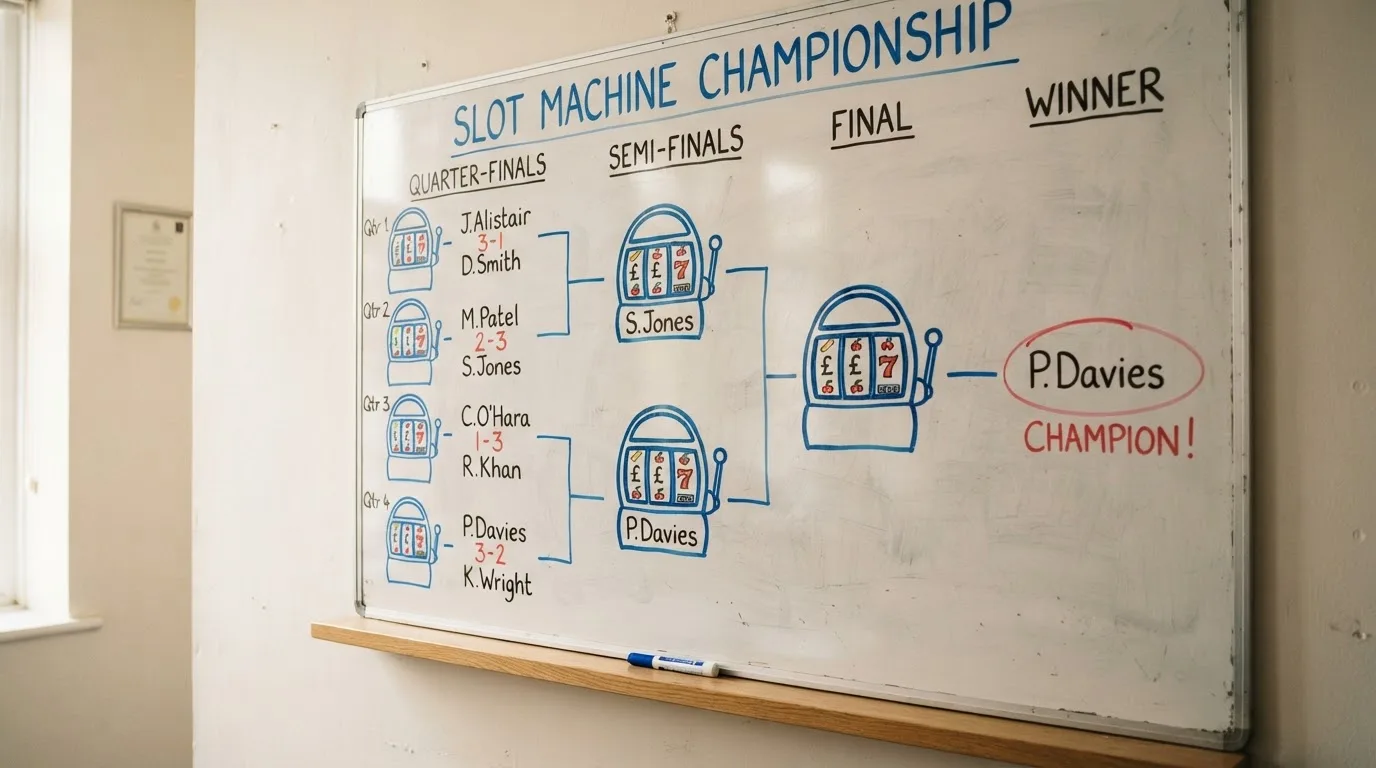
A slot tournament is a marketing construct wrapped around a slot session. The casino picks a slot title, fixes a stake per spin, opens entry to qualifying players for a window (anything from fifteen minutes to a week), and tallies a score for each entrant. The most common scoring rule is the cumulative win amount across all qualifying spins inside the window, with the highest ten or twenty scorers sharing the prize pool. A close variant is the multiplier format, where the score is win divided by bet — which removes the advantage of higher stakes and makes the format fairer across entry tiers. A rarer third format is the survival bracket, where the lowest scorers are eliminated at fixed intervals until only the top handful remain.
Entry takes three shapes at UK-licensed operators. A paid-entry tournament takes a stake from the player’s cash balance, often in the £1 to £10 range per entry, and offers cash or bonus prizes in return. A free-roll tournament takes no entry fee but pays the prize pool from a bonus fund, with the same wagering cap that any bonus carries. A deposit-gated tournament bundles entry into a qualifying deposit — for example, “deposit £20 this week and get five tournament entries” — and the deposit also activates any welcome or reload offer that the operator is running in parallel, though mixed-product seeding (sports bet plus casino spins) is no longer available since the 19 December 2025 bonus changes.
A player’s leaderboard score moves in the same direction as their spin volume, modulated by what those spins return. A player running 500 spins in the window with a 96% return-to-player slot will see roughly 480 “coins back” across the session, with the actual figure bouncing around that average by a margin that depends on the slot’s variance. The leaderboard measures that bounce, not the average. Two players on the same game, same stake, same window, same number of spins will see scores that differ by tens of percent on a low-volatility title and by hundreds of percent on a high-variance one. The format does not average out over a single session.
The mechanics that shape what a player can realistically do inside the window are the stake and spin-speed rules. The maximum-stake cap binds a tournament as surely as any other product — at a UK-licensed site a player aged 25 or over cannot stake more than £5 per spin on an online slot from 9 April 2025 onwards, and a player aged 18 to 24 is capped at £2 per spin from 21 May 2025 onwards, so a “max bet” tournament button that pushes above £5 simply does not exist at a licensed site. The spin-speed floor is the second mechanic: a slot spin must take at least 2.5 seconds (since 31 October 2021), so the spin rate is mechanically bounded: 1,000 spins takes at least 2,500 seconds, or 42 minutes, which rules out any faster pitch of the same spin count at a UK-licensed operator. Auto-play is the third: it has been banned at licensed sites since the same date, which means every spin is a manual press and a tournament session at a UK site is the player pressing a button for the full window.
The “free” entry paths come with their own terms, and those terms are not always visible from the leaderboard. A free-roll tournament typically limits entry to one per player, runs on a fixed start time and excludes players who have not deposited within a recent window. A no-deposit bonus that funds a tournament often carries a maximum cashout clause that caps what the player can actually withdraw from any winnings off the bonus, on top of the 10x wagering cap. The page on which the leaderboard is advertised does not always make those conditions prominent; the operator’s full bonus terms do, and they are worth reading before entry.
The UK Jurisdiction Behind a Tournament
The Gambling Commission’s public register is the test of whether a brand can legally offer a tournament to a British player. On 7 November 2026 the register listed 139 businesses holding an active remote casino operating licence. The same register’s domain list, which records each website against the licence account that runs it, held 1065 active and 361 white-label entries — a white-label site trading under another company’s licence, and therefore not an independent operator for the purposes of regulatory cover. A licence number on the register has the form 000000-R-000000-000: the leading six digits repeat the licence holder’s account number, the “R” marks a remote (online) licence, and the final sequence is a code the Commission uses to distinguish between a holder’s multiple licences. Paddy Power’s entry, for example, sits under PPB Games Limited with licence 039411-R-319335-010; Betfred under Petfre (Gibraltar) Limited with 039544-R-319290-010. The format is what a player or a journalist uses to confirm that a brand appearing on a search results page is in fact Commission-licensed.

What that licence buys a player is a specific set of obligations the operator has to meet, several of which bear directly on how a tournament can be run. The age threshold is 18, and the operator must verify name, address and date of birth before the first deposit or any play — a rule in force since 7 May 2019, and the rule that makes the “anonymous crypto” pitch untenable at any GB-licensed site. The stake limit binds every spin regardless of whether a tournament clock is running: £5 maximum per game cycle for players aged 25 and over (from 9 April 2025), £2 for 18 to 24-year-olds (from 21 May 2025). There is no state-set deposit or loss ceiling, but operators must prompt the player to set a financial limit before the first deposit (from 31 October 2025) — a rule that applies to a tournament-funded deposit as to any other.
The mechanics that bind a tournament session specifically are three. First, auto-play has been banned since 31 October 2021; every slot spin must be a manual press, which lengthens any tournament session in which the operator advertises a high spin count. Second, the same rule set a minimum spin duration of 2.5 seconds, which puts a ceiling on how many spins a player can fit into a 15-minute window — the “spin 1,000 times” pitch is not deliverable at a UK-licensed site. Third, “losss disguised as wins” — slot features that celebrate a spin that returned less than the stake as if it were a win — are banned, which simplifies what a player sees on the reels during a session but does not change the underlying math.
The bonus side is where the most material recent change sits. Since 19 December 2025, wagering requirements at GB-licensed operators are capped at 10x the bonus amount, and mixed-product bonuses — the “bet on sport, get casino spins” mechanic — are banned (the full arithmetic on what the cap means for a tournament prize is set out in its own section below). The Commission announced but has not yet brought into force a wider set of financial risk assessments; the lighter-touch financial vulnerability checks already running, at £150 net deposits over a rolling 30 days, have been in force since 28 February 2025 and use public data only.
A second obligation that bears on every GB-licensed online operator is participation in GAMSTOP, the national online self-exclusion scheme, mandatory since 31 March 2020 — see the responsible-gaming section below for how that exclusion interacts with a tournament session. A player who has self-excluded for six months, one year or five years cannot open a tournament entry, claim a tournament prize or deposit on the licensed site during the exclusion period, and the exclusion cannot be cancelled early. A player who self-excludes at one operator is excluded at every operator that holds a Commission licence. This is the protection layer that does not exist on the offshore crypto-curious sites the search term also surfaces.
The Commission’s enforcement reach stops at the GB border. Section 33 of the Gambling Act 2005 makes it an offence to provide gambling to people in Great Britain without a Commission licence, and the Commission does disrupt unlicensed sites through cease-and-desist notices, payment and hosting referrals and search-engine delisting. It does not have the power to block sites at ISP level. The penalty is aimed at the operator, not the player — what the player loses on an unlicensed site is protection, not prosecution.
On tax, the player pays nothing on gambling winnings in the UK; the operator pays Remote Gaming Duty, raised from 21% to 40% from 1 April 2026. The duty is operator-side and does not bear on a player’s prize. Where the player does need to engage HMRC is on income derived from professional play, which is a different category from a tournament prize.
When the Leaderboard Pulls You Past the Budget You Set
The shape of a tournament is the shape of a session stretched by a clock. A normal slot session ends when the player’s bankroll does, or when the player decides to stop; a tournament session ends when the clock does, which is the opposite pressure. A player who has set a £50 budget for the evening can blow through it in twenty minutes on a fast-spinning, high-tempo tournament, and the clock will still have an hour to run. The leaderboard is built to keep a player playing; the budget is built to stop one. They are not always pointing the same way.
Three rules apply regardless. GAMSTOP, the national online self-exclusion scheme, is a mandatory condition of every online licence at a GB-licensed operator (in force since 31 March 2020), with self-exclusion periods of six months, one year or five years, and no early cancellation. A player who has registered an exclusion cannot enter a tournament on any licensed site for the period chosen. The National Gambling Helpline (run by GamCare) and GambleAware are the routes a player can use to talk the choice through before it is final; the registration itself happens at the GAMSTOP site.
For the player who has not excluded but has noticed that tournament sessions tend to overrun the planned budget, the practical levers are two. The financial limit the operator prompts for before the first deposit (in force since 31 October 2025) is one — a deposit ceiling, a loss ceiling or a session-time ceiling, set in the cashier or the responsible-gaming settings page. The other is a reality check — the in-session pop-up the operator has to surface at fixed intervals, which reminds the player how long they have been playing and what they have spent. A reality check is mandatory; the player can choose to ignore it.
The lighter-touch financial vulnerability checks already in force since 28 February 2025 trigger at £150 net deposits in a rolling 30-day window, using public data only, and do not by themselves restrict play. The Commission has signalled wider financial risk assessments but has not brought those into force at the date of this page. A player whose deposit pattern trips the threshold will see a soft prompt rather than a hard block, and the prompt’s contents vary by operator.
The plainest read of the responsible-gaming layer is the one that does not depend on any of those rules firing: set the deposit limit before the first tournament entry, set a session-time alarm on the phone, leave the cashier open in a tab to see the running total, and stop when the limit is reached rather than when the clock is. The leaderboard will be there again next week; the budget for this evening will not.
The Ten Brands in Detail
Paddy Power
Paddy Power runs its UK casino under PPB Games Limited, account 39411, on the active remote casino operating licence 039411-R-319335-010 — the brand is listed on the public register. The licence-holder is the same company that runs the Paddy Power sportsbook, so a single wallet covers both products and a single GAMSTOP exclusion applies across both. For a player already running a Paddy Power sportsbook wallet, the casino tournament layer is the closest thing to a free add-on; for everyone else, this week’s leaderboard pitch is the only comparison that matters.
Ladbrokes
Ladbrokes runs its UK casino under LC International Limited, account 54743, on the active remote casino operating licence 054743-R-330863-014 — the same licence that covers Coral and Gala Bingo. The operator is registered as active. Three front-ends on one regulated entity means a player reading the bonus terms at Ladbrokes is reading the same document the Coral and Gala teams work from, with the same wagering cap, the same AML controls, the same dispute-resolution route and the same GAMSTOP integration. Ladbrokes, Coral and Gala are three shopfronts on the same operator, so the tournament pitch — not the brand — is the reason to pick one over another.
MrQ
MrQ runs on a single-brand licence under Tek Fox Ltd, account 60629, with the active remote casino operating licence 060629-R-337532-004 — a single-brand licence rather than a multi-brand account. This brand appears as an active site. The single-brand structure means the bonus terms at the cashier are the terms that apply, with no cross-brand caveat to weigh. MrQ has historically marketed a no-wagering bonus structure on some promotions; whether that structure applies to the current leaderboard prize is a question for the operator’s own page. MrQ’s single-brand licence and historically lighter bonus terms make it the cleanest read in this list, and the brand to evaluate directly against the current tournament page.
Coral
Coral is one of three LC International brands on the same licence account — LC International Limited, account 54743, with the active remote casino operating licence 054743-R-330863-014. The brand appears on the register as an active site. The same operator, the same bonus terms, the same GAMSTOP integration underwrite all three LC International front-ends, and any “Coral-exclusive” tournament pitch is a marketing distinction at the front-end rather than a regulatory one. A player who values brand familiarity gets continuity; a player who values the best leaderboard on any given week gets the same product under a different colour.
bet365
bet365 runs its UK casino under Hillside (UK Gaming) ENC, account 55149, with the active remote casino operating licence 055149-R-331499-004. This operator holds active status on the register. The casino sits inside the larger Hillside operation that also covers the bet365 sportsbook and poker product, all on the same licence account, so a single wallet, a single GAMSTOP exclusion and a single KYC check across the three products is the practical shape for a multi-product player. bet365’s casino tournament layer is one product inside a much larger Hillside operation — useful for an existing player, indistinguishable from the next site on this list for anyone else.
Betfred
Betfred’s UK casino sits under Petfre (Gibraltar) Limited, account 39544, with the active remote casino operating licence 039544-R-319290-010. The brand maintains active status. The licence-holder is a Gibraltar-registered company, which is permitted under the post-2014 regime where any operator taking customers in Great Britain requires a Commission licence regardless of where the holding company sits; the Commission licence is the only test that matters for a UK player, and a Gibraltar, Malta or Curaçao registration is not a substitute. Betfred’s licence sits under a Gibraltar-registered holding company, which is permitted under the post-2014 regime; the Commission’s supervision is the only test that matters for a UK player.
Casumo
Casumo runs on a single-brand licence under Recro Limited, account 61549, with the active remote casino operating licence 061549-R-336718-002. Casumo is verified on the register. Recro Limited is a single-brand licence rather than a multi-brand account, and Casumo has historically run a no-wagering bonus structure on some promotions — a position a player should verify directly against the operator’s terms for the specific tournament the brand runs in any given week. Casumo’s no-wagering history on some promotions is a position to verify against the current tournament page, and the single-brand structure makes that verification a one-step process.
888casino
888casino runs its UK casino under 888 UK Limited, account 39028, with the active remote casino operating licence 039028-R-319297-014. The operator appears as active. 888 UK Limited is the same entity that runs 888sport, although the casino and sportsbook are marketed as separate products, so a player who already has an 888casino slot-library account gets the tournament layer on top of it with no new KYC. 888casino’s longer casino-brand history gives it a familiar front-end; the licence confirms supervision and the rest is on this week’s promo page.
Jackpotjoy
Jackpotjoy’s UK casino sits inside the Gamesys group of brands, under Gamesys Operations Limited, account 38905, with the active remote casino operating licence 038905-R-319430-022. Jackpotjoy.com is on the public register as an active domain. Jackpotjoy has historically marketed itself around bingo, and the casino tournament pitch may follow the bingo calendar or run independently — the operator’s own page is the only way to tell. Jackpotjoy is a natural bridge from the bingo side for a player curious about the slot tournament layer, and a familiar brand for anyone who already keeps an account there.
Gala Bingo
Gala Bingo completes the trio of LC International brands on account 54743, with the active remote casino operating licence 054743-R-330863-014. Gala Bingo is on the public register as an active domain. The bingo-led brand framing is the front-end; the regulated entity is the same as the casino brands on the same account, and any “Gala-exclusive” tournament is a marketing distinction rather than a regulatory one. Gala is a natural fit for the bingo-origin player shopping the casino leaderboard — and one of three LC International front-ends on the same product.
The Turnover Behind a Tournament Bonus
The wagering cap that has applied at GB-licensed operators since 19 December 2025 is 10x the bonus amount. For a tournament whose prize is paid as bonus credit, that is the multiplier a player has to clear before the bonus — and any winnings from it — converts to withdrawable cash. The arithmetic is a single multiplication; the page states it as a band because tournament prizes at UK-licensed sites span a wide range, and the turnover requirement moves with the prize.
Assuming the player wagers only the bonus amount (and not a deposit on top of it), the band for typical UK tournament bonuses looks like this. A £10 no-deposit tournament bonus carries £100 of required turnover. A £50 freeroll or low-tier leaderboard prize carries £500 of required turnover. A £200 mid-tier leaderboard prize carries £2,000 of required turnover. A £500 headline leaderboard prize carries £5,000 of required turnover.
Each of those is a required-turnover figure, not a deposit, and the player must place that much qualifying wagering on the operator’s eligible slots before the bonus withdraws. At the £5 maximum stake for players aged 25 and over, that is 20 qualifying spins to clear a £10 bonus, 100 spins to clear a £50 bonus, 400 spins to clear a £200 bonus, and 1,000 spins to clear a £500 bonus — at the strict 2.5-second-per-spin floor that has been in force since 31 October 2021, that is roughly 50 seconds for the £10 bonus, four minutes for the £50, 17 minutes for the £200, and 42 minutes for the £500. The session length scales linearly with the prize; the wagering requirement does the same.
The condition that bounds the band is the 10x cap itself. Any tournament prize paid as bonus credit at a GB-licensed operator cannot carry a wagering requirement above this 10x figure. Anything that quoted a higher multiple was either on a site not covered by the Commission regime, or was set before 19 December 2025 and has since been changed. The player side of the calculation has not changed since the cap came in — the operator side has, and the lever moved down.
The gloss that follows from the formula is bounded by what the formula produces. The formula yields a required-turnover figure, which answers how much wagering the player has to do to clear the bonus. It does not yield an expected loss and does not yield a probability of finishing on the leaderboard; for those, a different calculation and a different set of inputs would be needed. What this calculation does is give the reader the figure the marketing tends to leave off the page — the number the bonus multiplies into before it is a real-money prize.
Frequently Asked Questions
How does a slot tournament actually work at a UK casino?
A UK slot tournament is a fixed-window competition on a named slot, with a published scoring rule — usually cumulative win amount over the qualifying spins. Entry can be a free-roll, paid in cash, or attached to a qualifying deposit. The prize pool is paid as cash, bonus credit (subject to the 10x wagering cap) or free spins, and the Gambling Commission’s stake and spin-speed limits apply throughout the session.
Can you enter a tournament without making a deposit?
Yes — no-deposit and free-roll tournaments exist at some UK-licensed operators. Entry does not require a deposit, but the prize is paid as bonus credit or free spins, both of which carry the 10x wagering cap in force since 19 December 2025. Any max-cashout provision also still applies before the bonus withdraws.
What decides where you sit on a tournament leaderboard?
The operator’s published scoring rule. Most often it is cumulative win amount across qualifying spins; another common rule is win divided by bet, which levels the field across stake sizes. The slot’s variance — not the player’s strategy — decides where a player finishes, and the format does not average out within a single session.
How quickly do tournament winnings reach the player’s account?
It depends on the prize shape. Cash prizes reach the withdrawable balance via the operator’s normal route — usually Faster Payments within minutes to two hours, or a debit card refund on a similar timescale. Bonus-credit and free-spin prizes become withdrawable only after the 10x wagering requirement is cleared; there is no tournament-specific fast lane.
Are cryptocurrency deposits treated the same as debit cards for tournament entry?
No GB-licensed casino takes cryptocurrency as a deposit method for its UK-facing site. Where the “crypto casino tournaments” pitch appears, the operator is licensed outside the UK regime, and Section 33 of the Gambling Act 2005 makes providing gambling to people in Great Britain without a Commission licence an offence. The player is not penalised for playing it, but GAMSTOP and the Commission’s complaints channel do not apply on an unlicensed site.