
Three reels, three rows, one decision: how UK players approach the classics in 2026
 Available in GB
Three-reel slots are the simplest format still in commercial play: three reels, three rows of symbols, a single payline across the middle, and a paytable that fits on one screen. That simplicity is what a player is paying for, and it is what shapes everything else on this page — the maths underneath the symbols, the rules the Gambling Commission applies to online slot play, the licences an operator must hold to take a stake, and the small set of UK-licensed brands where the format is still offered. This page reads those pieces together rather than treating them as separate questions, and offers paths through them rather than a single answer.
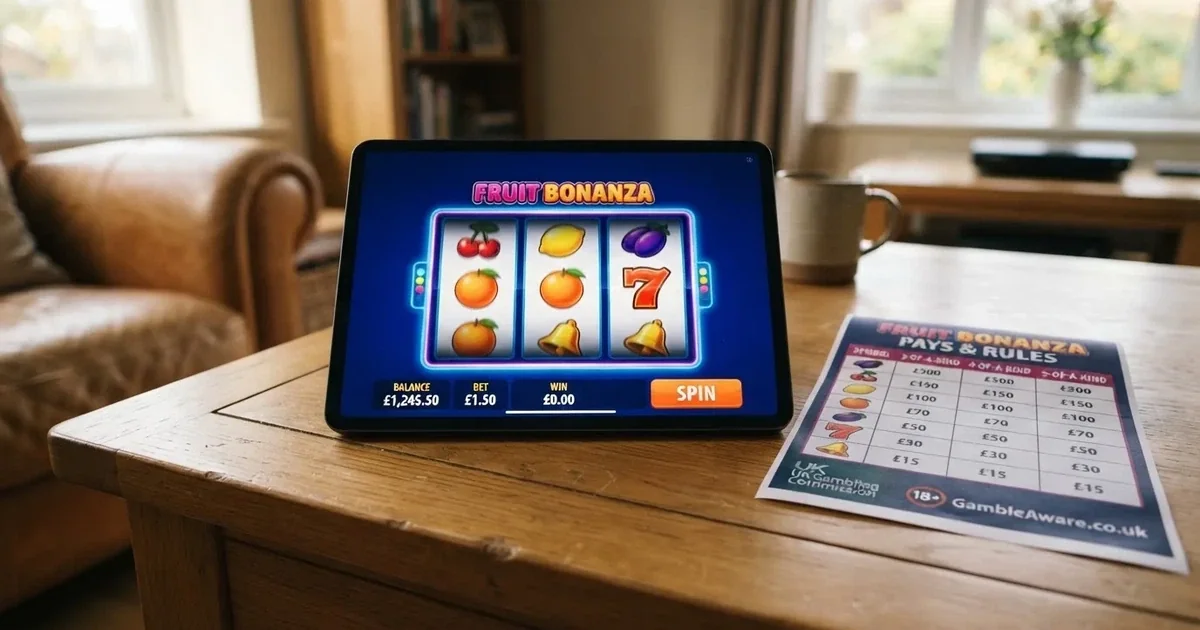
Data current as of 23 September 2026 and cross-checked against the Gambling Commission’s public register of gambling businesses.
Table of Contents
- Funding the reels: deposits, withdrawals, and the cash-flow mechanics of three-reel play
- What the paytable actually says: reading a three-reel slot
- Ten UK-licensed operators carrying three-reel games
- Three-reel slots: the fundamentals of the format
- UK jurisdiction: who may legally offer three-reel slots to UK players
- Safer play around three-reel slots: limits, exclusions, and the help on offer
- Three-reel slots without registration, and where real-money play still demands identity
- The ten operators on this page
- What the 10x wagering cap looks like in practice
- Frequently Asked Questions
Funding the reels: deposits, withdrawals, and the cash-flow mechanics of three-reel play
The reels are the game. The bank account is the mechanism that lets them turn. For three-reel slots specifically — and three-reel slots are no different from any other online slot in this respect — the cash-flow questions are the same ones a player would ask of any UK-licensed site: what does a deposit take, how quickly does a withdrawal land, and what happens to any winnings along the way?
A real-money spin on a three-reel game requires a real-money deposit first. UK rules have forbidden credit cards for gambling since 14 April 2020, including credit cards routed through an e-wallet. That single rule shapes what UK-licensed sites actually accept: Visa Debit and Mastercard Debit, Apple Pay and Google Pay where supported, bank transfer through Faster Payments or Trustly, and e-wallets such as PayPal, Skrill and Neteller, all loaded from a non-credit source.
The Commission’s stake caps apply to the spin itself (set out in the section on UK jurisdiction below), but the operator does not set a ceiling on deposits. What the operator must do before that first deposit is prompt the player to set a financial limit — a rule in force from 31 October 2025 — and from 28 February 2025 a financial vulnerability check fires automatically the moment a player passes £150 in net deposits across any rolling 30-day window. The check uses public data, not credit files, and is the lightest of the Commission’s safer-gambling interventions: a prompt to consider a limit rather than a block.
For a player who plays three-reel slots the way the format invites — small stakes, short sessions — the £150 threshold rarely trips. A £5 spin run a few times a week does not cross £150 of net deposits in a 30-day period; a £2 spin run daily by an 18-to-24-year-old, which the rules allow but the maths still constrains, does so only after a month of steady play. The check sits one rung above the stake cap, catching the players the cap does not.
Withdrawals are the test of whether an operator’s banking pages hold up. UK rules have banned reverse withdrawals since 31 October 2021 — funds a player has asked to withdraw cannot be pushed back into the betting balance without fresh consent. A withdrawal request that has not been reversed must be paid without unreasonable delay. The speed at which that happens depends on the operator and on the payment method: Faster Payments bank transfers can clear within hours at the major UK-licensed brands, while debit-card withdrawals typically take one to three working days, and e-wallet withdrawals land the same day once the operator has approved the request.
A three-reel slot that returns a win pays into the same wallet the stake came from. There is no separate “three-reel winnings” balance, and there is no fast-track lane for jackpot wins on a three-reel game specifically. The withdrawal time on any UK-licensed site is a property of the operator and the method, not of the slot format.
The payout percentage a player sees on a three-reel title — the share of stakes the game is programmed to return over a long run — is set by the operator within the game’s design. The Gambling Commission does not set a minimum RTP for online slots in Great Britain; it requires operators to monitor actual return-to-player performance against the advertised figure and to alert the Commission when performance falls outside an acceptable range. The Commission reviews that monitoring as part of annual games testing audits. Whether a specific three-reel game’s RTP is 94 per cent, 96 per cent, or somewhere between is a function of the title and the operator’s configuration, not a regulatory floor.
The Commission’s interest is that the advertised figure is the one the player gets. That is a lower bar than it looks. The advertised RTP is a long-run statistical average, and any individual session of any size will land somewhere above or below it; what the Commission’s monitoring rules mean is that the operator cannot quietly configure the game to a lower figure than the one on the paytable without being caught. The paytable is the contract; the RTP is the maths.
What the paytable actually says: reading a three-reel slot
The format is older than any UK player, and the paytable is older still. Charles Fey of San Francisco built the first automatic slot machine, the three-reel Liberty Bell, with reels bearing horseshoes, diamonds, spades, hearts and a bell symbol, paying ten nickels (50 cents) for three aligned bells. Before Fey’s device, Sittman and Pitt of Brooklyn built a poker-based machine in 1893 with five drums holding 50 card faces, though it made no automatic payouts. Herbert Mills produced the first copy of the Liberty Bell slot machine in 1907. By the time three-reel slots appeared on UK-licensed sites a century later, the reels had been redrawn thousands of times, but the structure had not.
A three-reel slot uses three reels, three rows of symbols, and typically a single horizontal payline across the middle row. Some titles add diagonal paylines, but most hold to the single-line heritage. Symbols appear in stacks or as single icons on each reel, and the paytable lists which combinations pay what. A typical fruit-machine three-reel pays a small multiple of the stake for three matching cherries, a larger multiple for three matching bars, and the top prize for three sevens or three bells.
The mathematics underneath has not been a mechanical reel for forty years. Norwegian mathematician Inge Telnaes patented in 1984 the use of a random number generator to select reel-stop positions, allowing manufacturers to weight symbol probabilities independently of how often the symbol physically appeared on a reel. Every three-reel slot on a UK-licensed site today is a video representation of outcomes decided by a random number generator. The reels are a picture; the outcomes are a calculation.
What the paytable does not say, but what the maths fixes, is volatility. A low-volatility slot pays smaller wins more regularly; a high-volatility slot pays fewer but bigger wins. The three-reel format, with a single payline and a small symbol set, tends toward lower volatility than five-reel games, but that is a tendency, not a rule. Individual titles within the format run from steady to swingy depending on how the random number generator weights the symbol stops.
What the paytable does say, when read carefully, is the symbol hierarchy. The single highest-paying symbol is the jackpot trigger; one rung down is the secondary prize; further down sit the small wins that keep a session alive. On a UK-licensed site the paytable is published and accessible from inside the game, and it lists every combination that pays, in cash or in credits, alongside the value of each combination. A player who wants to compare two three-reel titles compares paytables, not screenshots.
The UK’s regulatory approach is one of monitored disclosure rather than minimum RTP. Jurisdictions elsewhere take a different line: Nevada sets a 75 per cent minimum return on slot machines, and New Jersey an 83 per cent minimum. A UK-licensed three-reel slot could, in principle, be configured below those floors; what the UK rules require is that the figure the operator advertises is the figure the player gets.
Three-reel slots sit, mechanically, between two reference points. Below them: instant-win and crash-style games with no reel structure at all. Spribe’s Aviator, released in 2019 and described by its studio as the first true multiplayer crash game in the regulated igaming space, runs on a multiplier that rises from 1.00x until the round crashes and pays nothing to a player who failed to cash out in time. Spribe has reported more than 42 million active users and around 350,000 bets per minute across more than 5,000 operators worldwide — a benchmark the three-reel format does not chase, and a reminder that the format’s appeal is not commercial scale but the structure of play.
Above them: five-reel video slots with multiple paylines, free-spin rounds, scatter pays, and bonus features. The three-reel sits in the middle, neither as simple as a crash game nor as busy as a modern video slot, and its appeal is exactly that middle position. A player who wants to understand the format without staking reads the paytable, watches the symbol distribution, and counts the variance between the smallest and the largest pay. None of that requires an account at a UK-licensed site. The paytable is the cheapest part of the comparison, and the part that does not move.
Ten UK-licensed operators carrying three-reel games
A three-reel slot is a game. To play it for real money in the UK, the operator must hold a Gambling Commission remote casino operating licence, the domain from which the game is offered must be on the Commission’s public register, and the operator must take part in GAMSTOP. Those three conditions narrow the universe of available sites to the GB-licensed set.
The table below lists ten operators drawn from the Commission’s public register on 18 September 2026, in the order research carried them. None of the ten is a recommendation to play; each is a brand a UK player will encounter when searching for licensed three-reel slot play. The “subject support” column is blank across the set: the Commission’s register confirms each operator’s licence and domain status but does not record which game formats each operator offers.
| Brand | Licence holder and GB remote casino licence | Domain status on the register | Subject support |
|---|---|---|---|
| Paddy Power | PPB Games Limited · 039411-R-319335-010 | Active | — |
| Unibet | Platinum Gaming Limited · 045322-R-324275-019 | Active | — |
| Sky Vegas | Bonne Terre Gaming Limited · 065519-R-339675-002 | Active | — |
| kwiff | Eaton Gate Gaming Limited · 044448-R-323408-017 | Active | — |
| bet365 | Hillside (UK Gaming) ENC · 055149-R-331499-004 | Active | — |
| MrQ | Tek Fox Ltd · 060629-R-337532-004 | Active | — |
| Midnite | Dribble Media Limited · 042647-R-321653-022 | Active | — |
| Virgin Games | Gamesys Operations Limited · 038905-R-319430-022 | White-label | — |
| BetVictor | BV Gaming Limited · 039576-R-319370-028 | Active | — |
| Grosvenor Casinos | Rank Interactive (Gibraltar) Limited · 057924-R-334666-005 | Active | — |
Ten brands. Ten licences. One register.
The licence number follows a fixed format. The first six digits repeat the licence holder’s account number, the “R” marks a remote (online) licence, and the remaining digits are the licence-specific sequence. Reading the ten numbers above tells the reader which operators share a parent group. Paddy Power’s PPB Games Limited sits in the Flutter group alongside Sky Vegas’s Bonne Terre Gaming Limited in some accounts; that is a corporate fact, not a licence fact, and it does not change the licence under which a UK player plays at either site.
A note on Virgin Games. Its domain is listed as a white-label entry of account 38905, Gamesys Operations Limited, which means the licence under which a player plays at Virgin Games is Gamesys’s licence 038905-R-319430-022, not Virgin Games’s own. A white-label site trades under another operator’s licence. It is licensed, but it is not licensed in its own name. The distinction matters when a player reads the small print: the responsible gambling entity is Gamesys Operations Limited, the LCCP conditions bind Gamesys, and the ADR route runs through Gamesys’s complaints process.
What the table does not show is the catalogue. The Commission’s register confirms the licence, the licence holder, and the domain; it does not publish a list of games. A player who wants to know whether a specific three-reel title is available at any of these operators must check the operator’s own lobby. The comparison this page offers is therefore a licence comparison, not a catalogue comparison, and the “subject support” column is blank rather than fabricated.
A player who wants a deeper catalogue comparison opens each operator’s lobby and runs the same filter. The filter result — which three-reel titles the operator carries, which providers they come from, what RTP each title is configured to — is the comparison the Commission’s register does not provide. That comparison lives at the operator’s site, and it changes as the operator refreshes its catalogue.
Three-reel slots: the fundamentals of the format
The fundamentals of three-reel slots are four: a single payline, a small symbol set, a published paytable, and a stake per spin. Everything else about a three-reel game is a variation on those four. A player who knows them can read any three-reel paytable in a casino lobby.

A single payline across the middle row is the format’s defining feature. Some three-reel titles add diagonal paylines, and a small number add bonus lines that pay on specific symbol patterns, but the modal three-reel game pays only on three matching symbols across the centre row. That single line is what makes the format legible: a player looks at one row, sees whether three symbols match, and either wins or moves on.
A small symbol set keeps the paytable short. A five-reel video slot might run twenty or thirty symbols across scatters, wilds, bonus triggers, and themed icons. A three-reel slot typically runs between four and eight distinct symbols, of which three or four are the top-paying. The reduction is not just aesthetic; it is the entire reason the format persists. A paytable that fits on one screen is a paytable a player can read in ten seconds and remember for the rest of the session.
A published paytable is required on every UK-licensed slot, three-reel or otherwise. The Commission’s Remote Technical Standards require operators to make game rules, including the paytable and RTP, accessible from within the game. The paytable is, in practice, the closest thing to a contract between operator and player: it lists which combinations pay what, the conditions under which a bonus feature triggers, and any caps on the maximum payout.
A stake per spin is the only cost the player controls. Three-reel slots at UK-licensed sites offer a stake selector that runs from a few pence to the operator’s chosen maximum, subject to the Commission’s stake caps (set out in the section on UK jurisdiction below).
The format’s defining trade-off is volatility against clarity. A three-reel slot, holding a small symbol set and a single payline, can be tuned to either end of the volatility spectrum — the random number generator underneath has been decoupled from the reel picture since Telnaes’s 1984 patent. A low-volatility three-reel pays small wins frequently and runs a session out gradually; a high-volatility three-reel pays large wins rarely and ends sessions faster. Both versions sit on the same licence and on the same paytable. The difference is in how the symbol probabilities are weighted, and that weighting is the operator’s choice within the game’s design.
The format’s other trade-off is between the simplicity of one payline and the variety of five. A player who wants the largest single payout a slot can offer will not find it on a three-reel title; the biggest progressive jackpots sit on five-reel games with thousands of paylines and bonus features. A player who wants a game they can read in one screen, with no bonus round to remember, finds it exactly here.
What the fundamentals do not settle is whether a three-reel game is more or less expensive to play than a five-reel game at the same stake. That is a function of RTP, which is a function of the specific title and the operator’s configuration, and is not a property of the format. A three-reel slot can be programmed to a higher RTP than a five-reel slot at the same site, or vice versa. The format is the structure; the RTP is the maths.
A third trade-off, less often named, is between session length and outcome size. A three-reel slot’s single payline and small symbol set produce, on average, fewer outcomes per spin than a five-reel game’s multiple paylines. The effect on session length is mild at low stakes and meaningful at high stakes. A player who plans to play an hour at the £5 cap needs to know that an hour of three-reel spins costs roughly the same as an hour of five-reel spins at the same stake, but produces a different distribution of outcomes. The format’s character survives that distribution.
UK jurisdiction: who may legally offer three-reel slots to UK players
The short answer is: only operators holding a Gambling Commission remote casino operating licence, and only from domains listed against that licence on the Commission’s public register. Anything else is unlicensed play, which carries no Commission complaints route and no GAMSTOP coverage.

The Commission’s jurisdiction covers Great Britain — England, Scotland and Wales — under the Gambling Act 2005. Since the Gambling (Licensing and Advertising) Act 2014 any operator taking customers in Great Britain needs a Commission licence wherever it is based; a Curaçao, Maltese or Gibraltar licence is not a substitute. The remote casino operating licence is the specific permission that allows an operator to offer online casino games, including three-reel slots, to players in Great Britain.
A player who wants to check whether a brand is licensed asks two questions. First, is the operator on the Commission’s public register? The register, on 18 September 2026, listed 139 businesses holding an active remote casino operating licence. Second, is the specific domain the player is being asked to play on listed against that operator as active or as a white-label? On 18 September 2026 the register held 1065 active and 361 white-label domain entries. The two numbers measure different things: the 139 is the count of licence-holding businesses, the 1426 is the count of domains those businesses operate.
The remote casino licence number on the register has a fixed form. The first six digits repeat the licence holder’s account number, the “R” marks a remote (online) licence, and the remaining digits are the licence-specific sequence. Reading a licence number tells the player which operator is responsible for the site; reading the licence holder tells the player which corporate group is in turn responsible for the operator. A licence whose first six digits match those of a known operator is a strong signal — but not a guarantee — of group membership.
The Commission’s intervention does not stop at licensing. Online slot play carries rules the operator must enforce. A maximum stake of £5 per game cycle for players aged 25 and over, in force since 9 April 2025. A maximum stake of £2 for 18-to-24-year-olds, in force since 21 May 2025. A minimum spin speed of 2.5 seconds. No auto-play. No losses disguised as wins. No reverse withdrawals, since 31 October 2021. The Gambling Act 2005 categorises gaming machines from A to D by stake and prize limits; Category A machines, the highest tier, remain unlawful.
UK rules also restrict how a player may fund play. Credit cards have been banned for gambling since 14 April 2020, including credit cards routed through an e-wallet. Wagering requirements on bonuses are capped at 10x since 19 December 2025, and mixed-product bonuses — a sports bet that awards casino spins, for example — are banned. A player who accepts a UK-licensed casino bonus is accepting one with a wagering requirement that does not exceed 10x the bonus amount. Identity verification is required before the first deposit or any play, a regime in force since 7 May 2019.
The player-side protections sit alongside the operator-side rules. GAMSTOP, the national online self-exclusion scheme, has been a mandatory condition of every online licence since 31 March 2020. A player who has self-excluded cannot deposit or play at any GB-licensed operator for the chosen period — six months, one year or five years — and cannot reverse the exclusion early. A player in financial difficulty has access to the National Gambling Helpline (GamCare), to GambleAware, and to the operator’s own safer-gambling tools (set out in the section on safer play below).
The boundary the Commission enforces is the one that distinguishes a GB-licensed site from an offshore site. An offshore site may look identical: same games, same stakes, same interface. The difference is what happens when something goes wrong. A Commission-licensed operator is subject to the LCCP (Licence Conditions and Codes of Practice), is monitored by the Commission, has approved ADR (alternative dispute resolution) for complaints, and contributes to GAMSTOP. An offshore site has none of those, and the Commission’s ability to act against an offshore site — cease-and-desist notices, search-engine delisting, payment and hosting referrals — does not extend to a refund of money lost on the site.
The Commission’s enforcement record on unlicensed operators is real. Disruption actions against illegal sites — referring them to payment providers and hosting services, seeking search-engine delisting, publishing cease-and-desist notices — have removed a steady stream of brands from the UK-facing market since 2014. None of those actions reverse what a player has already lost, which is the structural cost of playing offshore.
The player pays no UK tax on gambling winnings, at a GB-licensed site or otherwise. Operators pay Remote Gaming Duty, raised from 21 per cent to 40 per cent from 1 April 2026 — a figure that affects operator margins and bonus terms rather than player returns.
Safer play around three-reel slots: limits, exclusions, and the help on offer
Three-reel slots are no exception to the Commission’s safer-gambling rules. The rules apply to every online slot, regardless of payline count, symbol set, or volatility profile, and the protections they offer apply to a player of a single-line classic in exactly the same way they apply to a player of a five-reel video slot.
The starting point is the operator’s own controls. Every GB-licensed operator must offer deposit limits (daily, weekly and monthly), time-outs (24 hours up to six weeks), and access to GAMSTOP for longer self-exclusion. The operator must also prompt a player to set a financial limit before the first deposit — a rule in force from 31 October 2025 — and must run a financial vulnerability check at £150 net deposits in any rolling 30-day window, using public data only.
GAMSTOP is the single most visible protection. A player who registers with GAMSTOP is excluded from every GB-licensed online operator for the chosen period and cannot undo the exclusion once it is in force. GAMSTOP is mandatory for every online licence, which means a GB-licensed site that does not take part is not licensed. The scheme’s coverage does not extend to offline gambling (bookmakers, casinos, arcades) or to offshore sites; a player who wants broader coverage must combine GAMSTOP with the multi-operator self-exclusion scheme run by land-based operators in Great Britain, where available.
The Commission’s stake caps are a structural protection aimed at the player group identified as most at risk. The UK government’s stated rationale, accompanying the lower £2 stake cap, was that 18-to-24-year-olds have the highest average problem gambling score of any age group, alongside lower disposable income and ongoing neurological development. The cap does not require the player to declare an age band; the operator’s account verification does that, and the stake selector is configured to the player’s verified age.
The operator’s monitoring obligation under the Commission’s safer-gambling rules extends beyond stake caps and identity checks. The LCCP requires operators to identify players who may be at risk and to intervene appropriately, including through affordability checks, time-outs, and exclusion. From 28 February 2025 a financial vulnerability check fires automatically at £150 in net deposits over 30 days; the wider financial risk assessments the Commission has announced are not yet in force as of 18 September 2026.
For a player who wants help directly, the National Gambling Helpline (run by GamCare) is open 24 hours a day and provides information, advice, and signposting to local treatment services. GambleAware funds treatment and research. Neither is a substitute for the operator’s safer-gambling tools or for GAMSTOP, but both sit alongside them as routes a player can take without going through the operator at all.
What the protections do not do is change the maths. A three-reel slot has a house edge set by its RTP and configuration, and the edge does not soften because the player has set a deposit limit or self-excluded. The protections limit the amount a player can lose; they do not affect the proportion of stakes the house keeps on the spins that happen.
A player who has self-excluded through GAMSTOP does not see three-reel slots offered to them on any GB-licensed site. The exclusion holds across every vertical the operator runs, so a sports, bingo, poker and casino account all close for the chosen period. A player who has set a deposit limit at one operator does not have that limit transfer to another; each operator sets its own, and a player who wants consistent limits across multiple sites must configure each one.
Three-reel slots without registration, and where real-money play still demands identity
Three-reel slots can be played in two very different modes. A no-registration demo lets a player spin the reels without an account and without a stake, against play-money credits supplied by the game provider. Real-money play at a UK-licensed operator requires the player to open an account, verify their identity, and deposit from a UK-eligible payment method. The two modes are not interchangeable.
A no-registration demo is widely available. Most three-reel game providers publish a free-play version of each title on their own websites, and aggregator sites host demo play for thousands of slot games with no account required. A player who wants to understand a three-reel title’s paytable, volatility, and bonus features can do so without registering anywhere. The trade-off is that demo play pays out play-money credits that cannot be withdrawn, and the random number generator’s outcomes in demo mode are configured by the provider separately from real-money play.
Free three-reel slots without download or registration are equally straightforward. Modern slot games are written in HTML5 and run in a browser tab; the only software a player needs is a current browser. A player can move from one three-reel title to another on a single demo site without installing anything, and can switch between providers without leaving the browser.
Real-money play is where the no-registration route stops. UK rules require operators to verify a player’s name, address and date of birth before the first deposit or any play, a regime in force since 7 May 2019. Verification is a condition of every GB-licensed operator’s licence. A player who wants to play a three-reel slot for real money must, therefore, register an account, complete verification, and deposit from a debit card, bank transfer, or e-wallet loaded from a UK-eligible source. Crypto deposits are not a feature of GB-licensed play; credit card deposits have been banned since 14 April 2020.
Anonymous play is not possible at a licensed site. The Commission’s identity-verification rules apply to every customer regardless of stake level or deposit size, and the operator must re-verify a player if the original documents expire or come into doubt. A player who wants anonymity has only the offshore route, which carries the trade-offs described in the section on UK jurisdiction above: no Commission complaints route, no GAMSTOP coverage, and no approved ADR.
A no-deposit three-reel slot bonus is a separate question. Some GB-licensed operators run promotions that award a small bonus or a handful of free spins without requiring a deposit. Such offers are subject to the Commission’s wagering cap of 10x, in force since 19 December 2025, and to the operator’s standard withdrawal rules. The promotional offer is not the same as a no-registration demo: an offer without a deposit still requires an account and verified identity, and any winnings remain subject to wagering requirements and to the operator’s withdrawal process.
“Free” in a no-deposit bonus is a property of the operator’s marketing, with strings attached — the 10x wagering requirement and the operator’s withdrawal rules being the most visible. Both demo and no-deposit bonus are technically free to enter; neither is free to leave with a balance, and only the demo lets a player walk away from the screen without an account.
The ten operators on this page
The ten write-ups below cover the operators in the order the Commission’s register and the research carried them. Each write-up covers the licence, the licence holder, the domain status, and one distinguishing characteristic the operator carries into this comparison. None of the ten is a recommendation to play.
Paddy Power
PPB Games Limited holds the active remote casino operating licence 039411-R-319335-010 for the Paddy Power domain, listed on the Commission’s public register as an active domain of account 39411. The brand sits within the Flutter group alongside Sky Vegas, Betfair and a handful of other UK-facing gambling brands; the corporate parentage does not change the licence under which a UK player plays at Paddy Power, but it does mean a player who already holds a Flutter-group account elsewhere may find onboarding here familiar. The breadth is the comparison: a multi-vertical brand on one licence, with sports betting, bingo, poker and casino games stacked behind a single account.
Unibet
The licence behind the Unibet domain is 045322-R-324275-019, held by Platinum Gaming Limited under account 45322. The brand sits within the Kindred Group, a Stockholm-listed operator with multiple European licences. The cross-border pool is what changes the comparison: a UK-facing brand inside a larger European operation, with jackpot sizing and tournament entry sized to the network rather than to the national market alone.
Sky Vegas
Sky Vegas sits under Bonne Terre Gaming Limited’s active remote casino operating licence 065519-R-339675-002 (account 65519). The brand is one of two GB-licensed online casino brands under Flutter alongside Paddy Power; Betfair, the third Flutter casino brand, runs on a separate licence. The media association is what some players arrive through and others leave around: a casino product positioned as a perk of a wider broadcast relationship, with the licence and the lobby otherwise unremarkable within the GB-licensed set.
kwiff
Eaton Gate Gaming Limited holds 044448-R-323408-017 for the kwiff domain, listed as an active domain of account 44448. The brand is a smaller independent operator relative to the Flutter and Kindred sets above. The focused alternative is the trade-off: a smaller independent running a tighter product, offering a contrasting position to the multi-vertical majors at the cost of the catalogue breadth a brand like Bet365 carries.
bet365
Hillside (UK Gaming) ENC carries 055149-R-331499-004 for the Bet365 domain, an active domain of account 55149. The brand is one of the two largest private gambling companies in Great Britain by revenue, alongside Flutter. The catalogue is the comparison on this brand: every major three-reel provider under one licence, with the rest of the operator’s vertical mix serving as the backstop.
MrQ
Tek Fox Ltd holds 060629-R-337532-004 for the MrQ domain, account 60629 on the register. The brand positions itself around no-wagering bonuses and a smaller, focused game lobby. No-wagering bonuses are the structural difference on this brand, and that difference trades against a smaller catalogue: a player who values the structure pays for it in the breadth of titles on offer, and gains in the absence of a clearing period between win and withdrawal.
Midnite
Dribble Media Limited is the licence holder behind 042647-R-321653-022 for the Midnite domain, account 42647. The brand is a newer entrant relative to the established set, having launched in the UK in the early 2020s, and positions itself around esports alongside casino games. The newer licence and the cross-vertical mix position this brand for the player who wants esports and casino under one account; for a player who wants only casino, the brand’s positioning does not move the comparison.
Virgin Games
Virgin Games is listed as a white-label domain of Gamesys Operations Limited, which holds 038905-R-319430-022 under account 38905. A white-label entry means the player sees Virgin and the licence is Gamesys’s. The responsible gambling entity, the ADR route and the LCCP obligations all run through Gamesys — that is the comparison that matters when something goes wrong.
BetVictor
BV Gaming Limited’s licence 039576-R-319370-028 covers the BetVictor domain, account 39576. The brand is a long-established independent bookmaker that has expanded into casino play. A private operator with a long licence history offers the kind of focused operation the multi-vertical majors do not; the trade-off is catalogue breadth, and the gain is an operation that has held a UK licence through successive regulatory regimes.
Grosvenor Casinos
Rank Interactive (Gibraltar) Limited holds 057924-R-334666-005 for the Grosvenor Casinos domain, an active domain of account 57924. The brand is the online arm of Grosvenor’s UK high-street casino estate, run by Rank Group. The high-street estate and the online licence sit under the same corporate parent, but not the same licence; a player who already uses a Grosvenor casino in town has the existing commercial relationship, while a player who does not is choosing among ten equal-positioned brands on this page.
What the 10x wagering cap looks like in practice
UK rules have, since 19 December 2025, capped wagering requirements on casino bonuses at 10x the bonus amount, and banned mixed-product bonuses. The cap applies to the bonus a player receives, not to the deposit that triggered it, and the operator’s terms determine whether the bonus alone or the bonus plus deposit is the base for the calculation.
A £10 bonus carries a turnover requirement of £100 at the 10x cap. A £50 bonus carries £500. A £100 bonus carries £1,000. The band that emerges for a typical UK-licensed welcome offer sits between £100 and £1,000 of required turnover, depending on the bonus size.
At the Commission’s maximum stake of £5 per game cycle, that turnover represents between 20 game cycles and 200 game cycles. At the lower £2 cap that applies to 18-to-24-year-olds, the same turnover represents between 50 and 500 game cycles. The band a player faces is therefore not a single figure but a range that depends on three things: the bonus amount, the player’s stake cap, and the game’s volatility, which determines how quickly the balance turns over.
The Commission’s minimum spin speed of 2.5 seconds sets a floor on the time those game cycles take. The fastest possible clearing run on a £100 bonus at 5x wagering — fifty spins at 2.5 seconds each — takes just over two minutes of pure spin time, with the rest of the session spent on decisions, account navigation, and the unavoidable slowness of a real player’s pace. The cap is a ceiling, not a sprint.
The point the cap does not change is the underlying RTP. A £100 bonus with a £1,000 turnover requirement on a three-reel slot at 96 per cent RTP carries an expected loss of £40 across the clearing period, before any winnings are paid. A £10 bonus with a £100 turnover on the same slot carries an expected loss of £4. The expected loss scales with the bonus; the cap sets a ceiling on the wagering required to clear it.
For a player comparing two welcome offers, the 10x cap is the worst case. A welcome offer at 5x wagering is half the clearing work; a no-wagering offer is none. The cap is the ceiling, not the floor, and the gap between the cap and an operator’s actual wagering requirement is the player’s first comparison point.
The cap’s structural effect is on the offer, not on the spin. A £5 stake on a three-reel slot costs £5 regardless of whether the spin is part of a bonus-clearing session or a cash session. The 10x cap limits the bonus’s drag on the player’s edge; it does not change the edge itself.
The arithmetic on this page is a statistical estimate: an average over many spins under the stated assumptions, not a guaranteed outcome for any individual player. The estimate assumes the player wagers only the bonus amount, that every spin returns the long-run RTP, and that no win during clearing alters the size of the remaining turnover. It promises no win, no payout and no return.
Frequently Asked Questions
Can I play a three-reel slot without registering for an account?
Yes, for demo play. Most three-reel game providers publish a free-play version of each title on their own websites, and aggregator sites host no-registration demos that run in a browser. Demo play pays out play-money credits that cannot be withdrawn. Real-money play at a UK-licensed operator requires account registration, identity verification, and a deposit from a UK-eligible payment method. The two modes are different products with different rules.
What is the typical payout percentage on a three-reel slot?
It varies by title and operator. The Gambling Commission does not set a minimum RTP for online slots in Great Britain; it requires operators to monitor actual return-to-player performance against the advertised figure and to alert the Commission when performance falls outside an acceptable range. A player who wants the RTP of a specific three-reel title checks the game’s paytable, which lists the figure alongside the symbol hierarchy and the conditions for each paying combination.
Are three-reel slots available to play online with no deposit required?
For demo play, yes. Real-money play requires a deposit, and the Commission’s identity-verification rules apply before the first deposit or any play, in force since 7 May 2019. A small number of GB-licensed operators run no-deposit bonus promotions, which award a bonus or free spins without a deposit; those offers still require an account and verified identity, and any winnings are subject to the operator’s standard bonus terms and the 10x wagering cap in force since 19 December 2025.
Which three-reel slots have the highest payout rates?
The Commission does not publish a comparative list, and the rate depends on the operator’s configuration as well as the title. A player who wants the highest-paying three-reel title at a specific operator opens the paytable on each candidate game and reads the RTP figure before staking. Cross-operator comparison requires checking each operator’s lobby, since the same title can carry a different RTP at different sites and the operator’s configuration is the deciding number.
How is a three-reel slot different from a five-reel slot in gameplay?
A three-reel slot uses three reels, three rows of symbols, and typically a single payline across the centre row. A five-reel slot uses five reels, three or more rows, and multiple paylines that run horizontally, diagonally, and in defined patterns. Three-reel games tend toward lower volatility than five-reel games, but that is a tendency, not a rule; volatility is set by the game’s random number generator configuration, not by the number of reels. The £5 maximum stake at UK-licensed sites applies to both formats equally, and the 2.5-second minimum spin speed applies to both.
Created by the ”quickpayoutcasinouk” editorial team.