
Casino sites that accept credit card UK 2026: what the register actually shows
 Available in GB
The short answer is brutal and it is also the entire page: as of 2026, no Gambling Commission licensed online casino accepts a credit card deposit. The ban has been in force since 14 April 2020. Every brand reviewed below is on the Commission’s public register, every one of them routes payments through the same prohibition, and the choice between them is not whether your card works but what you use instead. That single fact reorders the question. A player who uses this payment method is looking for a British casino that will take their Visa or Mastercard, and the honest answer is that none of them will, the one near-exception being an e-wallet that demonstrably blocks credit card funding. The interesting comparison then moves sideways — to the limits and tools that still apply once you pay by debit, to the banks that decline gambling transactions before they ever reach a casino, and to the offshore sites the Commission cannot reach. The figures below were verified against the Gambling Commission’s public register on 23 September 2026.

Table of Contents
- Legality and the shape of the prohibition
- Responsible gaming: the tools that still bind
- Payments and payout speed: where the card stops and the alternative starts
- How much turnover does a £100 bonus really take?
- The operator comparison
- What this looks like at the desk
- Where the offshore option sits
- The wording that has changed
- Frequently asked questions
Legality and the shape of the prohibition
The credit card ban came into force on 14 April 2020 and covers all forms of remote gambling plus non-remote betting. The one carve-out is non-remote (face-to-face) lotteries, which can still take credit card payment, a detail that matters for the National Lottery but for nothing else on this page. The Commission published its reasoning at the time, and the headline numbers are still the ones cited today: research ahead of the ban found that 22% of online gamblers who used credit cards to gamble were classed as problem gamblers, and UK Finance data showed around 800,000 UK consumers had used a UK-issued credit card to gamble in 2018. The figure that did the work, though, was simpler than either — the gap between a credit limit and a bank balance, a way to spend tomorrow’s wages today. That is what the ban closed.
The rule extends to e-wallets. A credit card deposit routed through a wallet is itself banned, unless the wallet provider can demonstrably prevent credit card funding of gambling transactions. In practice that means an e-wallet only counts as compliant if it stops the underlying funding source at the door — not if it simply refuses to label the merchant as gambling. Neteller and Skrill moved early to block credit card top-ups to gambling merchants; PayPal has run on its own prohibition since 2020. The distinction matters more than it sounds: a wallet that lets you top up with credit card and then forwards the funds to a casino has not solved the problem, it has routed around it.
The legal frame around the ban is the Gambling Act 2005 itself, which covers Great Britain (England, Scotland and Wales) but not Northern Ireland. Since the Gambling (Licensing and Advertising) Act 2014 any operator taking customers in Great Britain needs a Commission licence wherever it is based; a Curaçao, Maltese or Gibraltar licence on its own is not a substitute. Section 33 of the 2005 Act makes providing gambling to people in Great Britain without a licence an offence. The Commission disrupts illegal sites — cease-and-desist notices, search-engine delisting, payment and hosting referrals — but has no ISP-blocking power. What a player loses on an unlicensed site, then, is protection: no GAMSTOP, no Commission complaints route, no approved alternative dispute resolution. No penalty attaches to the player.
The register is the whole test. As of 23 September 2026, the Gambling Commission’s public register listed 139 businesses holding an active remote casino operating licence, with 1065 active and 361 white-label domain entries against them. Every licence number takes the form account-R-number-suffix, the leading six digits repeating the licence holder’s account number and the R marking a remote (online) licence. The register is downloadable as CSV or Excel and is updated as licences change. Anyone who wants to verify a brand before depositing can do so in two minutes; anyone who does not is trusting the casino’s word for it, and the casino’s word is what the ban is designed to take out of the equation.
Responsible gaming: the tools that still bind
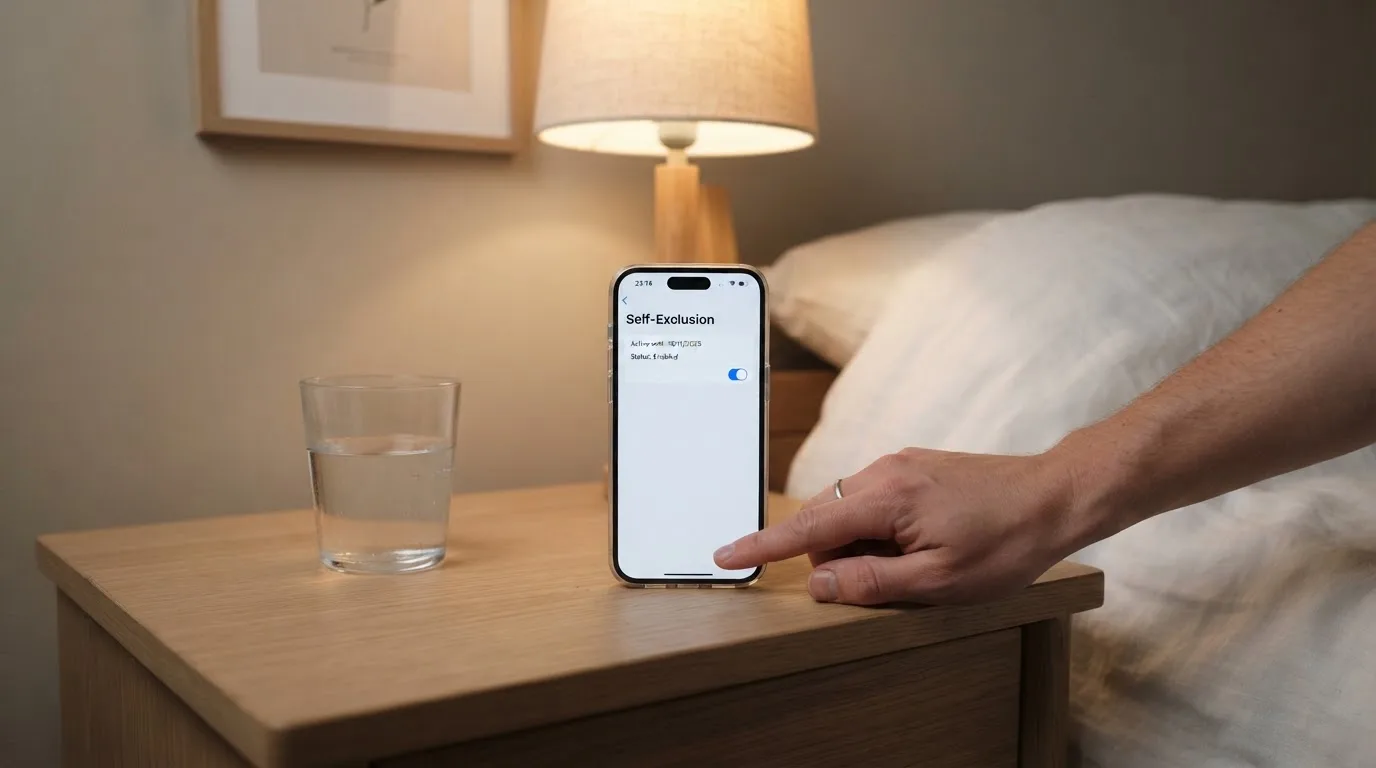
A credit card ban is a coarse tool. The finer ones are the operator-level obligations that bind every licensed brand regardless of how the account is funded, and they are the reason the responsible gaming question still belongs on a page about credit cards. The most-cited cluster of searches around this topic is the one asking how to get around GAMSTOP — non-GAMSTOP credit card casinos, casinos that take credit cards and are not on the self-exclusion register. None of those sites is licensed by the Gambling Commission. That is the answer in one sentence.

GAMSTOP itself has been a mandatory condition of every online licence since 31 March 2020. A player registers once, picks a period of six months, one year or five years, and cannot shorten it. Every Commission-licensed online operator must check the register before opening an account and refuse to do so if a match comes back. The check happens at sign-up, and it continues to happen on each login for the duration of the exclusion. A casino that takes deposits without performing the check is breaking its licence conditions; a casino outside the system simply is not licensed. The two cases are not the same, but from the player’s chair the result is identical — no protection if self-exclusion was the reason for opening an account.
The other obligations worth knowing in this context have dates attached and they cluster in the last two years. Online slots carry a maximum stake per game cycle — £5 for players aged 25 and over from 9 April 2025, and £2 for 18-24-year-olds from 21 May 2025. Auto-play has been banned since 31 October 2021, a slot spin may not be faster than 2.5 seconds, and losses disguised as wins are banned. Operators must prompt a customer to set a financial limit before the first deposit, in force from 31 October 2025. Financial vulnerability checks run at £150 net deposits in a rolling 30-day window using public data only, in force from 28 February 2025. The wider financial risk assessments have been announced but are not yet in force. None of these is about credit cards specifically; all of them apply to every account at every licensed brand on this page.
Identity verification sits in the same family. Since 7 May 2019, name, address and date of birth must be verified before the first deposit or any play. Anonymous play is not possible at a Commission-licensed site, regardless of the funding method. The check is what links a deposit method to a person, and it is the reason a credit card in someone else’s name, a spouse’s card, a work card, will not work even if a casino were willing to process it. The card is checked against the account holder at the funding stage as well.
Help is available and it is free. GamCare runs the National Gambling Helpline; GambleAware funds treatment and research. Both are signposted from every licensed operator’s responsible gambling page, alongside the GAMSTOP registration route. A player who has self-excluded and is looking for a way back into gambling has more options than the marketing suggests — Gamban blocks software-level access to gambling sites, and most banks now offer their own gambling transaction blocks at the card level. The bank-side blocks are the next shelf down.
Payments and payout speed: where the card stops and the alternative starts
The licensed operator is the first hurdle. The bank is the second, and on credit cards it is often the decisive one. HSBC declines credit card payments it identifies as gambling based on the merchant category assigned by Mastercard or Visa, and the restriction applies to all HSBC credit cards with no option to remove it. HSBC also states it cannot guarantee every gambling transaction will be blocked and customers remain liable for any that go through — a sentence that should be read in full, because it makes clear the block is the bank’s defence, not the customer’s. A debit card from the same bank is a different product line and a different decision.
Monzo was the first UK bank to introduce an in-app gambling block, launched in 2018. The block lets a customer choose a cooldown period from 2 days up to 1 year, during which the block cannot be switched off. Over 275,000 Monzo customers have activated the feature. Other banks followed: Starling, Revolut, and most of the high-street names now offer some variant, and the betting operators’ own pages carry the bank-by-bank run-down. The market has moved from a position where gambling blocks were a niche setting to one where they are a default for anyone who has ever asked the bank to help with their spending.
Apple Pay occupies an awkward middle. It launched on 20 October 2014 and began supporting UK-issued payment cards on 14 July 2015. The mechanism is tokenisation — the actual card number is replaced with a device-specific Device Primary Account Number and a dynamic security code is generated per transaction. In-store payments use near-field communication. The decision the bank makes when a card is tokenised for Apple Pay is the same decision the bank makes when the card itself is presented at a checkout: an HSBC credit card added to Apple Pay still cannot be used at a Commission-licensed casino, because the underlying funding source is unchanged. Debit cards tokenised through Apple Pay work in the usual way, subject to the same authentication — double-clicking the side button on a Face ID iPhone, double-clicking the Home button on Touch ID models.
AstroPay, a global digital wallet, illustrates the e-wallet end of the picture. Founded in 2009 and headquartered in Uruguay, AstroPay offers online payments, virtual and physical debit cards, and peer-to-peer transfers. Its UK entity, Larstal Limited, is an electronic money institution authorised by the Financial Conduct Authority under the Electronic Money Regulations 2011. AstroPay spun off its payment-processing business, dLocal, as a separate company in 2016. None of that history is the relevant fact on this page; what matters is the credit card funding test the Commission applies. A wallet that lets a UK customer top up with a credit card and then spend at a casino is not compliant. A wallet that refuses credit card top-ups outright, or restricts them at the merchant-category level, is. The brand on the wallet’s website does not tell you which side of that line it sits on; the small print on funding methods does.
For deposits that do go through — debit cards, bank transfers, approved e-wallets — credit is near-instant. A licensed casino credits a deposit made through any permitted method almost immediately, the delay usually being a payment-processor handshake rather than anything the casino controls. Withdrawals back out are a different story: the same settlement timetable applies regardless of funding method, typically minutes for e-wallets up to a few working days for cards and bank transfers, with the operator’s internal pending window on top. The pending window is the variable that actually decides how long a payout takes, and the funding method changes nothing about it.
The wagering requirement story has changed too. Since 19 December 2025 the cap on wagering requirements is 10x the bonus, and mixed-product bonuses — bet on sport, get casino spins — are banned. That cap interacts with credit card thinking in a particular way: the older marketing line that a deposit bonus is “free money” ran into a ceiling that fixes the upper bound of what a player has to turn over before withdrawing. A bonus with a 10x playthrough at £100, for instance, requires £1,000 of qualifying wagers, on which the house edge compounds at the game’s own RTP. The credit card question does not change that arithmetic, but the limits make the comparison easier to run.
How much turnover does a £100 bonus really take?
Worked against the 10x cap now in force, a £100 bonus carries £1,000 in required turnover — the bonus amount multiplied by the wagering factor. At a £1 stake per spin on a 96% RTP slot, that is 1,000 spins, and at five seconds per spin the seat time runs to roughly 83 minutes of continuous play. The house edge on a 96% slot is 4%, so the expected loss over those 1,000 spins is around £40, before any individual spin variance is accounted for. Read the 10x ceiling the other way: a £500 bonus demands £5,000 of turnover, the same 4% edge producing an expected loss of £200, and the time on the machine moves into the eight-hour band. The point of the cap is not to make bonuses cheap — the house edge is still the house edge — but to bound the multiplier that older offers could climb to. Above 10x the player is no longer clearing a bonus; they are working a second job at the casino’s marginal product. Below it, the same arithmetic produces a cost a player can price before signing up. The figure changes with stake size and RTP, but the band the regulator drew is fixed, and it is the only number on the page that stays the same whatever casino you walk into.
The operator comparison
The register has 139 active remote casino licence holders. The ten below are a representative slice — not a ranking, not a recommendation, and the order is the order the research handed them in, not a quality judgement. Every one of them is bound by the same prohibitions, the same identity checks, the same GAMSTOP requirement and the same financial vulnerability prompts. The comparison is about what each does with that common ground.
| Brand | Licence holder | GB remote casino licence | Domain status on the register | Subject support |
|---|---|---|---|---|
| Betfair | PPB Games Limited (account 39411) | 039411-R-319335-010 | Active | — |
| kwiff | Eaton Gate Gaming Limited (account 44448) | 044448-R-323408-017 | Active | — |
| 888casino | 888 UK Limited (account 39028) | 039028-R-319297-014 | Active | — |
| Grosvenor Casinos | Rank Interactive (Gibraltar) Limited (account 57924) | 057924-R-334666-005 | Active | — |
| Gala Bingo | LC International Limited (account 54743) | 054743-R-330863-014 | Active | — |
| Virgin Games | Gamesys Operations Limited (account 38905) | 038905-R-319430-022 | White Label | — |
| PokerStars | Stars Interactive Limited (account 39108) | 039108-R-319334-026 | Active | — |
| 32Red | Platinum Gaming Limited (account 45322) | 045322-R-324275-019 | Active | — |
| bet365 | Hillside (UK Gaming) ENC (account 55149) | 055149-R-331499-004 | Active | — |
| MrQ | Tek Fox Ltd (account 60629) | 060629-R-337532-004 | Active | — |
The “subject support” column is empty for every row, and that emptiness is the page. The register confirms a licence; it does not confirm a payment method. None of these operators advertises credit card deposits, none of them processes them, and the register does not record that distinction because the distinction is enforced by statute rather than by licence condition. A blank cell here is not a missing fact; it is the fact.
Betfair
PPB Games Limited holds the licence, account 39411, and Betfair is listed as an active domain. The Paddy Power Betfair group runs both the sportsbook and casino products off this licence account, with the same identity verification applying to either. The credit card position is the standard one: not accepted, no exception for tokenised cards, e-wallet funding gated by the wallet’s own credit card policy. Where Betfair earns its place in the comparison is the depth of the in-play product and the long history of the brand — the Paddy Power and Betfair merger predates the credit card ban by years, and the combined trading infrastructure is the reason the casino product sits beside a deep sportsbook rather than standing alone.
kwiff
Eaton Gate Gaming Limited, account 44448, with Kwiff.com listed as active. Kwiff is the newer name in the set, and the comparison it offers is product rather than licence: a smaller game library wrapped in a distinctive “surprise bet” mechanic on the sports side, with the casino running as a complement. The credit card story is the same as every other row, and the brand-specific reason to read the small print is the bonus structure, which on a smaller licensee can change more often than the market leaders’.
888casino
888 UK Limited, account 39028, active domain. The 888 group is one of the longer-established online casino names and operates its own proprietary platform on the casino side, alongside third-party content. The licence predates the credit card ban, and the operating company has been through its own regulatory history in other jurisdictions; what matters for this page is that the GB licence is current and the brand is on the register as an active domain. The credit card prohibition applies in the usual way, with the e-wallet carve-out interpreted by 888’s payments team in line with the Commission’s wording.
Grosvenor Casinos
Rank Interactive (Gibraltar) Limited, account 57924, active domain. Grosvenor’s claim is the high-street casino estate behind it — a UK land-based presence with the online product running off the same brand recognition. The credit card question resolves the same way at Grosvenor as at the others, but the cross-channel nature of the account (online balance tied to a land-based loyalty programme in many cases) is worth flagging, because the GAMSTOP exclusion applies online regardless of any land-based membership.
Gala Bingo
LC International Limited, account 54743, active domain. LC International also holds the licences for Ladbrokes and Coral, and the three brands share a payments and verification stack. A player who already has an LC International account under one brand will find the others faster to set up than a first-time customer would; a player with a GAMSTOP exclusion will find all three closed. The credit card position is shared too, and the bingo product carries the same stake limits as slots — £5 for 25 and over, £2 for 18-24.
Virgin Games
Gamesys Operations Limited, account 38905, listed as a white-label domain. The white-label status is the relevant detail: Virgin Games trades on Gamesys’s licence rather than holding its own, which means the responsible gambling infrastructure, payments and identity verification all run through Gamesys. A player excluded via GAMSTOP on one Gamesys-licensed brand is excluded across them; a credit card deposit attempt on any of them fails for the same statutory reason. The Virgin brand brings the recognition, the licence is Gamesys’s.
PokerStars
Stars Interactive Limited, account 39108, active domain. The Stars group runs the poker and casino products from this account, with the .uk domain reflecting the post-Brexit UK-specific operation. The poker product brings a player pool consideration that does not apply to the others; the credit card question does not, and the casino side of the platform operates under the same prohibitions as every other row.
32Red
Platinum Gaming Limited, account 45322, active domain. 32Red is a casino-first brand within the Kindred group, with the licence account dedicated to the casino product. The credit card story is the market-standard one, and the brand-specific angle is the sportsbook’s absence — players who want casino and sports under one roof will go elsewhere, players who want a casino-focused product will find the depth here.
bet365
Hillside (UK Gaming) ENC, account 55149, active domain. The largest single name in the comparison by both customer base and product breadth. The credit card question does not move at scale — what scale does move is the rest of the payments stack: bet365 has been at the front of the queue for new payment methods precisely because the volume justifies the integration work. The card position is unchanged regardless.
MrQ
Tek Fox Ltd, account 60629, active domain. MrQ is the smallest operation in the comparison by licence age and was set up specifically around a no-wagering bonus model, which interacts with the 19 December 2025 10x cap in a particular way: an offer that was already at zero wagering sits comfortably inside the ceiling, and the brand’s pitch is that the wagering mechanic does not apply to begin with. The credit card prohibition applies in the usual way; the distinctive bit is the bonus structure.
What this looks like at the desk
The register check is the first thing a player should do and it takes about two minutes. Open the Gambling Commission’s public register, type the brand name into the search box, confirm an account number that matches the one on the casino’s own footer, and read off the licence status. The status column on the register records Active, Inactive or White Label; the licence number takes the form account-R-number-suffix and the leading six digits repeat the licence holder’s account number. If the brand does not appear, walk away. If the brand appears but the licence is for a different domain, walk away. The CSV download on the register’s site is the same data in spreadsheet form and is the right reference for any cross-check involving more than one brand.
Once the licence is confirmed, the practical order at the casino is the one every licensed operator runs. Sign up with name, address and date of birth; complete the identity verification before the first deposit or any play; set a financial limit when prompted; deposit using a permitted method — debit card, bank transfer, approved e-wallet — and play within the slot stake ceilings that apply. The whole flow is the same at every brand in the comparison; the brand-specific differences are about game library, customer support and the size of the loyalty programme rather than anything in the regulatory layer.
The credit card attempt, where it happens, fails in one of three places. Most often the bank’s own gambling block rejects the transaction before the casino sees it — HSBC declines credit card gambling at the merchant-category level, Monzo’s block covers a customer-set period from 2 days to 1 year, and the other major names have analogues. Where the bank does not block, the casino’s payment processor refuses the transaction once it sees a credit card funding source. Where the funding is routed through an e-wallet that has not demonstrably blocked credit card top-ups to gambling, the merchant-of-record policy catches it. Three layers, three different companies, the same outcome.
A player who wants to use a card and has been declined should treat the decline as a feature rather than a fault. The bank is doing what the regulator asked of it; the casino is doing what its licence requires; the e-wallet is doing what its own compliance team has signed off on. The fastest route to a working deposit at this point is a debit card, or a bank transfer from an account that does not carry a gambling block. The slowest route is arguing with any of the three layers.
Where the offshore option sits
The unregistered site is the elephant on every page about UK gambling, and the credit card question is where it shows up most often. Unlicensed brands appear in search results alongside licensed ones, and the marketing reaches players that the licensed sites have excluded. None of those brands is on the Gambling Commission’s register; none of them runs GAMSTOP; none of them is bound by the 10x wagering cap; none of them applies the £5 and £2 stake ceilings; none of them offers the Commission complaints route. Some of them take credit card deposits, because the credit card ban is a UK rule and the merchant is not in the UK. That is the only sense in which a “UK credit card casino” exists as a working category — the casino is not in the UK, the player is.
The Commission can disrupt these sites — cease-and-desist notices, search-engine delisting, payment and hosting referrals — but it cannot block them at the ISP level. What it cannot do is refund a player who has lost money on one. Section 33 of the 2005 Act makes the providing of unlicensed gambling to people in Great Britain an offence; it does not make the playing of it one. There is no penalty on the player, only on the operator, and the operator is in a jurisdiction the Commission does not reach. The dispute resolution route that exists at a licensed site — the approved ADR provider — does not exist at an unlicensed one. A chargeback through the card issuer is sometimes possible and is sometimes the only practical recourse.
The honest framing is this: the bank-side and operator-side blocks are doing the work the ban itself set out to do. A player who has set a gambling block at the bank, who has registered with GAMSTOP, and who is using a licensed casino cannot reach a credit card deposit through any of the three layers. A player who wants to reach one has, by the time they have navigated around those three layers, also navigated around the consumer protections those layers are designed to enforce. The unlicensed site is a different product, not a more permissive version of the same one.
The wording that has changed
The marketing language around bonuses has shifted in the last two years and the shift is what makes the 10x cap legible. “Free spins” used to mean a no-deposit batch attached to a deposit bonus with a 35x playthrough, the kind of structure that put a player’s expected loss well above the bonus value before the wagering cleared. “Free bet” carried similar terms. The 19 December 2025 cap closed the upper end of that game: a bonus with a 10x wagering requirement is a bonus with a defined ceiling, and the defined ceiling is the one the worked example above uses. Offers that claim to remove all risk have shifted in line with these rules — the cap on wagering is also a cap on how any bonus can be structured, because any bonus with a wagering requirement above 10x is no longer a permissible bonus at all.
The wagering requirement cap does not change the house edge. A 96% RTP slot with a £1 stake still takes 4% in expectation over 1,000 spins, and the 10x cap does not bring that figure down. What it changes is the multiplier on the bonus itself, and the multiplier is what turns a marketing offer into a price. Above 10x, the price is hidden by the size of the multiplier. Below it, the price is visible, and the player can compare two bonuses the way they would compare two Annual Percentage Rates.
The earlier framing of this page returns at the close: the comparison between licensed brands is not about which one takes a credit card, because none of them does. It is about the rest of the package — the game library, the support operation, the loyalty programme, the brand’s track record with complaint volumes — and the wagering cap is what makes that comparison easier to run. A player who reads the small print on a 10x offer can compare it to another 10x offer on the same terms; a player who read the small print under a 50x cap was comparing two offers on terms neither of them made explicit.
Frequently asked questions
Is it legal for a licensed UK casino to accept credit card?
No. The Gambling Commission banned credit card gambling from 14 April 2020 across all forms of remote gambling and non-remote betting, with a narrow carve-out for face-to-face lotteries. A Commission-licensed online casino cannot legally process a credit card deposit, and any brand offering to do so is either unlicensed or breaking its licence conditions.
Is there a minimum deposit when paying with credit card?
The credit card question does not reach the minimum deposit, because the credit card deposit does not happen. At a licensed UK casino the minimum deposit for debit cards, bank transfers or approved e-wallets is set by the operator and is usually £5 or £10. The deposit ceiling is the player’s own financial limit, set at sign-up and adjustable afterwards subject to a cool-down.
How long does a credit card deposit take to show up in my account?
A deposit that goes through — debit card, bank transfer or compliant e-wallet — typically credits within seconds, the delay being the payment processor’s authorisation handshake rather than anything on the casino’s side. Withdrawals back out follow the same settlement timetable as the funding method, usually minutes for e-wallets and up to a few working days for cards and bank transfers on top of any operator pending window.
Do I need to verify my identity before depositing with credit card?
Identity verification is required before the first deposit or any play at a Commission-licensed casino regardless of funding method, in force since 7 May 2019. Name, address and date of birth are checked against documents and against public data, and the check is the reason a card in someone else’s name will not work even at a casino that were willing to process it.
Does GAMSTOP self-exclusion cover an account funded with credit card?
Yes. GAMSTOP is a mandatory condition of every online licence since 31 March 2020 and applies to every Commission-licensed account regardless of how it is funded. A self-exclusion period of six months, one year or five years cannot be shortened, and every licensed operator checks the register before opening an account and at each subsequent login.
Are there any fees for depositing with credit card?
The question does not arise at a licensed UK casino, which cannot accept credit card deposits at all. Banks may apply their own charges where a transaction is processed and later identified as gambling; HSBC’s policy, for instance, is to decline such transactions outright rather than to fee them.
Published by the quickpayoutcasinouk team.