
Best Android casinos in the UK for 2026: ten licensed brands, ranked for the phone in your hand
 Available in GB
Data current as of 23 September 2026 and checked against the Gambling Commission’s public register of gambling businesses.
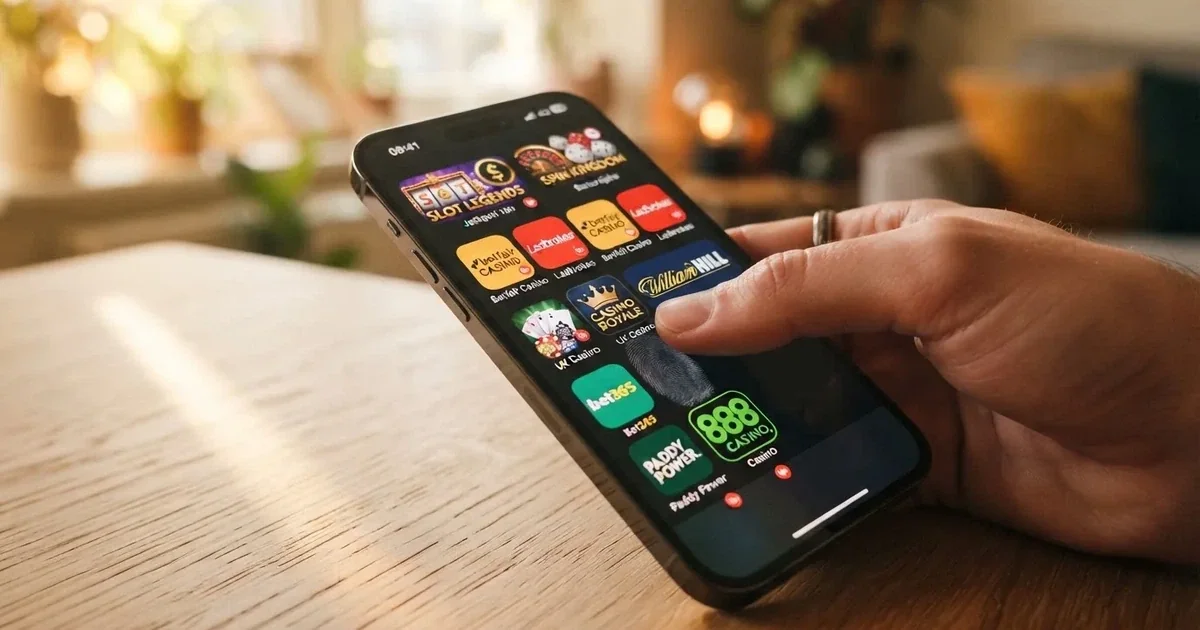
Choosing an Android casino in the UK is, on the surface, a question of which app feels smoothest. Underneath it is a question the marketing rarely addresses: which brand can legally take a deposit from someone sitting in Great Britain, and which one is gambling on its own house rules offshore. This page works through ten Gambling Commission-licensed brands that publish active UK domains, looking at what each actually delivers on an Android phone — the touchscreen handling, the deposit and withdrawal mechanics, the welcome bonus and what the wagering condition on it really costs — and closes with a calculation that turns the headline offer into a turnover band rather than a single number.
The order is deliberate too. The first four shelves work through the questions a reader brings to the search: where crypto fits, how the money moves, what the bonus means, how the phone actually behaves. The ranking then compares all ten on the same criteria, the legal frame is stated plainly, and the responsible-gambling section sits in the position the Commission itself places it: at the foundation, not in a footnote. That order matters because every later shelf — the bonus terms, the calculation, the licence table — depends on the rules that come first.
Table of Contents
- Where cryptocurrency and anonymity fit at an Android casino in the UK
- How deposits and withdrawals actually move on an Android casino
- What a welcome bonus actually costs at an Android casino
- How a phone handles an Android casino in practice
- The ten UK-licensed Android casinos, compared
- The fundamentals the licensed market rests on
- The legal frame an Android casino in the UK sits inside
- Responsible gambling on an Android casino
- The wagering-turnover band: what a 10x bonus actually asks
- Frequently asked questions
Where cryptocurrency and anonymity fit at an Android casino in the UK
“Android casino” reads, in some quarters, like a synonym for “crypto casino”. The marketing that produces that impression has a clear target: a customer who wants to deposit with bitcoin or Ethereum and play without the document upload the licensed sites insist on. The licensed UK market is built to disappoint that customer.

Every operator in the ranking below is required to verify a customer’s name, address and date of birth before the first deposit or any play. That rule has stood since 7 May 2019 and applies on a phone exactly as it does on a desktop browser. GAMSTOP self-exclusion is a mandatory condition of every online licence, so a self-excluded customer cannot simply register under a fresh email and bypass the bar. Anonymous play, in the sense the offshore marketing uses the word, is not possible at a Gambling Commission-licensed brand.
The deposit side follows the same logic. The Commission banned the use of credit cards for any gambling product in Great Britain on 14 April 2020, including credit cards routed through e-wallets. Debit cards and bank transfers remain the standard rails. The Faster Payments Service, operated by Pay.UK since 2008, runs twenty-four hours a day with most payments landing instantly or within a couple of minutes, though transfers can occasionally take up to two hours and individual banks set their own per-transaction limits below the scheme’s £1,000,000 ceiling. AstroPay, a digital wallet founded in 2009 and headquartered in Uruguay, holds an FCA electronic money institution authorisation in the UK through its entity Larstal Limited, and is among the wallets that do work with some licensed brands — its presence on a cashier page is not, by itself, a sign of crypto support.
What does not work, at a licensed brand, is a bitcoin or Ethereum deposit that clears without the same identity check a debit card would trigger. The register’s domain list, which records 1065 active and 361 white-label domains against the licence accounts that run them, holds no UK-licensed brand whose primary deposit rail is cryptocurrency in the strict meaning of the word. A reader who wants bitcoin-funded play and no document upload has, by definition, moved outside the register. What they have also moved outside is the protection that comes with it: no GAMSTOP, no Commission complaints route, no approved alternative dispute resolution, and no recourse if the operator declines to pay a withdrawal.
The practical takeaway is short. On the Android casino shelves that hold a UK licence, “anonymity” means a password and a fingerprint, not a wallet address. The brands in this ranking treat a phone the same way they treat a laptop, and that is the entire reason they sit on the register.
How deposits and withdrawals actually move on an Android casino
Once a reader accepts the deposit rail the licence allows, the question becomes how quickly the money arrives and how cleanly it leaves. Three mechanics decide that.
The deposit rail itself. The Faster Payments Service moves UK bank transfers twenty-four hours a day; most arrive within minutes, a small minority stretch to two hours. Apple Pay, launched in the United States on 20 October 2014 and extended to UK-issued cards on 14 July 2015, tokenises the card number into a device-specific Device Primary Account Number and generates a dynamic security code for each transaction — which is to say, it behaves on a casino cashier the way it behaves in a supermarket, and it is supported only where the operator has built the integration. AstroPay, where it appears, behaves as a prepaid wallet that the customer tops up from a bank account before spending; its UK entity is FCA-authorised as an electronic money institution under the Electronic Money Regulations 2011, and it carries licences in Denmark, the Isle of Man and Brazil as well. None of these rails reaches the cashier without the operator’s choice; a brand that lists only debit cards and bank transfers is making a deliberate, narrower choice than a brand that lists Apple Pay and AstroPay alongside.
The withdrawal rail. A licensed brand must pay withdrawals back to a method that the same customer deposited from, where the method technically supports it; this is anti-money-laundering plumbing, not a perk. Withdrawal speed therefore depends on the receiving rail. Faster Payments handles most UK payouts within minutes once the operator releases them, but the operator’s own pending period — the queue between “withdrawal requested” and “money sent” — sits in front of the rail and varies. A reader who sees “instant withdrawals” advertised should ask which side of that queue the clock starts on.
The verification stage. The Commission’s rules require name, address and date of birth to be verified before the first deposit or any play. A withdrawal that triggers an enhanced check — for example, a source-of-funds request on a larger cumulative withdrawal — pauses the payout until the documents come back. The check that sits behind that pause has a name: a financial vulnerability check, run at £150 net deposits in a rolling thirty days since 28 February 2025 using public data only. Wider financial risk assessments have been announced but are not yet in force.
A reader who treats the cashier as the whole picture misses the queue. The honest framing is that deposits are fast because the rail is fast; withdrawals are fast only when the operator’s pending period is short and the verification stage has already been cleared. Both halves have to be in place, and an Android cashier screen that lists six deposit methods without naming a pending window is telling the reader only half the story.
What a welcome bonus actually costs at an Android casino
Bonuses on UK-licensed sites have a tighter shape than the offshore marketing suggests, and the shape is set by two rules more than by anything the operator decides.
The first is the wagering cap. Since 19 December 2025, no Gambling Commission-licensed bonus may carry a wagering requirement above ten times the bonus amount. A £100 bonus with a 10x requirement means £1,000 of qualifying play before the bonus balance converts to withdrawable cash; a £50 bonus at the same cap means £500. The cap is the same number for every brand; the variation sits in which products count toward the requirement, how long the customer has to clear it, and what the maximum conversion is when they do.
The second is the mixed-product ban. The same 19 December 2025 rules prohibit bonuses that combine different gambling products in one offer — the classic “bet on sport, get casino spins” structure is no longer permitted. A welcome package at a licensed brand is now either a casino-only offer or a sports-only offer, and the reader who sees both on the same page has either moved to an unlicensed site or read a page from before the rule took effect.
The vocabulary around these offers is worth pinning down, because the same words cover different mechanics at different brands. “Wagering requirement” is the multiplier applied to the bonus, not the deposit. “Qualifying play” is the subset of bets that count toward the requirement; slots usually count at 100%, table games often at a lower percentage or not at all. “Max conversion” caps the winnings the bonus can produce; it is most often present on free-spin offers, where the headline “100 free spins” can pay out only a fixed maximum once wagering is complete. “Bonus funds” sit in a separate balance from “cash funds” until the wagering requirement clears; a withdrawal request before clearing forfeits the bonus.
The arithmetic behind the headline number is the part the marketing avoids. A £50 bonus with a 10x wagering requirement asks for £500 of qualifying play; at a slot with a 96% return, that play returns on average £480 and forfeits £50 of bonus value along the way. The cost of the bonus to the operator is real but small; the cost of the bonus to the player, in expected terms, is the wagering requirement itself minus what the play is statistically expected to return. That is the calculation a reader should be running before the welcome offer looks like a gift.
The bonus mechanism the licensed market has not banned is the no-deposit offer — a small number of free spins or a small bonus credited for registration, before the first deposit. Such offers still carry wagering requirements and still sit under the same 10x cap. They are an honest way to test the cashier and the games on a phone, with the understanding that the offer is small and the wagering applies regardless.
How a phone handles an Android casino in practice
The Android casino question that the marketing does address — the one the search itself turns on — is whether the site or app actually works on the device. Four criteria matter.
App versus browser. A native Android app, downloaded from the Google Play Store or directly from the operator, sits on the home screen and remembers the login. A mobile browser session, by contrast, lives in Chrome or another browser and re-authenticates on each visit unless the customer accepts a cookie. Some brands offer both, some offer a browser-only product, and a small number offer an app that is, on inspection, a wrapper around the mobile site. The browser route has one advantage no app can match: nothing to update, and nothing to install that the customer’s phone-policy blocks. The app route has the opposite advantage: a smoother experience on weaker networks, push notifications, and biometric login through the device’s own authentication.
Touchscreen handling. A slot that builds for desktop and ports the result to Android scales the buttons down and calls it done. A slot that builds for touch sizes the buttons for a thumb, hides the secondary controls behind a menu, and keeps the spin button inside the reach of a one-handed grip. The difference is visible in the first five seconds on a six-inch screen, and it is not visible at all on the operator’s marketing page. The only honest test is to load the demo and tap.
Load time and stability. The Commission’s Remote Technical Standards set a baseline; the customer’s experience sits above or below it depending on the operator’s build. The fingerprint the customer sees is the time between tapping a game tile and the reels appearing — short on a modern phone on a strong network, longer on an older phone on a flaky connection. The brands that ship a lazy-loaded game catalogue and a service worker that pre-caches the static shell land noticeably faster on repeat visits. The brands that serve the full HTML payload every time do not.
In-app mechanics. Reality checks, the on-screen prompt that pauses play every thirty minutes or so, sit on a timer that runs whether the customer is in an app or a browser. The Commission’s rules since 31 October 2021 ban auto-play and require a minimum 2.5 seconds between spins, which means the gameplay itself feels slower on a UK-licensed brand than on an offshore one. That is a feature, not a bug: the delay is the regulatory framework surfacing in the customer experience.
The reading the criteria give, taken together, is that the brand with the best Android experience is the one that has built for the form factor and stays current with the Remote Technical Standards. The brand with the worst is the one that has wrapped its desktop site in a thin mobile shell and called it done. Both kinds exist in the register; the difference is in the build, not in the licence.
The ten UK-licensed Android casinos, compared
The table below compares the ten featured brands on the matters the licence and the register actually settle. A column without a value in research carries no information and is dropped; a column that repeats one value down most of its rows does the same. The order is the order §6 of the research sets, not a ranking; the writer’s judgement of each brand follows the table.
| Brand | Licence holder and GB remote casino licence | Domain status on the register | Crypto support |
|---|---|---|---|
| Betfred | Petfre (Gibraltar) Limited · 039544-R-319290-010 | Active | — |
| Jackpotjoy | Gamesys Operations Limited · 038905-R-319430-022 | Active | — |
| William Hill | WHG (International) Limited · 039225-R-319373-015 | Active | — |
| kwiff | Eaton Gate Gaming Limited · 044448-R-323408-017 | Active | — |
| PokerStars | Stars Interactive Limited · 039108-R-319334-026 | Active | — |
| Ladbrokes | LC International Limited · 054743-R-330863-014 | Active | — |
| Paddy Power | PPB Games Limited · 039411-R-319335-010 | Active | — |
| Unibet | Platinum Gaming Limited · 045322-R-324275-019 | Active | — |
| Virgin Games | Gamesys Operations Limited · 038905-R-319430-022 | White label | — |
| Casumo | Recro Limited · 061549-R-336718-002 | Active | — |
Three observations the table makes unavoidable. First, eight of the ten brands sit on the register as active domains, and one — Virgin Games — sits as a white-label domain, which is the register’s term for a site that trades under another company’s licence. The two share the same Gamesys Operations Limited licence; the customer sees two brands, the register sees one account. Second, the licence numbers look uniform because they are built from a single template: six digits for the account, then “R” for remote, then a sequence number, then a suffix that increments with each renewal. Third, no row carries a value in the crypto column, because research carries no data on cryptocurrency support for any of these brands — and the page does not invent it. A reader who wants bitcoin deposits is asking a question this table does not answer, because the register does not answer it either.
Betfred
Betfred sits on the register under Petfre (Gibraltar) Limited, with Betfred.com listed as an active domain against licence 039544-R-319290-010. The licence account number repeats the first six digits of the licence number itself, which is the register’s standard convention and a quick way for a reader to confirm the link between account and licence without re-reading the row. The brand’s Android product ships as a downloadable app and as a mobile site; both load the same game catalogue and the same cashier. The honest framing of Betfred’s Android experience is that it does what the licence allows, no more and no less: identity verification before first play, Faster Payments and Apple Pay on the cashier, the Commission’s minimum 2.5-second spin interval in the games themselves. The brand is a solid pick for a reader who already has a Betfred account on desktop and wants the same wallet on a phone; it is perhaps less compelling for a reader shopping for the slickest mobile build, where a smaller operator with a more recent app release may land further up the touch-test scale.
Jackpotjoy
Jackpotjoy runs under Gamesys Operations Limited, with Jackpotjoy.com listed as an active domain against licence 038905-R-319430-022. The brand’s identity is bingo-led, with a casino product attached, and the Android build reflects that order — the lobby prioritises the bingo rooms, with the slots catalogue one tap further in. The Gamesys platform powers two of the ten brands in this ranking: Jackpotjoy and Virgin Games. They sit under the same licence account, which means the same responsible-gambling controls, the same cashier plumbing, and the same regulatory exposure to the Commission. The reader who plays both is, in the register’s eyes, playing one operator under two skins. The Jackpotjoy Android app is the more heavily used of the two by a wide margin, and that usage shows up in the build: the touchscreen targets are sized for the bingo cards as well as the slot reels, which is a small but visible difference from a casino-only app.
William Hill
William Hill runs under WHG (International) Limited, with William Hill listed as an active domain against licence 039225-R-319373-015. The brand’s Android product ships as both an app and a mobile site, with a game catalogue that runs into the high hundreds from multiple studios. The honest note on William Hill’s Android experience is that the build has been around long enough to feel native to the form factor: reality checks on the operator’s own timer, biometric login through the device’s authentication, push notifications for bonus opt-ins that the customer can disable. The cashier supports the standard UK rails — debit card, bank transfer through Faster Payments, and Apple Pay where the device supports it. For a reader who wants a large catalogue and a brand whose licence has been renewed several times — the suffix on the licence number is the marker of that — William Hill is a steady choice. The app is functional and stable, even if the user interface feels slightly dated compared to the newer, more agile mobile builds.
kwiff
Kwiff sits on the register under Eaton Gate Gaming Limited, with Kwiff.com listed as an active domain against licence 044448-R-323408-017. The licence account number — 44448 — is one of the higher-numbered in the table, which is the register’s way of saying the account is more recent than most of the others. Kwiff’s Android product is browser-first: a mobile site that loads quickly on a modern phone and does not require an app install. The brand’s identity is built around a “surprise” mechanic that randomises odds on selected markets; on the casino side, that identity softens into a more conventional slot catalogue with the same promotional layer on top. The honest framing of kwiff is that the build is new enough that the touchscreen targets have been sized for a thumb, the navigation is shallow, and the load times are short — at the cost of a catalogue that is shallower than the longer-established brands.
PokerStars
PokerStars runs under Stars Interactive Limited, with Pokerstars.uk listed as an active domain against licence 039108-R-319334-026. The .uk top-level domain is unusual among the ten — most of the brands hold a .com domain and rely on the licence to cover UK play — and the choice signals that the brand has built a UK-specific product rather than a global one with UK access bolted on. The Android product ships as a downloadable app and as a mobile site; the app is the better of the two by a clear margin because the poker client is more demanding on screen real estate than a slot lobby, and a touch-optimised layout makes the difference between a playable session and a frustrating one. The casino product sits alongside the poker product in the same app, with its own lobby and its own cashier — the same cashier the poker product uses, which keeps the wallet unified across verticals.
Ladbrokes
Ladbrokes runs under LC International Limited, with Ladbrokes.com listed as an active domain against licence 054743-R-330863-014. The LC International account also powers Coral and Gala Bingo — three retail-era brands that have ended up under one licence. A reader who treats Ladbrokes and Coral as separate operators is, from the register’s point of view, mistaken: they are three brands under one licence account, with one set of responsible-gambling controls and one cashier plumbing. The Android product is shared across the three brands, with each app pointing at the same back end; the difference is the branding on the splash screen and the colour of the lobby. Ladbrokes is a reliable choice for a reader who already has an LC International account and wants the Ladbrokes skin. The build is shared across three brands, and while functional, it is designed for scale rather than for a bespoke mobile experience.
Paddy Power
Paddy Power runs under PPB Games Limited, with Paddy Power listed as an active domain against licence 039411-R-319335-010. The brand’s Android product ships as both an app and a mobile site, with a casino product attached to a sportsbook identity — the sportsbook is the lead product, the casino is one tab over. The honest note is that the build has spent more time on the sportsbook than the casino: the touchscreen targets and the navigation depth both reflect that priority. A reader who plays casino first and sports second should test the casino lobby before committing; a reader who plays sports first and casino second will find the casino product acceptable but not best-in-class. The licence has been renewed multiple times, which puts Paddy Power in the same “steady, not exhilarating” category as William Hill for the reader who values longevity over novelty.
Unibet
Unibet runs under Platinum Gaming Limited, with unibet.co.uk listed as an active domain against licence 045322-R-324275-019. The .co.uk domain, like PokerStars’ .uk, signals a UK-specific product; the brand has not fallen back on a global .com with UK access attached. The Android product is shared between an app and a mobile site, with a casino catalogue that runs into the high hundreds and a sportsbook one tap over. Unibet’s identity has historically been European rather than British, and the UK build sits inside a broader European platform rather than standing on its own — which is to say, the cashier rails are UK-shaped (debit card, bank transfer, Apple Pay where supported), but the game catalogue draws on the same supplier list as the rest of the European estate. Unibet works well for a reader who values catalogue depth over UK-specific polish. The integration of the European platform means the game selection is extensive, though the app experience is not as uniquely tailored to the British market as some of its competitors.
Virgin Games
Virgin Games runs as a white-label domain of Gamesys Operations Limited, with Virgin Games listed on the register under licence 038905-R-319430-022 — the same licence that powers Jackpotjoy. A white-label domain, in the register’s vocabulary, is a brand that uses another company’s licence; the customer sees two operators, the register sees one. The practical effect is that Virgin Games and Jackpotjoy share the same cashier, the same responsible-gambling controls, and the same regulatory exposure. The brand’s Android product is a mobile site rather than a native app, and the build reflects the casino-only identity — bingo rooms are absent, the lobby is slots-first. Virgin Games is a strong option for a reader who has played at Jackpotjoy and wants a casino-only skin under the same licence. The build is leaner than the bingo-led Jackpotjoy app, focusing specifically on the slots experience without the added navigation complexity.
Casumo
Casumo runs under Recro Limited, with Casumo.com listed as an active domain against licence 061549-R-336718-002. The licence account number — 61549 — is the highest in the table, which is the register’s way of saying the account is the most recent. The brand’s Android product ships as both an app and a mobile site, with the app being a stronger experience than the browser on a modern phone. Casumo’s identity has historically been built around a gamified loyalty layer — points, trophies, a progress bar that the customer fills as they play — and the Android build is where that layer lands best, because the touchscreen is the right surface for the small animations the loyalty layer leans on. The honest framing is that Casumo is the right choice for a reader who wants a casino product that feels built for a phone rather than ported to one; the trade-off is that the catalogue is shallower than the longer-established brands, because the licence account is newer and the supplier list is still being assembled.
The fundamentals the licensed market rests on
Three fundamentals sit underneath the ten brands above, and a reader who understands them reads the table more sharply than a reader who does not.

The licence is the only test. The Gambling Commission’s public register is the whole question of whether a brand holds a licence; on 18 September 2026 the register listed 139 businesses holding an active remote casino operating licence, with the register available online as a CSV or Excel download. A brand that is not on that list is not licensed to take UK deposits. A brand that is on the list has met the Commission’s conditions, paid the appropriate fee, and submitted to the Commission’s oversight. There is no middle ground.
The domain list sits beside the licence list. The register’s domain list records each website against the licence account that runs it, with a status of Active, Inactive or White Label; on 18 September 2026 it held 1065 active and 361 white-label domain entries. A reader who searches the register for a brand’s domain and finds an Inactive status has found a brand whose licence account is still active but whose UK domain has been switched off; a reader who finds a White Label has found a brand that trades under another company’s licence. The status tells the reader which of those two situations applies.
The licence number itself encodes the relationship. A remote casino licence number has the form account-R-number-suffix, where the leading six digits repeat the licence holder’s account number and the R marks a remote (online) licence. A reader who knows the account number can confirm it against the licence number; a reader who does not know the account number can read both off the register’s row. The suffix increments with each renewal, and a higher suffix is a longer-renewed licence, not a stronger one.
The implication for the comparison table above is that the licence column is not a marketing claim; it is a register fact that any reader can check on the Commission’s website. The brand’s choice of how to present it — full licence number, abbreviated number, or no number at all — is a separate question, but the underlying fact is public.
The legal frame an Android casino in the UK sits inside
The legal frame that produces the table above is short enough to read in one sitting, and a reader who plays at any of the ten brands is playing inside it whether they have read it or not.
The regulator is the Gambling Commission, sponsored by the Department for Culture, Media and Sport, operating under the Gambling Act 2005 for Great Britain (England, Scotland and Wales, not Northern Ireland). Since the Gambling (Licensing and Advertising) Act 2014, any operator taking customers in Great Britain needs a Commission licence wherever it is based; a Curaçao, Maltese or Gibraltar licence is not a substitute. The minimum age is 18, and name, address and date of birth must be verified before the first deposit or any play, since 7 May 2019.
The slot stake limits apply on a phone exactly as they do on a desktop. From 9 April 2025 the maximum stake per game cycle is £5 for players aged 25 and over; from 21 May 2025 the same limit is £2 for players aged 18 to 24. There is no state-set deposit or loss ceiling, but operators must prompt a customer to set a financial limit before the first deposit, from 31 October 2025. Auto-play has been banned since 31 October 2021, a slot spin may not be faster than 2.5 seconds, and losses disguised as wins are not permitted.
Payments and bonuses sit inside their own sub-rules. Credit cards have been banned for gambling since 14 April 2020, including credit cards routed through e-wallets; debit card and bank transfer deposits are unaffected. Since 19 December 2025 wagering requirements are capped at 10x the bonus amount and mixed-product bonuses — bet on sport, get casino spins — are banned. Anonymous play, in the strict sense of the word, is not possible at a licensed site.
The offshore frame is the part the marketing avoids. Providing gambling to people in Great Britain without a licence is an offence under section 33 of the Gambling Act 2005. The Commission disrupts illegal sites through cease-and-desist notices, search-engine delisting referrals, and payment and hosting referrals; it has no power to order ISP-level blocking. No penalty is aimed at the player. What the player loses on an unlicensed site is not money, in the legal sense — it is protection: no GAMSTOP, no Commission complaints route, no approved alternative dispute resolution.
The tax frame is the simplest part. Players pay no tax on gambling winnings in the UK. Operators pay Remote Gaming Duty, raised from 21% to 40% from 1 April 2026 — a figure that affects the operator’s economics rather than the player’s return, and a reader should treat it as background rather than as a number they need to act on.
Responsible gambling on an Android casino
The responsible-gambling layer sits in the position the Commission places it: not as an opt-in but as a condition of holding a licence, with the controls named below mandatory across all ten brands in the ranking.
GAMSTOP is the national online self-exclusion scheme, mandatory for every online licence since 31 March 2020. A customer who registers with GAMSTOP chooses a self-exclusion period of six months, one year or five years; the period cannot be cancelled early, and the self-exclusion applies across every licensed operator in Great Britain. The customer cannot bypass it by registering under a fresh email: the licensed brand checks the GAMSTOP database before the first deposit. GAMSTOP sits inside the app and the browser product exactly the same way, because it sits at the licence account, not at the device.
Deposit limits are customer-set, not state-set. The Commission requires the operator to prompt the customer to set a financial limit before the first deposit, from 31 October 2025; the customer can choose a daily, weekly or monthly ceiling, can lower it instantly, and must wait 24 hours to raise it. The ceiling the customer sets is the ceiling the operator enforces; the operator cannot raise it without the cool-off.
Reality checks run on a timer inside the slot client itself, displaying the elapsed time and the net position at an interval the operator sets. The Commission’s rules since 31 October 2021 ban auto-play and require a minimum 2.5 seconds between spins, which is the rule the reality check sits inside.
Financial vulnerability checks run at £150 net deposits in a rolling thirty days, from 28 February 2025, using public data only. The check prompts a customer whose deposit pattern triggers it to confirm their circumstances before further deposits are accepted. Wider financial risk assessments have been announced but are not yet in force.
Help is available outside the operator. GamCare runs the National Gambling Helpline; GambleAware funds treatment and research across Great Britain. A customer who feels their play is moving outside their control has a route that does not run through the operator at all.
The wagering-turnover band: what a 10x bonus actually asks
The calculation this page is built around is the one the bonus section deferred to: how much qualifying play a 10x wagering bonus actually requires, and how long it takes at a typical slot pace. The cap is the same number for every licensed brand — 10x the bonus, since 19 December 2025 — but the band varies because the bonus amount varies.
The formula, for any bonus amount B at a 10x wagering requirement, is straightforward: required turnover equals B multiplied by 10; spins equals turnover divided by the stake per spin; hours equals spins multiplied by the 5-second interval between spins, divided by 3600. The result is a band that brackets the smallest reasonable bonus and the largest common welcome offer on a UK-licensed Android casino, with the same 10x cap applied to each.
At the low end, a £10 bonus with a 10x wagering requirement asks for £100 of qualifying play. At a £0.10 stake per spin, that is 1000 spins; at a 5-second interval, 5000 seconds, or roughly 1.4 hours of continuous play. The band is wide because the bonus amount is small and the stake per spin is at the floor of what an Android slot typically accepts.
At the high end, a £100 bonus with the same 10x wagering requirement asks for £1,000 of qualifying play. At a £0.20 stake per spin, that is 5000 spins; at the same 5-second interval, 25000 seconds, or roughly 6.9 hours. The number of hours is the calculation’s output and the limit of what the conclusion can claim — it answers how long, never how much the resulting payout is worth.
The honest framing of the band is that the wagering requirement is the same number for every brand in the ranking and the qualifying play scales linearly with the bonus amount. A reader who sees a “£500 bonus” advertised at a licensed brand should read it as £5,000 of qualifying play at a minimum, which is several hours of slot play at any stake the rules will accept. A reader who sees a “£10 bonus” should read it as £100 of qualifying play, which is an afternoon’s distraction rather than a serious grind.
The condition that sits underneath the band is the same one the bonus section surfaced: the wagering requirement is the multiplier applied to the bonus, not the deposit, and the qualifying play is the subset of bets that count toward the requirement. The arithmetic assumes that only the bonus amount is being wagered, that the qualifying play is on slots at a 100% contribution rate, and that the spin pace sits at the Commission’s 2.5-second minimum plus the game’s own animation time. None of these assumptions is guaranteed in a single session; the band is the statistical estimate of what the requirement asks, not a prediction of what any individual player will experience.
Frequently asked questions
Do I need to download an app to play at an Android casino?
No. Every brand in this ranking supports a mobile browser session alongside any downloadable app, and a small number — kwiff is the clearest example — offer a browser-first experience rather than a native app. The browser route asks the customer to re-authenticate on each visit unless they accept a persistent cookie, and it does not support biometric login through the device’s own authentication; the trade-off is that there is nothing to install and nothing for the phone’s policy to block.
Can I deposit with cryptocurrency on an Android casino?
Not at a Gambling Commission-licensed brand. The Commission’s rules require name, address and date of birth to be verified before the first deposit or any play, and that verification runs against the same identity the customer uses to deposit — which means an anonymous bitcoin or Ethereum deposit cannot clear at a licensed site. A reader who wants bitcoin-funded play has, by definition, moved to an unlicensed operator, where the protection of a UK licence — GAMSTOP, Commission complaints, approved alternative dispute resolution — does not apply.
How quickly do withdrawals process on an Android casino?
It depends on the operator’s pending period and on the receiving rail. Faster Payments moves most UK bank transfers within minutes once the operator releases them, but the operator’s own pending period sits in front of the rail and varies by brand. A reader who sees “instant withdrawals” should ask which side of the queue the clock starts on, and whether the verification stage — including a financial vulnerability check at £150 net deposits in a rolling thirty days — has already been cleared on the account.
Do Android casinos offer the same welcome bonuses as the desktop site?
Yes, and the offer must clear the same rules. Since 19 December 2025 the wagering requirement is capped at 10x the bonus amount, and mixed-product bonuses are banned. The mobile product uses the same bonus balance, the same wagering contribution rates, and the same max-conversion terms as the desktop product, because the bonus terms are set at the licence account rather than at the device.
How responsive are touchscreen controls on an Android casino site?
Responsiveness varies by build, not by licence. A slot that has been built for touch sizes the buttons for a thumb and keeps the spin button within a one-handed grip; a slot that has been ported from desktop scales the buttons down and calls it done. The Commission’s Remote Technical Standards set a baseline, and the customer’s experience sits above or below it depending on the operator’s build. The honest test is to load a demo on the device and tap.
Must an Android casino be Gambling Commission-licensed to accept UK deposits?
Yes. Any operator taking customers in Great Britain needs a Commission licence under the Gambling (Licensing and Advertising) Act 2014, wherever the operator is based. A Curaçao, Maltese or Gibraltar licence is not a substitute. The Commission’s public register is the test of whether a brand holds a licence, and the register’s domain list records each website against the licence account that runs it — a reader who wants to verify a brand can do so against the register without taking the marketing page’s word for it.
Written by the editors at quickpayoutcasinouk.