
Online craps at UK-licensed casinos: who offers it, what it costs, and how the rules actually bite
 Available in GB
A handful of UK-licensed casinos carry craps. Most of the bigger brands don’t. That gap is the whole reason this page exists — not to advertise any of the operators named in it, but to lay out who is on the Gambling Commission’s register, who among them has a live or digital craps table worth a bettor’s time, and what the bonus terms and stake rules look like once a reader has narrowed the list down. The page treats craps itself as information: the bets, the house edge, the bet types a UK player meets at an online table. It is not a place to be talked into signing up anywhere.
Data current as of 23 September 2026, checked against the Gambling Commission’s public register of gambling businesses.
Table of Contents
- Crypto and anonymity: what the payment method does — and what the licence overrides
- Bonus terms on craps at UK casinos: how the £10x cap reshapes the picture
- Mobile and apps: how craps travels to a phone
- Live craps, RNG craps and the studios that run them
- The ten UK-licensed casinos: licence, domain, and where each one stands
- Online craps in the UK: what the licence does and doesn’t cover
- Safer gambling around online craps: what the licence obliges the operator to do
- How to read the £10x wagering cap in practice
- Reading the craps table itself: bets, edges and the layout a UK player meets
- What this page is, and what it isn’t
- Frequently asked questions
Crypto and anonymity: what the payment method does — and what the licence overrides
Crypto-friendly marketing is loud. The licence is quiet, and it wins. A casino that takes Bitcoin or Ethereum from a UK customer still needs a Gambling Commission licence to take that deposit legally, and the licence imposes identity checks before the first deposit regardless of how the money arrives. There is no anonymous path to a craps table at a UK-licensed site, and there is no licensed site that ships craps specifically because of how a player pays.
The £10x cap on bonus wagering, in force since 19 December 2025, applies to any bonus a UK player is offered — crypto-funded welcome offers included. Credit cards have been banned for gambling since 14 April 2020, and that ban covers credit-card-funded e-wallet deposits too. A player holding a Bitcoin balance in a non-UK exchange cannot route it through a credit card to a UK licensee; the card is barred before the chain even matters.
What “crypto-friendly” means at a UK-licensed site, then, is narrower than the headline suggests. It means the cashier accepts a coin or token alongside debit cards and bank transfers, runs source-of-funds checks in line with anti-money-laundering rules, and verifies name, address and date of birth before any first deposit. The craps table it leads to is the same table a debit-card player sees. The only choice the payment method changes is which rail the deposit uses.
The brands named further down this page are the licence holders the register lists as running an active or white-label UK domain. None of them is on this page because it accepts a particular coin. They are on it because it holds the licence that makes taking UK depositors lawful, and the craps question follows from that.
Bonus terms on craps at UK casinos: how the £10x cap reshapes the picture
Bonuses tied to craps at UK-licensed casinos have to clear the £10x wagering cap that took effect on 19 December 2025. The cap is on the multiplier applied to a bonus before it becomes withdrawable cash, not on the cash a player puts in. A £100 bonus now requires £1,000 of qualifying play at most, before any game-weighting rules are layered on top. The pre-cap market ran to 35x and 50x on comparable offers, so the change matters in pounds, not just in headline.

Two structural points shape how that plays out on a craps table specifically.
First, craps is a table game, and most UK-licensed sites weight table games below 100% for wagering purposes. A £1 slot spin typically counts in full; a £1 craps Pass Line bet may count at 20% or less, or not at all, depending on the operator’s terms. The £10x cap is a ceiling, not a floor, and game weighting pulls the real multiple back up. A reader who sees a “10x wagering” line and assumes it means ten times their bonus in Pass Line bets has been told half the story.
Second, since 19 December 2025 mixed-product bonuses have been banned. An offer that bundles sports bet credit with casino spins, or slots credit with a craps-eligible bonus, is no longer licensable. Welcome packages at UK-licensed casinos are now either a single casino bonus, a single sports bonus, or a sequence of single-product bonuses — not a stitched-together bundle. For a craps player the practical effect is that bonus money, when it’s available, is available against one product only.
The worked-out cost of clearing a bonus depends on the craps bet the player makes. The Pass Line bet, at 1.41% house edge, is the cheapest wager on the table per unit staked; any bonus play funnelled into it is leaving the smallest possible margin to the house. A player running a £100 bonus at 10x through Pass Line alone would need to generate £1,000 of turnover to clear it. With a £5 Pass Line stake, that is 200 decisions; at Evolution’s live-dealer pace of roughly 30 seconds per Come Out or Point resolution, the time on table comes to about 100 minutes. A heavier bonus, £500 at 10x, runs to £5,000 of turnover and around 1,000 decisions — sixteen or seventeen hours at the same pace, longer if Point rolls run.
Two things keep these numbers honest. They assume every pound of qualifying turnover goes onto Pass Line, which is the most efficient game-eligible craps bet a UK player can make. They assume no weighting knocks the contribution down; if the site counts craps at, say, 20%, the £1,000 the wagering requirement says is needed becomes £5,000 in actual Pass Line stakes, and the time on table multiplies by five. A reader who knows the game-weighting rule on their chosen site has the real number; a reader who doesn’t has the marketing one.
Mobile and apps: how craps travels to a phone
Three of the bigger UK-licensed brands — bet365, Sky Casino and a couple of the on-course-to-online names — run dedicated iOS and Android apps for casino play. Most of the rest of the register’s brands run a browser-based mobile site that scales down to phone width without an app wrapper. The craps situation across those two routes is uneven.
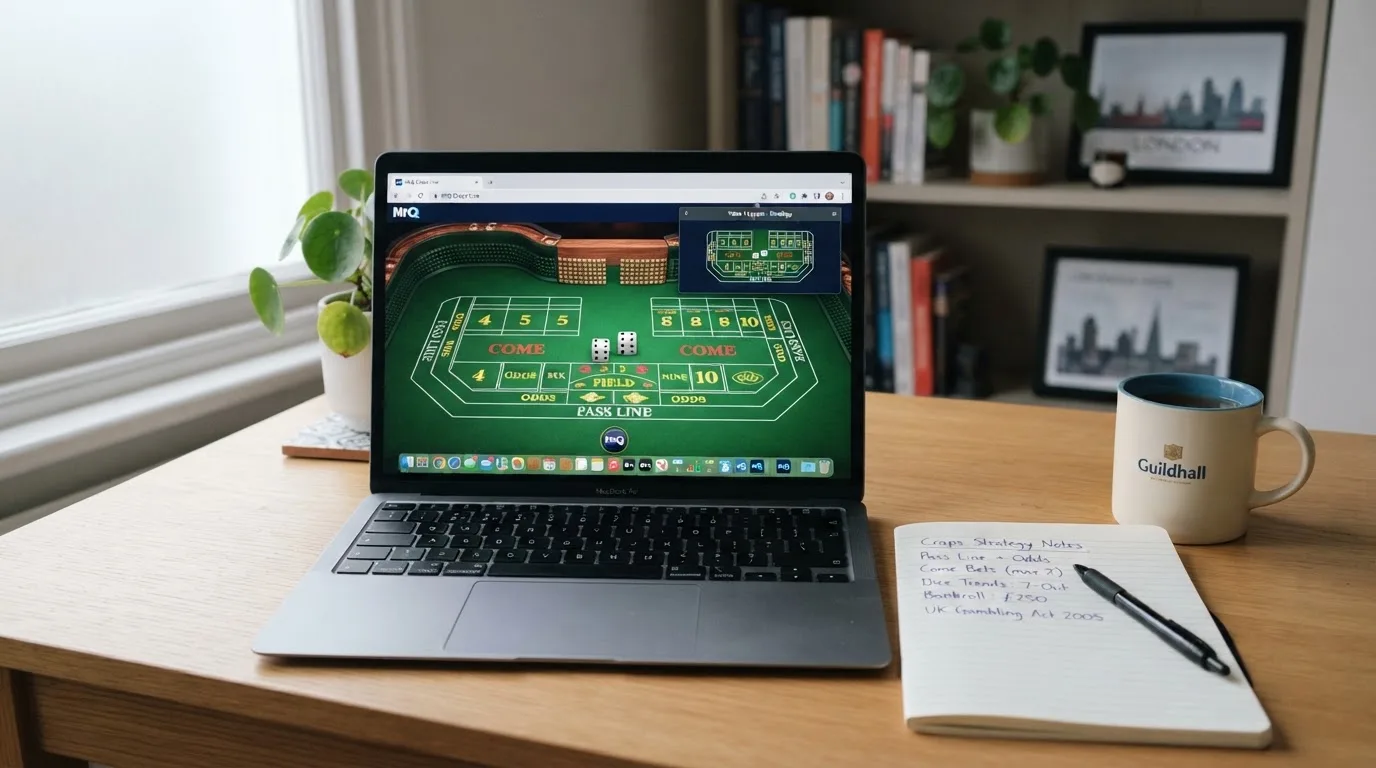
Browser-first sites tend to carry the digital craps variant that runs as an RNG table. It loads in a portrait or landscape phone browser, takes touch input on the bet layout, and resolves rolls against a random number generator. The maths is the same as a desktop RNG table; the experience is a screen rather than a felt. Live-dealer craps, by contrast, is a video stream with betting controls overlaid, and on a phone the stream eats data, the touch targets on the betting layout shrink, and the round time per decision stretches.
Dedicated casino apps have two practical advantages on craps specifically. They push the live-dealer stream through the app’s own video path, which is more stable on a flaky mobile network than the browser equivalent. They also surface the craps table in the lobby under a game-type filter, which a browser site sometimes buries under “Other” or “Dice”. A reader who plays craps once a week rather than every day will feel the difference more sharply than a reader who plays it for an hour at a time on a desktop.
The underlying rule is the same in either case. UK-licensed mobile play is gated by the same age and identity verification as desktop play — name, address and date of birth confirmed before a first deposit, regardless of whether the deposit is made through an app or a browser. GAMSTOP enrolment blocks the player from the mobile product too, not just the desktop one.
Live craps, RNG craps and the studios that run them
Online craps comes in two distinct shapes at UK-licensed sites. The first is a digital table backed by a random number generator, which loads in any browser or app and resolves rolls in a fraction of a second. The second is a live-dealer table streamed from a studio, with a real stickman rolling real dice and a betting layout underneath. The maths — house edge, true-odds payoffs, the bets available — is identical across the two. The pace, the look and the social texture are not.
Evolution’s Live Craps is the live-dealer product most UK players meet. It is set in a speakeasy-themed studio and bundles an interactive tutorial plus an Easy Mode aimed at players new to the game. Each round splits into a Come Out roll followed by a Point roll when a point is established; some bets — Pass Line, Don’t Pass, Field — resolve after a single roll, while others — Come, Odds behind a Pass Line — span several rolls and only settle when the point is made or missed. The pace at a full table is around 30 seconds per decision, longer on a quiet one.
RNG craps on UK-licensed sites is usually a single-studio product. The bet layout looks like a regulation craps table — U-shaped, with duplicate betting areas at each end and pyramid-textured walls designed to randomise the dice throw in a real casino — but the dice are a number generator rather than a physical object. The pace is the player’s pace. A reader who wants a quick run-through of bet types in private tends to land here; a reader who wants the table feel tends to land on the live product.
One product adjacent to craps, not the same as it, is the crash-game format typified by Spribe’s Aviator. Spribe was founded in 2018 and released Aviator in 2019; it is described by the studio as the first true multiplayer crash game in the regulated iGaming space. In a crash round a multiplier rises from 1.00x until the round randomly crashes, and a player must cash out before the crash to win their stake multiplied by the current value. The mechanism is not craps — there are no dice, no Pass Line, no Don’t Pass — but the betting cadence has a kinship with a fast craps round, and a reader who likes craps for its pace sometimes finds their way to crash games on the same licensed site.
The ten UK-licensed casinos: licence, domain, and where each one stands
The brands below are the Gambling Commission’s register entries for active and white-label domains held by GB remote casino operating licence holders. The ordering follows the order research names them; it is not a ranking and not a recommendation, and it carries no bonus terms, no payout speeds and no promotional claims that research does not back. Several of the brands sit under the same parent company — Ladbrokes and Paddy Power are different storefronts of the same gambling group, for instance — and a reader comparing them is comparing skins over a single licence account rather than ten independent operators. Every brand below participates in GAMSTOP, because every GB-licensed online operator must.
| Brand | Licence holder | GB remote casino licence | Domain status | Subject support |
|---|---|---|---|---|
| Grosvenor Casinos | Rank Interactive (Gibraltar) Limited (account 57924) | 057924-R-334666-005 | Active | — |
| Betfred | Petfre (Gibraltar) Limited (account 39544) | 039544-R-319290-010 | Active | — |
| 32Red | Platinum Gaming Limited (account 45322) | 045322-R-324275-019 | Active | — |
| BetVictor | BV Gaming Limited (account 39576) | 039576-R-319370-028 | Active | — |
| William Hill | WHG (International) Limited (account 39225) | 039225-R-319373-015 | Active | — |
| Virgin Games | Gamesys Operations Limited (account 38905) | 038905-R-319430-022 | White Label | — |
| Ladbrokes | LC International Limited (account 54743) | 054743-R-330863-014 | Active | — |
| Paddy Power | PPB Games Limited (account 39411) | 039411-R-319335-010 | Active | — |
| Betfair | PPB Games Limited (account 39411) | 039411-R-319335-010 | Active | — |
| Jackpotjoy | Gamesys Operations Limited (account 38905) | 038905-R-319430-022 | Active | — |
The table is built from the register’s data and nothing else. Where a cell carries a dash, research carries no figure the page can quote for that subject on that brand; that is not a judgement of whether craps is on the site, only a sign that the page does not have a sourced figure to print.
Grosvenor Casinos — the on-course brand with a Gibraltar parent
Grosvenor’s licence is held by Rank Interactive (Gibraltar) Limited on account 57924, and the Commission’s register lists Grosvenor Casinos as an active domain against that account. The same group runs a chain of physical casinos across the UK, which is the brand’s clearest differentiator: a player who likes the live-dealer feel of a Grosvenor casino floor may want the same operator online. The craps product, like at most of the larger UK-licensed brands, is a single live-dealer table or a single RNG variant rather than a deep lobby.
Betfred — a high-street bookmaker that runs casino alongside
Betfred sits under Petfre (Gibraltar) Limited on account 39544, with Betfred listed as active. The brand is better known for sports betting than for casino, and the casino product follows from that: a competent but not deep lobby, with table games present and craps in some form. A reader who already has a Betfred sports account will find the casino tab close to hand; a reader choosing on casino grounds alone has more specialised options on the register.
32Red — a casino-first brand on a Platinum Gaming licence
32Red is held by Platinum Gaming Limited on account 45322, with 32Red active on the register. The brand has positioned itself around casino play rather than sports for most of its life, and the casino lobby is correspondingly the centre of the product. Whether the live craps table or an RNG variant sits in the lobby depends on which studios the brand has integrated at any given moment; the licence account is the durable fact.
BetVictor — a casino and sports brand on BV Gaming’s licence
BetVictor sits under BV Gaming Limited on account 39576, with BetVictor active. The brand runs casino and sports in parallel, and the casino product is the second of the two pillars rather than the dominant one. A reader who plays a mix of bets and table games has a familiar shape here; a craps-only player is shopping among the casino-first brands above and below.
William Hill — the high-street name with a WHG (International) licence
William Hill’s licence is held by WHG (International) Limited on account 39225, and William Hill is listed active. The brand is the most recognisable name on this list, and the casino product sits inside a wider gambling operation. The craps offering, like the rest of the casino lobby, is present rather than central.
Virgin Games — a Gamesys-branded white-label
Virgin Games sits on Gamesys Operations Limited’s licence, account 38905, and is listed on the register as a white-label domain. A white-label site trades under another company’s licence, which is the only reason Virgin Games and Jackpotjoy share an account number below. The Virgin brand is the visible face; the licence, the safer-gambling infrastructure and the dispute route all sit with Gamesys. A reader comparing the two brands is comparing storefronts, not operators.
Ladbrokes — LC International’s high-street casino and sports brand
Ladbrokes is held by LC International Limited on account 54743, with Ladbrokes active. The same parent group runs a string of UK high-street bookmakers and several online brands, and the casino product is one of several the group operates. Craps is present in some form on most LC International skins; the differentiator across them is which sports, slots or live tables the group has prioritised on each one.
Paddy Power — the Irish-rooted brand on PPB Games’ licence
Paddy Power sits under PPB Games Limited on account 39411, with Paddy Power active. The brand carries a strong sports identity; the casino product is the second pillar, present rather than dominant. The licence account below is shared with Betfair, which is the same operator running two storefronts.
Betfair — the exchange brand sharing a licence with Paddy Power
Betfair is also held by PPB Games Limited on account 39411, with Betfair active. The exchange is the brand’s centre of gravity, and the casino product sits alongside. For a craps player the relevant question is whether the casino tab has a live or RNG craps table at any given time; the licence fact is settled by the register.
Jackpotjoy — the Gamesys brand that Virgin Games is a white-label of
Jackpotjoy is held by Gamesys Operations Limited on account 38905, with Jackpotjoy active. Like Virgin Games, the brand runs under Gamesys’s licence; unlike Virgin Games, it is listed as an active domain rather than a white-label. The two brands sit on the same licence, the same safer-gambling infrastructure and the same complaints route, with different storefronts and a slightly different product mix.
Online craps in the UK: what the licence does and doesn’t cover
The Gambling Commission is the regulator for online casino gambling in Great Britain, sponsored by DCMS under the Gambling Act 2005. Northern Ireland is covered by separate legislation, and the Commission’s remit does not extend to it. The Gambling (Licensing and Advertising) Act 2014 closed the route by which an overseas operator could serve UK customers without a Commission licence: any operator taking deposits from people in Great Britain needs a UKGC licence wherever it is based. A Curaçao, Maltese or Gibraltar licence is not a substitute for a Commission licence when the customer is in Britain.
A remote casino operating licence is the licence type that covers online casino play. The Commission’s register listed 139 businesses holding an active remote casino operating licence on 18 September 2026, and the register is the test of whether a brand holds one. The register can be searched online and downloaded in full as CSV or Excel files, which is how the operator list on this page was assembled. The register’s domain list records each website against the licence account that runs it, with a status of Active, Inactive or White Label. As of 18 September 2026 the list held 1,065 active and 361 white-label domain entries; a white-label site trades under another company’s licence, which is why two brands on this page share an account number.
A remote casino licence number on the register has the form account-R-number-suffix (where the account number and licence number components are specific to each operator). The leading six digits repeat the licence holder’s account number; the “R” marks a remote, online licence; the suffix is a sequence index. The numbers attached to each brand above are read straight off the register.
The minimum age for online casino play in Great Britain is 18. Name, address and date of birth must be verified before the first deposit or any play, a rule in force since 7 May 2019. Credit cards have been banned for gambling since 14 April 2020, and the ban covers credit-card-funded e-wallet deposits too. Anonymous play is not possible at a licensed site, and a reader who values that path is looking outside the licensed market — which is a path with no GAMSTOP, no Commission complaints route and no approved ADR when something goes wrong.
The slot stake limit that took effect from 9 April 2025 set a £5 maximum stake per game cycle for players aged 25 and over, and a £2 maximum for 18-24 year olds from 21 May 2025. The lower limit on the younger group reflects the UK government’s view that 18 to 24 year olds have the highest average problem gambling score of any age group, and that lower disposable income and ongoing neurological development are reasons to constrain stakes on that group. The stake limit applies to online slots; it does not apply to craps or to other table games. A craps player staking £10 on the Pass Line at a UK-licensed site is staking within the rules regardless of age, because the £5 / £2 ceiling is a slots ceiling rather than a casino-wide one.
Other slot-side rules that travel with the casino licence: a slot spin may not be faster than 2.5 seconds, and auto-play is permanently banned. UK gambling operators had until 31 October 2021 to fully implement the Commission’s ban on reverse withdrawals, which previously let a customer re-gamble funds they had already requested to withdraw. The rules are aimed at slots, but a craps player meets some of them at the cashier — the reverse-withdrawal ban, in particular, applies across the casino product rather than to slots alone.
Safer gambling around online craps: what the licence obliges the operator to do
GAMSTOP, the national online self-exclusion scheme, is a mandatory condition of every online licence since 31 March 2020. A player who enrols in GAMSTOP for six months, one year or five years is blocked from every UK-licensed online gambling site for the period, and the period cannot be cancelled early. A craps player who self-excludes is self-excluding from the rest of the licensed casino product too — there is no way to GAMSTOP out of slots and stay in for craps.
The deposit-limit obligation runs in two layers. There is no state-set deposit or loss ceiling; what the licence requires is that a customer be prompted to set a financial limit before the first deposit, a rule in force from 31 October 2025. After the first deposit, financial vulnerability checks run at £150 net deposits in a rolling 30-day window from 28 February 2025, using public data only. Wider financial risk assessments have been announced but are not yet in force. The obligation is on the operator to prompt and to check, not on the player to set a limit; a player who declines the prompt is recorded as declining, which is itself a safer-gambling signal the operator has to manage.
The player-protection routes outside the operator sit with GamCare and the National Gambling Helpline, funded by GambleAware. Where a dispute with a licensed operator cannot be resolved directly, an approved ADR provider handles it — every UK-licensed online operator is required to be a member of one. The ADR route is not open to a player at an unlicensed site, which is the second practical cost of stepping outside the licensed market alongside the loss of GAMSTOP coverage.
How to read the £10x wagering cap in practice
The £10x cap that took effect on 19 December 2025 sets a ceiling, not a floor, on the bonus multiplier a UK-licensed casino can attach to its offers. The pre-cap market ran to 35x, 40x and higher; the cap closes that headroom at 10x. For a craps player, the cap changes two things at once.
First, it shrinks the headline number on a welcome offer. A £100 bonus at 10x needs £1,000 of qualifying play; the same bonus at 35x would have needed £3,500. The smaller number is real money the player does not have to find on the table.
Second, it changes what the player should look at beyond the multiplier. Game weighting — the share of each stake that counts toward the wagering requirement — matters more now, because the headline is lower and the weighting eats into a smaller pile. A craps Pass Line bet weighted at 100% needs £1,000 of stakes to clear a £100 bonus; the same bet weighted at 20% needs £5,000 of stakes, which is the same wagering burden as a 50x bonus on a fully-weighted game. The cap is a ceiling the operator cannot exceed; the weighting is the floor the player cannot fall below without doing five times the work.
The wagering band the cap produces, then, runs from 10x on a fully-weighted craps bet — the most generous shape the licence allows — to whatever the site’s game-weighting rule sets, which the player has to read in the bonus terms before claiming. The page treats the band as information, not as a guarantee: a bonus that says “10x wagering on craps” with 100% weighting is a different offer from one that says the same thing at 20%, and the player who treats them as the same has been told half the story again.
Reading the craps table itself: bets, edges and the layout a UK player meets
Craps developed in the United States as a simplification of the earlier European dice game Hazard. The name “craps” itself derives from London slang “crabs”, a term used for the losing dice rolls of two and three in the game of Hazard — a small linguistic artefact of a game that moved west and shed its British vocabulary on the way. Around 1907, Philadelphia dicemaker John H. Winn introduced the betting layout that added a Don’t Pass wager, which became the standard for modern casino craps. The change mattered because it let casinos profit whichever way a bet went: players could now bet against the shooter as well as with them, removing the casino’s incentive to use weighted or unfair dice.
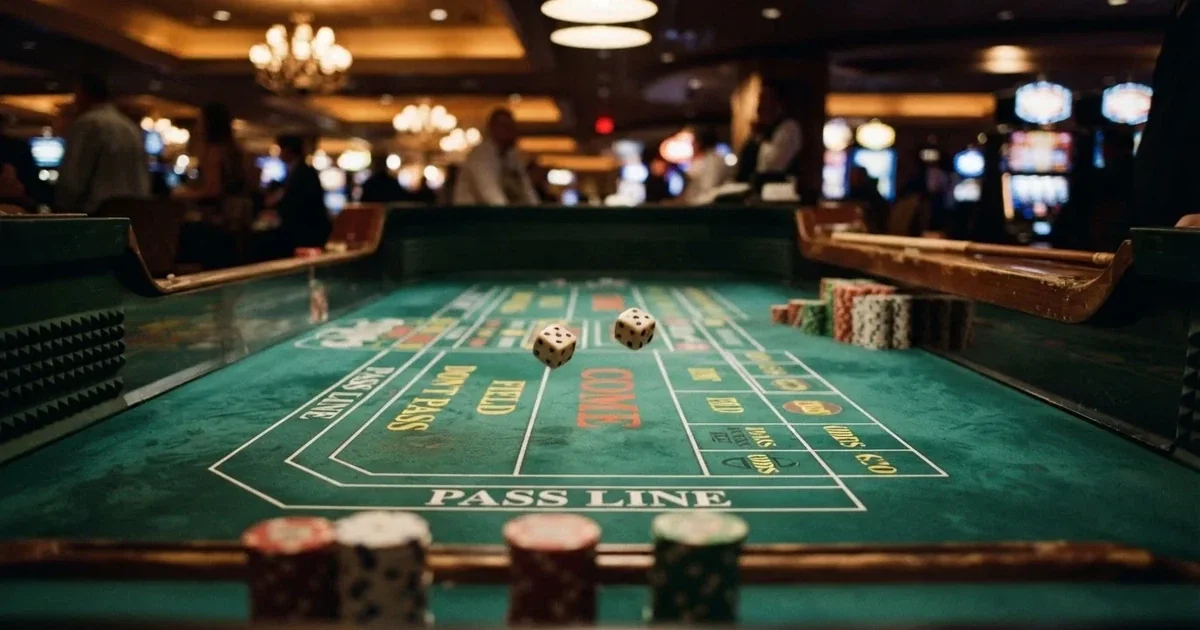
A regulation craps table has a U-shaped layout with duplicate betting areas at each end and pyramid-textured walls designed to randomise the dice throw. The duplicate layout is so a table full of players can each reach a set of betting areas without leaning across the felt. The walls are a physics fix: the pyramids make the dice bounce in unpredictable directions, so the outcome of a roll cannot be read off the way the dice leave the shooter’s hand.
The Pass Line bet carries a 1.41% house edge. It is the bet a new player meets first and the one the marketing around craps anchors on, because it is the lowest-edge proposition on the layout. The Odds bet, placed behind an existing Pass or Don’t Pass wager, pays at true mathematical odds and carries a 0% house edge — but can only be made alongside an existing Pass or Don’t Pass bet. A player staking Pass Line plus maximum Odds behind it is staking the lowest-edge combination the table offers, but the Odds portion cannot stand alone, so the combination still requires the 1.41% line bet underneath it.
What that means for a UK player working through a bonus is mechanical. Every pound staked on the Pass Line carries the 1.41% edge; every pound staked on Odds behind it carries no edge. A wagering requirement weighted at 100% on craps and routed entirely through Pass Line costs the player 1.41% of turnover in expected loss before any other consideration. Routed through Odds behind Pass Line, the cost falls, because the Odds portion of every stake carries no edge. Game weighting rules vary, but a player who knows the weighting and chooses the lowest-edge eligible bet on each round has done the only thing the maths lets them do.
What this page is, and what it isn’t
The page is a description of the UK-licensed market for online craps. It is built from the Gambling Commission’s public register and from named sources for the rules and the game; it does not invent figures, does not recommend a casino and does not print a bonus code. The table on this page is the register’s data laid out for comparison; the figures in the prose are the rules attached to a UK-licensed craps table; the worked calculation is the £10x wagering cap and the time and turnover it implies on a Pass Line bet.
What it isn’t, and what a reader should not take it for: it is not a place to be talked into signing up at any of the named operators. The brand write-ups are descriptions, not endorsements. A reader choosing a casino should do so on grounds the page lays out — the licence account, the safer-gambling infrastructure, the craps product on offer at the moment of signing up — and on grounds the page does not, because those grounds change week to week and the page is a snapshot. The page’s job is to put the snapshot in front of the reader and stop.
Frequently asked questions
How do craps payouts work at a licensed UK online casino?
UK online craps runs on the same Pass Line, Don’t Pass, Come and Odds structure as a physical table. The Pass Line pays 1:1 and carries a 1.41% house edge; Odds behind a Pass Line bet pay at true odds with a 0% edge, but must sit behind an existing line bet. Live and RNG variants resolve against the same maths; the difference is pace and presentation, not payout.
Is online craps available as a live-dealer game or only as a digital table?
Both. Evolution’s Live Craps is the live-dealer product most UK players meet, set in a speakeasy-themed studio with an interactive tutorial and an Easy Mode for new players. RNG craps is also available at most UK-licensed casinos, running as a digital table against a random number generator with a craps layout and the same bet types. The maths is identical across the two; the pace is the player’s on RNG and roughly 30 seconds per decision on live.
Can craps be played through a casino app on a phone?
Where the brand runs a dedicated iOS or Android casino app, yes. The craps product travels with the rest of the casino lobby in the app, with the live-dealer video stream handled by the app’s video path rather than the phone browser. Brands without a dedicated app run a mobile browser product that scales the craps table to phone width; the experience is comparable on RNG tables and a tighter fit on live-dealer streams.
Do UK craps tables use the same bet types as a physical casino table?
Yes. Pass Line, Don’t Pass, Come, Don’t Come, Odds behind a line bet, Place bets and Proposition bets are all present in both live and RNG UK online craps, and the pay tables match the standard physical layout. The U-shaped felt with duplicate betting areas and pyramid-textured walls is a real-table feature; in online play the dice are a random number generator rather than a physical object, but the betting surface and the bet resolution are the same.
What bonus terms usually apply when a bonus can be used on craps?
Since 19 December 2025, wagering requirements are capped at 10x the bonus at UK-licensed casinos, and mixed-product bonuses are banned. On top of that cap, most sites weight craps below 100% for wagering purposes — typically 20% or lower — which raises the real turnover needed to clear the bonus. A £100 bonus at 10x with full weighting on craps requires £1,000 of Pass Line turnover; the same bonus at 20% weighting requires £5,000.
Are craps tables offered by crypto-friendly casinos different from standard ones?
The table is the same. A UK-licensed casino that accepts a cryptocurrency alongside debit cards and bank transfers runs the same craps product on the same live or RNG studios as a non-crypto-licensed casino. The licence imposes identity checks before the first deposit regardless of the payment method, and credit cards are banned for gambling including credit-card-funded e-wallet deposits, so the payment-method choice changes only which rail the deposit uses.
Prepared by the quickpayoutcasinouk editorial staff.